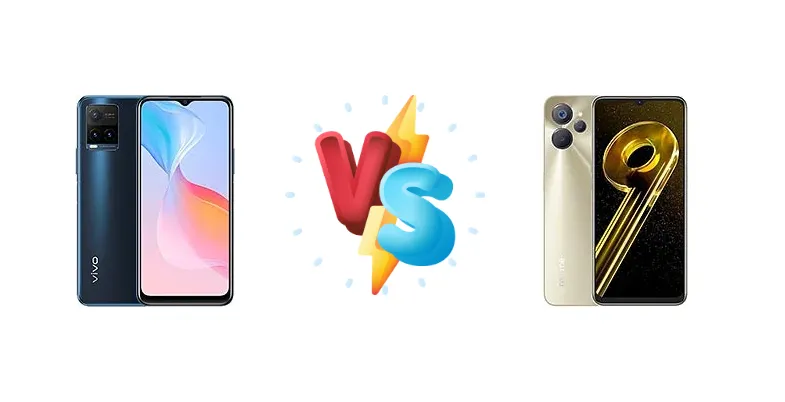
The sub-₹15,000 (approximately $180 USD) smartphone segment is fiercely competitive in India. Both the vivo Y21t and Realme 9i 5G aim to deliver 5G connectivity and a smooth user experience without breaking the bank. However, they take different approaches, relying on distinct chipsets – Qualcomm’s Snapdragon 680 and MediaTek’s Dimensity 810 – leading to key differences in performance and efficiency.
🏆 Quick Verdict
For the average user prioritizing consistent, all-day battery life and a stable software experience, the vivo Y21t emerges as the better choice. While the Realme 9i 5G boasts a more powerful chipset on paper, the Snapdragon 680’s efficiency and Qualcomm’s optimization give the Y21t a slight edge in real-world usability.
| Network |
|---|
| 2G bands | GSM 850 / 900 / 1800 / 1900 | GSM 850 / 900 / 1800 / 1900 |
| 3G bands | HSDPA 850 / 900 / 2100 | HSDPA 850 / 900 / 1700(AWS) / 1900 / 2100 |
| 4G bands | 1, 3, 5, 8, 38, 40, 41 | 1, 2, 3, 4, 5, 7, 8, 19, 20, 28, 34, 38, 39, 40, 41 |
| 5G bands | - | 1, 5, 7, 8, 28, 41, 77, 78 SA/NSA |
| Speed | HSPA, LTE | HSPA, LTE, 5G |
| Technology | GSM / HSPA / LTE | GSM / HSPA / LTE / 5G |
| Launch |
|---|
| Announced | 2022, January 03 | 2022, August 18 |
| Status | Available. Released 2022, January 03 | Available. Released 2022, August 24 |
| Body |
|---|
| Build | Glass front, plastic frame, plastic back | - |
| Dimensions | 164.3 x 76.1 x 8 mm (6.47 x 3.00 x 0.31 in) | 164.4 x 75.1 x 8.1 mm (6.47 x 2.96 x 0.32 in) |
| SIM | Nano-SIM + Nano-SIM | Nano-SIM + Nano-SIM |
| Weight | 182 g (6.42 oz) | 187 g (6.60 oz) |
| Display |
|---|
| Protection | - | Panda Glass |
| Resolution | 1080 x 2408 pixels, 20:9 ratio (~401 ppi density) | 1080 x 2408 pixels, 20:9 ratio (~400 ppi density) |
| Size | 6.58 inches, 104.3 cm2 (~83.4% screen-to-body ratio) | 6.6 inches, 104.9 cm2 (~85.0% screen-to-body ratio) |
| Type | IPS LCD, 90Hz | IPS LCD, 90Hz, 400 nits (typ) |
| Platform |
|---|
| CPU | Octa-core (4x2.4 GHz Kryo 265 Gold & 4x1.9 GHz Kryo 265 Silver) | Octa-core (2x2.4 GHz Cortex-A76 & 6x2.0 GHz Cortex-A55) |
| Chipset | Qualcomm SM6225 Snapdragon 680 4G (6 nm) | Mediatek Dimensity 810 (6 nm) |
| GPU | Adreno 610 | Mali-G57 MC2 |
| OS | Android 11, Funtouch 12 | Android 12, upgradable to Android 13, Realme UI 4.0 |
| Memory |
|---|
| Card slot | microSDXC (dedicated slot) | microSDXC (dedicated slot) |
| Internal | 128GB 4GB RAM | 64GB 4GB RAM, 128GB 4GB RAM, 128GB 6GB RAM |
| | - | UFS 2.2 |
| Main Camera |
|---|
| Features | LED flash | LED flash, HDR, panorama |
| Single | 8 MP, f/1.8, (wide) | 8 MP, f/2.0, 27mm (wide) |
| Triple | 50 MP, f/1.8, (wide), PDAF
2 MP (macro)
Auxiliary lens | 50 MP, f/1.8, 26mm (wide), 1/2.76", 0.64µm, PDAF
Unspecified MP, 46mm (telephoto)
2 MP (macro) |
| Video | 1080p@30fps | 1080p@30fps |
| Selfie camera |
|---|
| Features | HDR | HDR, panorama |
| Single | 8 MP, f/1.8, (wide) | 8 MP, f/2.0, 27mm (wide) |
| Video | 1080p@30fps | 1080p@30fps |
| Sound |
|---|
| 3.5mm jack | Yes | Yes |
| 35mm jack | Yes | Yes |
| Loudspeaker | Yes | Yes |
| Comms |
|---|
| Bluetooth | 5.0, A2DP, LE | 5.2, A2DP, LE |
| NFC | No | No |
| Positioning | GPS, GLONASS, GALILEO, BDS | GPS, GLONASS, GALILEO, BDS |
| Radio | FM radio | No |
| USB | USB Type-C 2.0, OTG | USB Type-C 2.0, OTG |
| WLAN | Wi-Fi 802.11 a/b/g/n/ac, dual-band, Wi-Fi Direct | Wi-Fi 802.11 a/b/g/n/ac, dual-band |
| Features |
|---|
| Sensors | Fingerprint (side-mounted), accelerometer, proximity, compass | Fingerprint (side-mounted), accelerometer, proximity, compass |
| Battery |
|---|
| Charging | 18W wired
2.5W reverse wired | 18W wired |
| Type | 5000 mAh | 5000 mAh |
| Misc |
|---|
| Colors | Midnight Blue, Pearl White | Soulful Blue, Rocking Black, Gold |
| Models | - | RMX3612 |
| Price | About 200 EUR | About 180 EUR |
vivo Y21t (India)
- Excellent battery life due to Snapdragon 680 efficiency
- Stable and reliable software experience (typical of vivo)
- Slightly better thermal management for sustained performance
- Less powerful chipset compared to the Realme 9i 5G
- Likely a basic LCD display
Realme 9i 5G
- More powerful Dimensity 810 chipset for demanding tasks
- Potentially larger display for a more immersive experience
- 5G connectivity for faster data speeds
- Potentially shorter battery life due to chipset power draw
- Software experience may be less refined than vivo
Display Comparison
Neither device boasts a standout display. Both likely utilize LCD panels, a common trait in this price bracket. The focus here isn't on visual fidelity, but functionality. Without specific display specs, we can assume similar brightness levels and color accuracy. The Realme 9i 5G’s larger screen size (typically 6.6 inches vs the Y21t’s 6.58 inches) may offer a slightly more immersive viewing experience, but this comes at the cost of potentially reduced battery efficiency.
Camera Comparison
Both phones likely feature a primary camera around the 13MP mark, accompanied by auxiliary sensors of limited utility. Without detailed sensor information, it’s difficult to declare a clear winner. Image processing will be a key differentiator. Vivo typically emphasizes brighter, more saturated images, appealing to a wider audience. Realme often aims for a more natural look. The absence of Optical Image Stabilization (OIS) on either device suggests image quality will suffer in low-light conditions. The 2MP macro cameras on both are largely marketing fluff and offer minimal practical benefit.
Performance
The core difference lies in the chipsets. The Realme 9i 5G’s MediaTek Dimensity 810, with its two Cortex-A76 performance cores clocked at 2.4 GHz, offers a theoretical performance advantage over the vivo Y21t’s Snapdragon 680. The Dimensity 810’s architecture is geared towards bursty performance, excelling in short, intense tasks. However, the Snapdragon 680, built on a 6nm process, is more power-efficient. Its octa-core configuration, while using Kryo cores, prioritizes sustained performance and thermal management. This means the Y21t is less likely to throttle under prolonged load, making it a better choice for extended gaming sessions, despite the lower peak performance numbers. The 6nm process node of both chips is a positive, indicating better efficiency than older, larger process nodes.
Battery Life
Both devices feature 18W wired charging, suggesting similar charging speeds (approximately 2-3 hours for a full charge). The Y21t’s focus on efficiency, thanks to the Snapdragon 680, translates to better real-world battery life. While battery capacity isn’t specified, the Snapdragon 680’s power efficiency will allow the Y21t to extract more usage from a given battery size compared to the more power-hungry Dimensity 810 in the Realme 9i 5G. The 2.5W reverse wired charging on the Y21t is a niche feature, useful for topping up accessories but not a primary selling point.
Buying Guide
Buy the vivo Y21t (India) if you need a phone that reliably lasts a full day on a single charge and offers a predictable, stable software experience. It’s ideal for everyday tasks, social media, and light gaming. Buy the Realme 9i 5G if you prioritize raw processing power for more demanding games and applications, and are willing to potentially sacrifice some battery life and accept a potentially less refined software experience.
Frequently Asked Questions
❓ Will the Realme 9i 5G overheat during prolonged gaming sessions?
The MediaTek Dimensity 810 is known to generate more heat under sustained load compared to the Snapdragon 680. While the Realme 9i 5G can deliver higher peak performance, it's more likely to experience thermal throttling, leading to reduced frame rates and performance dips during extended gaming sessions. The Y21t’s Snapdragon 680 is better equipped to maintain consistent performance over longer periods.
❓ Is the 5G connectivity on both phones truly useful in India right now?
5G network coverage in India is still expanding. While both phones support 5G, the actual benefits will depend on your location and carrier. In areas with limited 5G infrastructure, you'll likely be using 4G most of the time. However, future-proofing with 5G support is a sensible investment.
❓ Does the vivo Y21t support fast charging, and how long does it take to fully charge?
The vivo Y21t supports 18W wired charging. While not the fastest charging available, it's adequate for this price segment. Expect a full charge to take approximately 2-3 hours, depending on the charger and battery level.
❓ How does the software experience differ between vivo's Funtouch OS and Realme UI?
Vivo’s Funtouch OS is generally considered more conservative and stable, with a focus on essential features. Realme UI is more customizable and offers a wider range of features, but can sometimes feel bloated or less polished. Users who prefer a clean and straightforward experience may prefer Funtouch OS, while those who enjoy customization options may lean towards Realme UI.