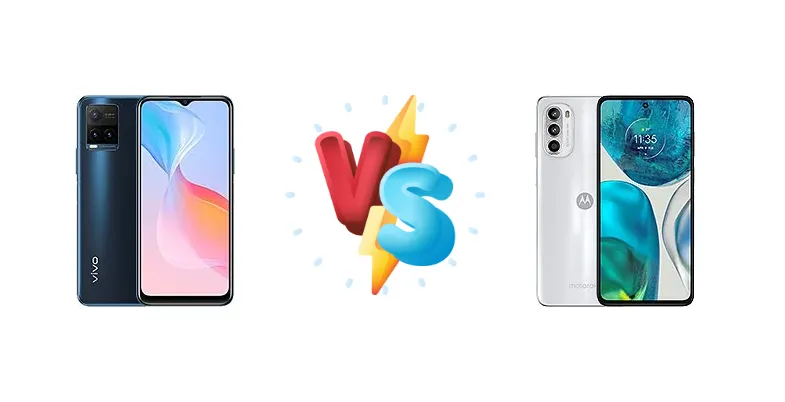
The vivo Y21t (India) and Motorola Moto G52 represent a common scenario in the budget smartphone market: two devices with nearly identical core hardware – in this case, the Qualcomm Snapdragon 680 – differentiated by subtle but impactful choices in charging technology and potentially software optimization. This comparison dissects these nuances to determine which phone delivers the better overall experience.
🏆 Quick Verdict
For the average user, the Motorola Moto G52 emerges as the slightly better choice. While both phones share the same Snapdragon 680 chipset, the Moto G52’s 30W charging significantly reduces downtime, making it ideal for those who frequently need to top up their battery throughout the day. The vivo Y21t remains a viable option, but the charging difference is a key differentiator.
| Network |
|---|
| 2G bands | GSM 850 / 900 / 1800 / 1900 | GSM 850 / 900 / 1800 / 1900 |
| 3G bands | HSDPA 850 / 900 / 2100 | HSDPA 850 / 900 / 1700(AWS) / 1900 / 2100 |
| 4G bands | 1, 3, 5, 8, 38, 40, 41 | LTE |
| Speed | HSPA, LTE | HSPA, LTE |
| Technology | GSM / HSPA / LTE | GSM / HSPA / LTE |
| Launch |
|---|
| Announced | 2022, January 03 | 2022, April 12 |
| Status | Available. Released 2022, January 03 | Available. Released 2022, April 20 |
| Body |
|---|
| Build | Glass front, plastic frame, plastic back | - |
| Dimensions | 164.3 x 76.1 x 8 mm (6.47 x 3.00 x 0.31 in) | 160.1 x 74.5 x 8 mm (6.30 x 2.93 x 0.31 in) |
| SIM | Nano-SIM + Nano-SIM | Nano-SIM + Nano-SIM |
| Weight | 182 g (6.42 oz) | 169 g (5.96 oz) |
| | - | Water-repellent design |
| Display |
|---|
| Resolution | 1080 x 2408 pixels, 20:9 ratio (~401 ppi density) | 1080 x 2400 pixels, 20:9 ratio (~402 ppi density) |
| Size | 6.58 inches, 104.3 cm2 (~83.4% screen-to-body ratio) | 6.6 inches, 103.6 cm2 (~86.9% screen-to-body ratio) |
| Type | IPS LCD, 90Hz | AMOLED, 90Hz |
| Platform |
|---|
| CPU | Octa-core (4x2.4 GHz Kryo 265 Gold & 4x1.9 GHz Kryo 265 Silver) | Octa-core (4x2.4 GHz Kryo 265 Gold & 4x1.9 GHz Kryo 265 Silver) |
| Chipset | Qualcomm SM6225 Snapdragon 680 4G (6 nm) | Qualcomm SM6225 Snapdragon 680 4G (6 nm) |
| GPU | Adreno 610 | Adreno 610 |
| OS | Android 11, Funtouch 12 | Android 12, planned upgrade to Android 13 |
| Memory |
|---|
| Card slot | microSDXC (dedicated slot) | microSDXC (uses shared SIM slot) |
| Internal | 128GB 4GB RAM | 64GB 4GB RAM, 128GB 4GB RAM, 128GB 6GB RAM, 256GB 6GB RAM |
| Main Camera |
|---|
| Features | LED flash | LED flash, HDR, panorama |
| Single | 8 MP, f/1.8, (wide) | - |
| Triple | 50 MP, f/1.8, (wide), PDAF
2 MP (macro)
Auxiliary lens | 50 MP, f/1.8 (wide), 1/2.76", 0.64µm, PDAF
8 MP, f/2.2, 118˚ (ultrawide), 1/4.0", 1.12µm
2 MP (macro) |
| Video | 1080p@30fps | 1080p@30fps |
| Selfie camera |
|---|
| Features | HDR | - |
| Single | 8 MP, f/1.8, (wide) | 16 MP, f/2.5, (wide), 1.0µm |
| Video | 1080p@30fps | 1080p@30fps |
| Sound |
|---|
| 3.5mm jack | Yes | Yes |
| 35mm jack | Yes | Yes |
| Loudspeaker | Yes | Yes, with stereo speakers |
| Comms |
|---|
| Bluetooth | 5.0, A2DP, LE | 5.0, A2DP, LE |
| NFC | No | Yes (market/region dependent) |
| Positioning | GPS, GLONASS, GALILEO, BDS | GPS, GLONASS, GALILEO |
| Radio | FM radio | Unspecified |
| USB | USB Type-C 2.0, OTG | USB Type-C 2.0 |
| WLAN | Wi-Fi 802.11 a/b/g/n/ac, dual-band, Wi-Fi Direct | Wi-Fi 802.11 a/b/g/n/ac, dual-band, Wi-Fi Direct |
| Features |
|---|
| Sensors | Fingerprint (side-mounted), accelerometer, proximity, compass | Fingerprint (side-mounted), accelerometer, gyro, proximity, compass |
| Battery |
|---|
| Charging | 18W wired
2.5W reverse wired | 30W wired |
| Type | 5000 mAh | Li-Po 5000 mAh |
| Misc |
|---|
| Colors | Midnight Blue, Pearl White | Charcoal Gray, Porcelain White |
| Models | - | XT2221-1, XT2221-2 |
| Price | About 200 EUR | About 470 EUR |
vivo Y21t (India)
- Potentially refined software experience (FunTouch OS)
- 2.5W Reverse Wired Charging
- Established Brand Presence in India
- Slower 18W Charging
- Software bloatware potential (FunTouch OS)
Motorola Moto G52
- Faster 30W Charging
- Near-Stock Android Experience
- Generally cleaner software
- Potentially less optimized software for the Indian market
- May lack some region-specific features
Display Comparison
Both devices are expected to feature LCD panels, typical for this price segment. However, detailed display specifications like resolution, peak brightness, and color gamut coverage are not provided. Given the market positioning, we can anticipate both displays will prioritize power efficiency over exceptional color accuracy. The absence of high refresh rate panels is also likely. Bezels are expected to be moderate, focusing on maximizing screen real estate within the budget constraints.
Camera Comparison
Camera details are sparse. Both phones likely feature a multi-camera setup, but the quality will heavily depend on the primary sensor and image processing algorithms. Without sensor size or aperture information, it’s difficult to assess image quality. The inclusion of a 2MP macro camera on either device is likely a marketing feature with limited practical utility. Image processing will likely differ between vivo and Motorola, potentially resulting in different color profiles and levels of detail. The Snapdragon 680’s ISP capabilities are sufficient for basic photography, but don’t expect flagship-level performance.
Performance
The core of both the vivo Y21t and Motorola Moto G52 is the Qualcomm Snapdragon 680 4G (6 nm) chipset, featuring an octa-core CPU configuration with 4x2.4 GHz Kryo 265 Gold and 4x1.9 GHz Kryo 265 Silver cores. This means CPU performance will be virtually identical between the two. The 6nm process node contributes to reasonable power efficiency. However, sustained performance will depend heavily on thermal management, a detail not specified. RAM configuration (likely 4GB or 6GB) will also play a role, but the chipset itself is the primary bottleneck for demanding tasks. Gaming performance will be adequate for casual titles, but graphically intensive games will require reduced settings.
Battery Life
The battery capacity is not specified for either device, but both are likely to house a 5000mAh battery, a common size in this segment. The critical difference lies in charging speed. The vivo Y21t offers 18W wired charging, while the Motorola Moto G52 boasts 30W wired charging. This translates to significantly faster charging times for the Moto G52. A 0-100% charge on the Y21t could take upwards of 2 hours, while the Moto G52 could potentially achieve a full charge in around 1 hour 30 minutes, depending on the charging adapter used. The Y21t also includes 2.5W reverse wired charging, a niche feature for topping up accessories, but not a primary selling point.
Buying Guide
Buy the vivo Y21t (India) if you prioritize a potentially more refined software experience (depending on your preference for vivo’s FunTouch OS) and are less concerned about rapid charging. Buy the Motorola Moto G52 if you value faster charging speeds and a cleaner, near-stock Android experience, making it ideal for users who want a quick and reliable power boost when needed.
Frequently Asked Questions
❓ Will the Snapdragon 680 in the Moto G52 struggle with multitasking compared to more powerful chipsets?
The Snapdragon 680 is a capable chipset for everyday tasks like browsing, social media, and light gaming. However, it's not designed for heavy multitasking or demanding applications. Expect some slowdowns when running multiple resource-intensive apps simultaneously. Optimizing app usage and closing unused apps will help mitigate this.
❓ Is the 30W charging on the Moto G52 compatible with Power Delivery (PD) chargers?
While Motorola doesn't explicitly state PD compatibility, the Moto G52 supports Quick Charge 3.0, which is widely supported by many USB-PD chargers. Using a PD charger with the appropriate voltage and amperage will likely result in fast charging, but it's always best to use the charger included in the box or a Motorola-certified charger for optimal performance and safety.
❓ How does the software experience differ between vivo’s FunTouch OS and Motorola’s near-stock Android on these devices?
Vivo’s FunTouch OS is heavily customized, offering a unique user interface with various features and pre-installed apps. It can be visually appealing but often includes bloatware. Motorola’s near-stock Android provides a cleaner, more streamlined experience with minimal pre-installed apps and faster software updates. The choice depends on your preference for customization versus simplicity.