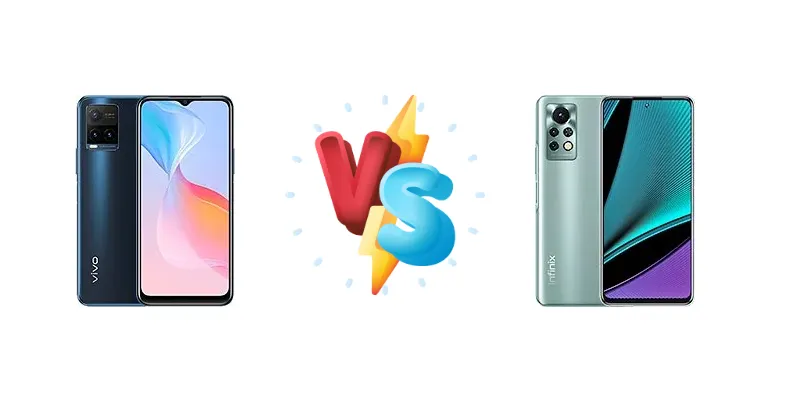
The sub-₹15,000 (approximately $180 USD) smartphone market in India is fiercely competitive. The vivo Y21t, powered by the Snapdragon 680, and the Infinix Note 11s, featuring the Helio G96, represent compelling options. This comparison dissects their key differences, focusing on performance, battery, and charging to help you choose the right device.
🏆 Quick Verdict
For the average user prioritizing efficiency and a smoother everyday experience, the vivo Y21t emerges as the better choice. Its Snapdragon 680, built on a 6nm process, offers superior power efficiency and sustained performance compared to the 12nm Helio G96 in the Infinix Note 11s, despite the latter's faster charging.
| Network |
|---|
| 2G bands | GSM 850 / 900 / 1800 / 1900 | GSM 850 / 900 / 1800 / 1900 |
| 3G bands | HSDPA 850 / 900 / 2100 | HSDPA 850 / 900 / 1700(AWS) / 1900 / 2100 |
| 4G bands | 1, 3, 5, 8, 38, 40, 41 | 1, 2, 3, 4, 5, 7, 8, 20, 28, 38, 41, 40 |
| Speed | HSPA, LTE | HSPA, LTE |
| Technology | GSM / HSPA / LTE | GSM / HSPA / LTE |
| | - | 1, 3, 7, 8, 20, 28 |
| Launch |
|---|
| Announced | 2022, January 03 | 2021, November 08 |
| Status | Available. Released 2022, January 03 | Available. Released 2021, November 08 |
| Body |
|---|
| Build | Glass front, plastic frame, plastic back | Glass front, plastic frame, plastic back |
| Dimensions | 164.3 x 76.1 x 8 mm (6.47 x 3.00 x 0.31 in) | 173.1 x 78.4 x 8.7 mm (6.81 x 3.09 x 0.34 in) |
| SIM | Nano-SIM + Nano-SIM | Nano-SIM + Nano-SIM |
| Weight | 182 g (6.42 oz) | - |
| Display |
|---|
| Resolution | 1080 x 2408 pixels, 20:9 ratio (~401 ppi density) | 1080 x 2460 pixels (~387 ppi density) |
| Size | 6.58 inches, 104.3 cm2 (~83.4% screen-to-body ratio) | 6.95 inches, 114.7 cm2 (~84.5% screen-to-body ratio) |
| Type | IPS LCD, 90Hz | IPS LCD, 120Hz |
| Platform |
|---|
| CPU | Octa-core (4x2.4 GHz Kryo 265 Gold & 4x1.9 GHz Kryo 265 Silver) | Octa-core (2x2.05 GHz Cortex-A76 & 6x2.0 GHz Cortex-A55) |
| Chipset | Qualcomm SM6225 Snapdragon 680 4G (6 nm) | Mediatek MT6781 Helio G96 (12 nm) |
| GPU | Adreno 610 | Mali-G57 MC2 |
| OS | Android 11, Funtouch 12 | Android 11, XOS 10 |
| Memory |
|---|
| Card slot | microSDXC (dedicated slot) | microSDXC (dedicated slot) |
| Internal | 128GB 4GB RAM | 64GB 4GB RAM, 64GB 6GB RAM, 128GB 4GB RAM, 128GB 6GB RAM, 128GB 8GB RAM |
| | - | UFS 2.2 |
| Main Camera |
|---|
| Features | LED flash | Quad-LED flash, HDR, panorama |
| Single | 8 MP, f/1.8, (wide) | 16 MP |
| Triple | 50 MP, f/1.8, (wide), PDAF
2 MP (macro)
Auxiliary lens | 50 MP, f/1.6, (wide), PDAF
2 MP (macro)
Auxiliary lens |
| Video | 1080p@30fps | 1440p@30fps |
| Selfie camera |
|---|
| Features | HDR | - |
| Single | 8 MP, f/1.8, (wide) | 16 MP |
| Video | 1080p@30fps | 1080p@30fps |
| Sound |
|---|
| 3.5mm jack | Yes | Yes |
| 35mm jack | Yes | Yes |
| Loudspeaker | Yes | Yes, with dual speakers |
| Comms |
|---|
| Bluetooth | 5.0, A2DP, LE | Yes |
| NFC | No | No |
| Positioning | GPS, GLONASS, GALILEO, BDS | GPS |
| Radio | FM radio | FM radio |
| USB | USB Type-C 2.0, OTG | USB Type-C 2.0, OTG |
| WLAN | Wi-Fi 802.11 a/b/g/n/ac, dual-band, Wi-Fi Direct | Wi-Fi 802.11 a/b/g/n/ac, dual-band, Wi-Fi Direct |
| Features |
|---|
| Sensors | Fingerprint (side-mounted), accelerometer, proximity, compass | Fingerprint (side-mounted), accelerometer, gyro, proximity, compass |
| Battery |
|---|
| Charging | 18W wired
2.5W reverse wired | 33W wired |
| Type | 5000 mAh | 5000 mAh |
| Misc |
|---|
| Colors | Midnight Blue, Pearl White | Haze Green, Mithril Gray, Symphony Cyan |
| Models | - | X698 |
| Price | About 200 EUR | About 180 EUR |
vivo Y21t (India)
- More power-efficient Snapdragon 680 chipset
- Better sustained performance due to 6nm process
- Potentially longer battery life
- Slower 18W charging
- Likely less impressive peak gaming performance
Infinix Note 11s
- Faster 33W wired charging
- Higher peak CPU clock speeds (potentially)
- May offer slightly better graphics performance in short bursts
- Less power-efficient Helio G96 chipset
- Potential for thermal throttling during extended gaming
- Likely shorter battery life
Display Comparison
Neither device boasts a standout display. While specific display specs (resolution, panel type) are missing, both likely feature LCD panels common in this price bracket. The key difference lies in charging; this impacts how often you're looking *at* the display. The focus here isn't display quality, but how efficiently the phone can get back to a usable state.
Camera Comparison
Without detailed camera specs, a direct comparison is difficult. However, the market segment suggests both phones will rely heavily on software processing. The absence of Optical Image Stabilization (OIS) on either device indicates a reliance on computational photography. The larger sensor (if present, which is likely on the main camera) will generally capture more light and detail, but software algorithms will play a crucial role in image quality. The 2MP macro cameras found on many phones in this class are often of limited practical use.
Performance
The core difference lies in the chipsets. The Qualcomm Snapdragon 680 (6nm) in the vivo Y21t benefits from a more modern fabrication process compared to the MediaTek Helio G96 (12nm). This translates to better thermal efficiency – the Snapdragon 680 will generate less heat under load, reducing the likelihood of performance throttling during extended gaming sessions. While the Helio G96’s Cortex-A76 cores offer a higher peak clock speed (2.05 GHz vs 2.4 GHz on the Kryo 265 Gold), the Snapdragon 680’s architecture and process node provide a more balanced and sustained performance profile. The Snapdragon 680’s octa-core configuration (4x2.4 GHz & 4x1.9 GHz) is well-suited for multitasking and everyday use.
Battery Life
The Infinix Note 11s’ 33W wired charging is a significant advantage over the vivo Y21t’s 18W charging. This means the Infinix Note 11s can replenish its battery much faster, potentially going from 0-100% in under an hour, while the Y21t will likely take considerably longer. However, the Snapdragon 680’s superior efficiency means the Y21t will likely draw less power overall, potentially offsetting the charging speed difference for users who don’t frequently need to top up. The 2.5W reverse wired charging on the Y21t is a niche feature, useful for charging accessories but not a primary selling point.
Buying Guide
Buy the vivo Y21t (India) if you need a phone that prioritizes all-day battery life and consistent performance for daily tasks like social media, browsing, and light gaming. Buy the Infinix Note 11s if you prefer faster charging speeds and are willing to trade some battery life and sustained performance for quicker top-ups, particularly if you're a more demanding user who frequently engages in graphically intensive games.
Frequently Asked Questions
❓ Will the Helio G96 in the Infinix Note 11s overheat during prolonged gaming sessions like PUBG or Call of Duty?
The Helio G96, being built on a 12nm process, is more prone to thermal throttling than the Snapdragon 680. While it can deliver decent performance in short bursts, extended gaming sessions may lead to noticeable frame drops as the chip heats up and reduces its clock speed to manage temperature.
❓ How much faster is the 33W charging on the Infinix Note 11s compared to the 18W charging on the vivo Y21t in real-world usage?
The Infinix Note 11s can realistically charge from 0-100% in approximately 60-75 minutes, while the vivo Y21t will likely take around 90-120 minutes. This difference is most noticeable when quickly topping up the battery before heading out.
❓ Is the Snapdragon 680 in the vivo Y21t powerful enough for smooth multitasking and everyday apps?
Yes, the Snapdragon 680 is well-suited for everyday tasks like browsing, social media, and running multiple apps simultaneously. Its octa-core configuration and efficient architecture provide a responsive and fluid user experience for typical smartphone usage.
❓ Does the difference in chipset affect video recording quality on either phone?
The chipset's image signal processor (ISP) plays a role in video recording. While both phones likely offer 1080p recording, the Snapdragon 680's ISP may provide slightly better stabilization and dynamic range, but the difference will be minimal without detailed camera testing.