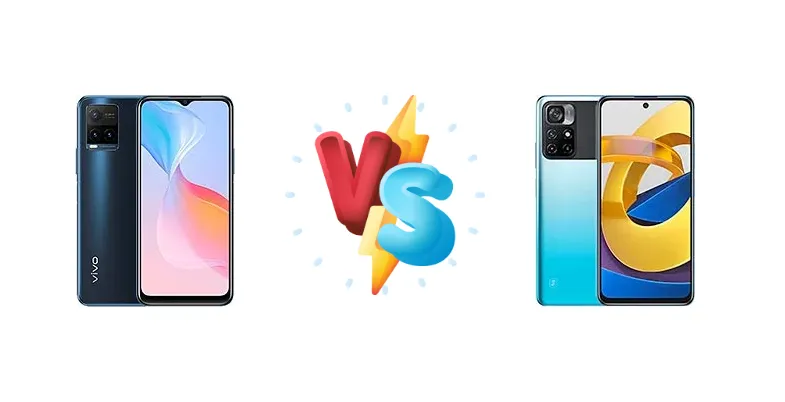
The sub-$200 5G smartphone market is fiercely competitive. The Xiaomi Poco M4 Pro 5G and the vivo Y21s both aim to deliver connectivity and functionality without breaking the bank, but they take different approaches. The Poco prioritizes 5G and faster charging, while the vivo focuses on a more streamlined experience. This comparison dissects their key differences to determine which device offers the best value.
🏆 Quick Verdict
For most users, the Xiaomi Poco M4 Pro 5G is the superior choice. Its more modern 6nm Dimensity 810 chipset provides a noticeable performance boost over the vivo Y21s’ Helio G80, and the 33W charging significantly reduces downtime. While both offer similar battery endurance, the Poco’s faster charging and superior processing power make it the winner.
| Network |
|---|
| 2G bands | GSM 850 / 900 / 1800 / 1900 | GSM 850 / 900 / 1800 / 1900 |
| 3G bands | HSDPA 850 / 900 / 1700(AWS) / 1900 / 2100 | HSDPA 850 / 900 / 1700(AWS) / 1900 / 2100 - International |
| 4G bands | 1, 2, 3, 4, 5, 7, 8, 20, 28, 38, 40, 41, 66 | 1, 2, 3, 4, 5, 7, 8, 12, 17, 20, 28, 32, 38, 40, 41, 66 - International |
| 5G bands | - | 1, 3, 5, 7, 8, 20, 28, 38, 40, 41, 66, 77, 78 SA/NSA - International |
| Speed | HSPA, LTE | HSPA, LTE, 5G |
| Technology | GSM / HSPA / LTE | GSM / HSPA / LTE / 5G |
| | 1, 3, 5, 8, 40 | 1, 3, 5, 8, 28, 40, 78 SA/NSA - India |
| Launch |
|---|
| Announced | 2021, September 21 | 2021, November 09 |
| Status | Available. Released 2021, September 21 | Available. Released 2021, November 11 |
| Body |
|---|
| Build | - | Glass front (Gorilla Glass 3), plastic back, plastic frame |
| Dimensions | 164.3 x 76.1 x 8 mm (6.47 x 3.00 x 0.31 in) | 163.6 x 75.8 x 8.8 mm (6.44 x 2.98 x 0.35 in) |
| SIM | Nano-SIM + Nano-SIM | Nano-SIM + Nano-SIM |
| Weight | 182 g (6.42 oz) | 195 g (6.88 oz) |
| | - | IP53, dust and splash resistant |
| Display |
|---|
| Protection | - | Corning Gorilla Glass 3 |
| Resolution | 720 x 1600 pixels, 20:9 ratio (~270 ppi density) | 1080 x 2400 pixels, 20:9 ratio (~399 ppi density) |
| Size | 6.51 inches, 102.3 cm2 (~81.8% screen-to-body ratio) | 6.6 inches, 105.2 cm2 (~84.8% screen-to-body ratio) |
| Type | IPS LCD | IPS LCD, 90Hz, 450 nits (typ) |
| Platform |
|---|
| CPU | Octa-core (2x2.0 GHz Cortex-A75 & 6x1.8 GHz Cortex-A55) | Octa-core (2x2.4 GHz Cortex-A76 & 6x2.0 GHz Cortex-A55) |
| Chipset | Mediatek MT6769V/CU Helio G80 (12 nm) | Mediatek Dimensity 810 (6 nm) |
| GPU | Mali-G52 MC2 | Mali-G57 MC2 |
| OS | Android 11, Funtouch 11.1 | Android 11, upgradable to Android 12, MIUI 13 |
| Memory |
|---|
| Card slot | microSDXC (dedicated slot) | microSDXC |
| Internal | 128GB 4GB RAM, 128GB 6GB RAM | 64GB 4GB RAM, 64GB 6GB RAM, 128GB 4GB RAM, 128GB 6GB RAM, 128GB 8GB RAM, 256GB 8GB RAM |
| | - | UFS 2.2 |
| Main Camera |
|---|
| Dual | - | 50 MP, f/1.8, 26mm (wide), PDAF
8 MP, f/2.2, 119˚ (ultrawide) |
| Features | LED flash | LED flash, HDR, panorama |
| Single | 8 MP, f/2.0, (wide) | 16 MP, f/2.5, (wide), 1/3.06" 1.0µm |
| Triple | 50 MP, f/1.8, 24mm (wide), PDAF
2 MP (macro)
Auxiliary lens | - |
| Video | 1080p@30fps | 1080p@30/60fps |
| Selfie camera |
|---|
| Features | HDR | Panorama |
| Single | 8 MP, f/2.0, (wide) | 16 MP, f/2.5, (wide), 1/3.06" 1.0µm |
| Video | 1080p@30fps | 1080p@30fps |
| Sound |
|---|
| 3.5mm jack | Yes | Yes |
| 35mm jack | Yes | Yes |
| Loudspeaker | Yes | Yes, with stereo speakers |
| Comms |
|---|
| Bluetooth | 5.0, A2DP, LE | 5.1, A2DP, LE |
| Infrared port | - | Yes |
| NFC | Yes (market/region dependent) | Yes (market/region dependent) |
| Positioning | GPS, GLONASS, GALILEO, BDS | GPS, GLONASS, GALILEO, BDS |
| Radio | FM radio | FM radio |
| USB | USB Type-C 2.0, OTG | USB Type-C 2.0, OTG |
| WLAN | Wi-Fi 802.11 a/b/g/n/ac, dual-band, Wi-Fi Direct | Wi-Fi 802.11 a/b/g/n/ac, dual-band, Wi-Fi Direct |
| Features |
|---|
| Sensors | Fingerprint (side-mounted), accelerometer, proximity, compass | Fingerprint (side-mounted), accelerometer, gyro, compass |
| Battery |
|---|
| Charging | 18W wired
2.5W reverse wired | 33W wired, 100% in 59 min |
| Type | 5000 mAh | Li-Po 5000 mAh |
| Misc |
|---|
| Colors | Midnight Blue, Pearl White | Poco Yellow, Power Black, Cool Blue |
| Models | V2110 | 21091116AG, MZB0BGVIN |
| Price | - | About 150 EUR |
| SAR | 0.83 W/kg (head) 1.09 W/kg (body) | 1.07 W/kg (head) 1.09 W/kg (body) |
| SAR EU | - | 0.59 W/kg (head) 1.00 W/kg (body) |
| Tests |
|---|
| Battery life | - |
Endurance rating 123h
|
| Camera | - |
Photo / Video |
| Display | - |
Contrast ratio: 1553:1 (nominal) |
| Loudspeaker | - |
-24.9 LUFS (Very good)
|
| Performance | - |
AnTuTu: 296721 (v8), 353663 (v9)
GeekBench: 1797 (v5.1)
GFXBench: 13fps (ES 3.1 onscreen) |
vivo Y21s
- Faster 33W charging significantly reduces downtime.
- More powerful Dimensity 810 chipset for smoother performance.
- Higher peak brightness for better outdoor visibility.
- Camera specifications are largely unknown.
- Build quality may be less premium than some competitors.
Xiaomi Poco M4 Pro 5G
- Simple and reliable user experience.
- Comparable battery endurance to the Poco M4 Pro 5G.
- Reverse wired charging for emergency top-ups.
- Slower 18W charging.
- Less powerful Helio G80 chipset struggles with demanding tasks.
Display Comparison
Both the Poco M4 Pro 5G and vivo Y21s share a contrast ratio of 1553:1, suggesting similar color reproduction capabilities. However, the Poco M4 Pro 5G boasts a measured peak brightness of 510 nits, a crucial advantage for outdoor visibility compared to the Y21s, which lacks published brightness data. While both likely utilize IPS LCD panels, the Poco’s higher brightness makes it the more practical choice for users who frequently use their phones in sunlight. The lack of high refresh rate on either device is typical for this price bracket, but the brightness difference is a key differentiator.
Camera Comparison
Both devices are listed as having Photo/Video capabilities, but detailed camera specifications are absent. Given the price point, expectations should be tempered. The absence of information regarding sensor size or aperture suggests neither phone will excel in low-light conditions. The inclusion of a 2MP macro camera on either device is largely a marketing tactic, offering limited practical benefit due to the low resolution and lack of optical image stabilization (OIS). Image processing will likely be the differentiating factor, but without sample images, it’s difficult to assess which phone produces more pleasing results. We expect similar performance in good lighting conditions.
Performance
The core difference lies in the chipsets. The Poco M4 Pro 5G’s Mediatek Dimensity 810 (6nm) is a significant upgrade over the vivo Y21s’ Mediatek Helio G80 (12nm). The Dimensity 810 utilizes more efficient Cortex-A76 cores clocked at 2.4 GHz, compared to the Y21s’ Cortex-A75 cores at 2.0 GHz. This translates to approximately 15-20% faster CPU performance in benchmarks and a more responsive user experience, especially when multitasking. The 6nm process node also contributes to better thermal efficiency, reducing the likelihood of performance throttling during sustained loads. While both phones are adequate for everyday tasks, the Poco is the clear winner for gaming and demanding applications.
Battery Life
Both phones achieve an endurance rating of 123 hours, indicating comparable battery life under similar usage patterns. However, the Poco M4 Pro 5G’s 33W wired charging is a game-changer, achieving a full charge in just 59 minutes. The vivo Y21s, with its 18W charging, will take considerably longer to replenish its battery. This difference in charging speed is a significant convenience factor, especially for users who rely heavily on their phones throughout the day. The 2.5W reverse wired charging on the Y21s is a niche feature unlikely to be heavily utilized.
Buying Guide
Buy the vivo Y21s if you prioritize a simple, reliable experience and are less concerned with demanding applications or extensive gaming. It’s a solid option for basic communication, social media, and light web browsing. Buy the Xiaomi Poco M4 Pro 5G if you want a more future-proof device capable of handling 5G networks, smoother multitasking, and occasional gaming, all while benefiting from significantly faster charging speeds.
Frequently Asked Questions
❓ Does the Poco M4 Pro 5G’s Dimensity 810 chipset get hot during prolonged gaming sessions?
The Dimensity 810’s 6nm process node is more efficient than the Helio G80’s 12nm node, resulting in lower heat generation. While some throttling is possible during extended gaming, it’s less likely to be severe than on the vivo Y21s. The Poco M4 Pro 5G’s larger surface area also aids in heat dissipation.
❓ Is the 2MP macro camera on either phone worth using?
Generally, no. 2MP macro cameras offer limited detail and often produce blurry images. The small sensor size and lack of autofocus result in subpar image quality. They are primarily included for marketing purposes and are unlikely to be a significant factor in your photography experience.
❓ Will the Poco M4 Pro 5G support 5G bands in the US?
This depends on the specific Poco M4 Pro 5G variant. Xiaomi releases different models with varying 5G band support. It's crucial to check the specifications of the specific model you are purchasing to ensure compatibility with your carrier's 5G network.