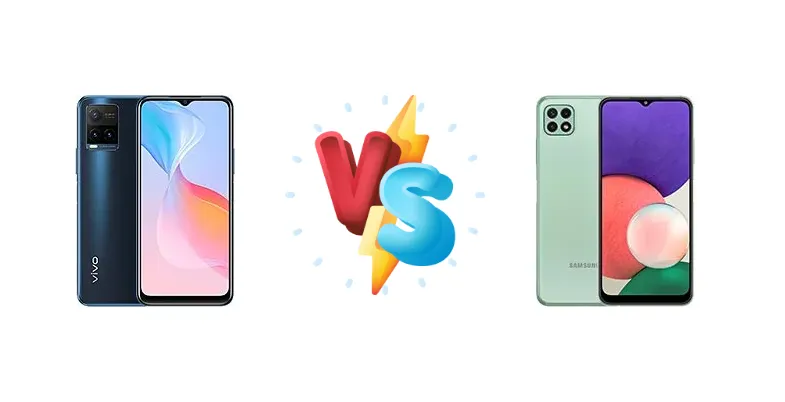
The sub-$200 5G smartphone market is fiercely competitive. Both the vivo Y21s and the Samsung Galaxy A22 5G aim to deliver 5G connectivity at an accessible price point, but they take different approaches. The Y21s prioritizes a more powerful CPU core configuration, while the A22 5G leverages a more efficient chipset and a slightly brighter display. This comparison dives deep into the specs to determine which phone offers the best value.
🏆 Quick Verdict
For most users, the Samsung Galaxy A22 5G emerges as the better choice. Its Mediatek Dimensity 700, built on a 7nm process, offers superior power efficiency and sustained performance compared to the vivo Y21s’ Helio G80. While the Y21s boasts a faster clock speed on its prime cores, the A22 5G’s overall system optimization and 5G modem integration provide a smoother, more reliable experience.
| Network |
|---|
| 2G bands | GSM 850 / 900 / 1800 / 1900 | GSM 850 / 900 / 1800 / 1900 |
| 3G bands | HSDPA 850 / 900 / 1700(AWS) / 1900 / 2100 | HSDPA 850 / 900 / 1900 / 2100 |
| 4G bands | 1, 2, 3, 4, 5, 7, 8, 20, 28, 38, 40, 41, 66 | 1, 2, 3, 5, 7, 8, 20, 28, 38, 40, 41 |
| 5G bands | - | 1, 3, 5, 7, 8, 20, 28, 38, 40, 41, 78, 79 SA/NSA/Sub6 |
| Speed | HSPA, LTE | HSPA, LTE, 5G |
| Technology | GSM / HSPA / LTE | GSM / HSPA / LTE / 5G |
| | 1, 3, 5, 8, 40 | - |
| Launch |
|---|
| Announced | 2021, September 21 | 2021, June 03 |
| Status | Available. Released 2021, September 21 | Available. Released 2021, June 24 |
| Body |
|---|
| Build | - | Glass front, plastic frame, plastic back |
| Dimensions | 164.3 x 76.1 x 8 mm (6.47 x 3.00 x 0.31 in) | 167.2 x 76.4 x 9 mm (6.58 x 3.01 x 0.35 in) |
| SIM | Nano-SIM + Nano-SIM | · Nano-SIM· Nano-SIM + Nano-SIM |
| Weight | 182 g (6.42 oz) | 203 g (7.16 oz) |
| Display |
|---|
| Resolution | 720 x 1600 pixels, 20:9 ratio (~270 ppi density) | 1080 x 2400 pixels, 20:9 ratio (~399 ppi density) |
| Size | 6.51 inches, 102.3 cm2 (~81.8% screen-to-body ratio) | 6.6 inches, 105.2 cm2 (~82.3% screen-to-body ratio) |
| Type | IPS LCD | TFT LCD, 90Hz |
| Platform |
|---|
| CPU | Octa-core (2x2.0 GHz Cortex-A75 & 6x1.8 GHz Cortex-A55) | Octa-core (2x2.2 GHz Cortex-A76 & 6x2.0 GHz Cortex-A55) |
| Chipset | Mediatek MT6769V/CU Helio G80 (12 nm) | Mediatek Dimensity 700 (7 nm) |
| GPU | Mali-G52 MC2 | Mali-G57 MC2 |
| OS | Android 11, Funtouch 11.1 | Android 11, upgradable to Android 13, One UI core 5 |
| Memory |
|---|
| Card slot | microSDXC (dedicated slot) | microSDXC (dedicated slot) |
| Internal | 128GB 4GB RAM, 128GB 6GB RAM | 64GB 4GB RAM, 128GB 4GB RAM, 128GB 6GB RAM, 128GB 8GB RAM |
| Main Camera |
|---|
| Features | LED flash | LED flash, panorama, HDR |
| Single | 8 MP, f/2.0, (wide) | 8 MP, f/2.0, (wide) |
| Triple | 50 MP, f/1.8, 24mm (wide), PDAF
2 MP (macro)
Auxiliary lens | 48 MP, f/1.8, (wide), PDAF
5 MP, f/2.2, 115˚ (ultrawide), 1/5.0", 1.12µm
Auxiliary lens |
| Video | 1080p@30fps | 1152p@30fps |
| Selfie camera |
|---|
| Features | HDR | - |
| Single | 8 MP, f/2.0, (wide) | 8 MP, f/2.0, (wide) |
| Video | 1080p@30fps | 1080p@30fps |
| Sound |
|---|
| 3.5mm jack | Yes | Yes |
| 35mm jack | Yes | Yes |
| Loudspeaker | Yes | Yes |
| Comms |
|---|
| Bluetooth | 5.0, A2DP, LE | 5.0, A2DP, LE |
| NFC | Yes (market/region dependent) | Yes (market/region dependent) |
| Positioning | GPS, GLONASS, GALILEO, BDS | GPS, GLONASS, GALILEO, BDS |
| Radio | FM radio | FM radio |
| USB | USB Type-C 2.0, OTG | USB Type-C 2.0 |
| WLAN | Wi-Fi 802.11 a/b/g/n/ac, dual-band, Wi-Fi Direct | Wi-Fi 802.11 a/b/g/n/ac, dual-band, Wi-Fi Direct |
| Features |
|---|
| Sensors | Fingerprint (side-mounted), accelerometer, proximity, compass | Fingerprint (side-mounted), accelerometer, gyro, proximity, compass |
| Battery |
|---|
| Charging | 18W wired
2.5W reverse wired | 15W wired |
| Type | 5000 mAh | Li-Po 5000 mAh |
| Misc |
|---|
| Colors | Midnight Blue, Pearl White | Gray, White, Mint, Violet |
| Models | V2110 | SM-A226B, SM-A226B/DS, SM-A226B/DSN, SM-A226BR, SM-A226BR/N, SM-A226L, SC-56B |
| Price | - | £ 92.00 / € 125.99 |
| SAR | 0.83 W/kg (head) 1.09 W/kg (body) | - |
| SAR EU | - | 0.73 W/kg (head) 1.23 W/kg (body) |
| Tests |
|---|
| Battery life | - |
Endurance rating 118h
|
| Camera | - |
Photo / Video |
| Display | - |
Contrast ratio: 1631:1 (nominal) |
| Loudspeaker | - |
-28.5 LUFS (Average)
|
| Performance | - |
AnTuTu: 242155 (v8), 223188 (v9)
GeekBench: 6913 (v4.4), 1719 (v5.1)
GFXBench: 12fps (ES 3.1 onscreen) |
vivo Y21s
- Faster CPU clock speeds on prime cores
- Slightly faster charging (18W vs 15W)
- Reverse wired charging capability
- Less efficient 12nm chipset
- Potential for thermal throttling
- Likely lower sustained performance
Samsung Galaxy A22 5G
- More efficient 7nm chipset
- Superior 5G modem integration
- Brighter display (385 nits)
- Better sustained performance
- Slower charging (15W)
- No reverse wired charging
- Potentially less raw CPU power for short bursts
Display Comparison
Both phones feature similar contrast ratios at 1631:1, suggesting comparable color reproduction. However, the Samsung Galaxy A22 5G edges out the vivo Y21s with a measured peak brightness of 385 nits. While not dramatically brighter, this difference is noticeable in direct sunlight. Both manufacturers provide nominal contrast ratio figures, but the measured value on the A22 5G provides a more realistic expectation for outdoor visibility. Panel technology details are missing for both, but given the price point, expect IPS LCDs on both devices.
Camera Comparison
Both phones are listed as having 'Photo / Video' capabilities, lacking specific details. Given the market segment, expect similar image quality in good lighting conditions. However, the A22 5G likely benefits from Samsung’s image processing algorithms, potentially offering more refined results. Without sensor size information, it’s difficult to make a definitive judgment, but the A22 5G’s overall system optimization suggests a slight advantage in image quality. The prevalence of 2MP macro lenses on both devices suggests they are largely marketing features and offer limited practical benefit.
Performance
The core difference lies in the chipsets. The Samsung Galaxy A22 5G’s Mediatek Dimensity 700 (7nm) utilizes more advanced fabrication technology than the vivo Y21s’ Mediatek Helio G80 (12nm). This translates to better thermal efficiency and sustained performance under load. While the Y21s has a higher clock speed on its Cortex-A75 cores (2.0 GHz vs 2.2 GHz on the A22 5G), the Dimensity 700’s Cortex-A76 cores are architecturally superior, offering better instructions per clock (IPC). The 7nm process also allows for a more power-efficient 5G modem, crucial for consistent connectivity. The A22 5G is likely to exhibit less throttling during extended gaming sessions.
Battery Life
Both devices achieve an endurance rating of 118 hours, indicating similar overall battery life. However, the Dimensity 700’s superior power efficiency in the A22 5G means it achieves this endurance with a potentially smaller battery capacity. The Y21s’ 18W charging is slightly faster than the A22 5G’s 15W charging, potentially reducing 0-100% charge times by a small margin. The Y21s also offers 2.5W reverse wired charging, a niche feature for topping up accessories, absent on the A22 5G.
Buying Guide
Buy the vivo Y21s if you prioritize raw CPU power for occasional demanding tasks and don't mind potentially shorter battery life. This phone is best suited for users who frequently switch between many apps or engage in light gaming. Buy the Samsung Galaxy A22 5G if you value all-day battery life, consistent 5G performance, and a slightly brighter display. It’s the ideal choice for everyday users who prioritize reliability and efficiency over peak performance.
Frequently Asked Questions
❓ Does the Mediatek Dimensity 700 in the A22 5G get hot during prolonged gaming sessions?
The Dimensity 700’s 7nm process and efficient design minimize heat generation. While it will warm up during extended gaming, it’s significantly less prone to thermal throttling compared to the Helio G80 in the Y21s, allowing for more consistent frame rates over longer periods.
❓ Is the 2MP macro camera on either phone worth using?
Generally, 2MP macro cameras on budget phones offer limited detail and image quality. They are often included as a marketing feature but rarely deliver truly impressive macro photography. Expect soft images and limited dynamic range.
❓ How does the 5G performance differ between the two phones?
The Samsung Galaxy A22 5G’s Dimensity 700 integrates a more optimized 5G modem, resulting in more stable and reliable 5G connectivity. The Y21s’ Helio G80, while capable of 5G, may experience more fluctuations in signal strength and data speeds due to its less efficient modem design.
❓ Will I notice a significant difference in app loading times between the two devices?
While both phones have adequate RAM, the Dimensity 700’s superior CPU architecture and memory controller in the A22 5G will result in slightly faster app loading times and smoother multitasking, especially with more demanding applications.