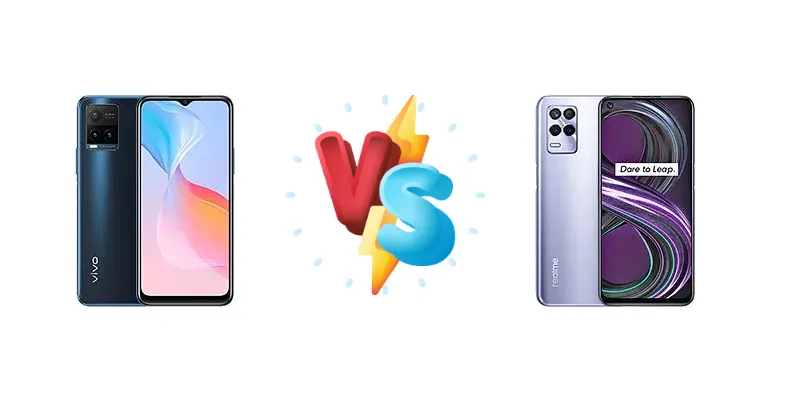
The Realme 8s 5G and vivo Y21s represent compelling options in the crowded budget smartphone market. Both aim to deliver essential features at accessible price points, but they diverge significantly in their core hardware. The Realme 8s 5G prioritizes 5G connectivity and faster charging, while the vivo Y21s focuses on a streamlined experience with a slightly more conservative approach to processing power. This comparison will dissect their differences to determine which device best suits your needs.
🏆 Quick Verdict
For most users, the Realme 8s 5G emerges as the stronger choice. Its Mediatek Dimensity 810 chipset, built on a more efficient 6nm process, provides a noticeable performance uplift over the vivo Y21s’ Helio G80. Coupled with 33W fast charging, the 8s 5G offers a more future-proof and convenient experience.
| Network |
|---|
| 2G bands | GSM 850 / 900 / 1800 / 1900 | GSM 850 / 900 / 1800 / 1900 |
| 3G bands | HSDPA 850 / 900 / 1700(AWS) / 1900 / 2100 | HSDPA 850 / 900 / 1900 / 2100 |
| 4G bands | 1, 2, 3, 4, 5, 7, 8, 20, 28, 38, 40, 41, 66 | 1, 2, 3, 5, 7, 8, 28, 34, 38, 39, 40, 41 |
| 5G bands | - | 1, 28, 41, 77, 78 SA/NSA |
| Speed | HSPA, LTE | HSPA, LTE, 5G |
| Technology | GSM / HSPA / LTE | GSM / HSPA / LTE / 5G |
| | 1, 3, 5, 8, 40 | - |
| Launch |
|---|
| Announced | 2021, September 21 | 2021, September 09 |
| Status | Available. Released 2021, September 21 | Available. Released 2021, September 13 |
| Body |
|---|
| Dimensions | 164.3 x 76.1 x 8 mm (6.47 x 3.00 x 0.31 in) | 162.5 x 74.8 x 8.8 mm (6.40 x 2.94 x 0.35 in) |
| SIM | Nano-SIM + Nano-SIM | Nano-SIM + Nano-SIM |
| Weight | 182 g (6.42 oz) | 191 g (6.74 oz) |
| Display |
|---|
| Resolution | 720 x 1600 pixels, 20:9 ratio (~270 ppi density) | 1080 x 2400 pixels, 20:9 ratio (~405 ppi density) |
| Size | 6.51 inches, 102.3 cm2 (~81.8% screen-to-body ratio) | 6.5 inches, 102.0 cm2 (~83.9% screen-to-body ratio) |
| Type | IPS LCD | IPS LCD, 90Hz, 600 nits (peak) |
| Platform |
|---|
| CPU | Octa-core (2x2.0 GHz Cortex-A75 & 6x1.8 GHz Cortex-A55) | Octa-core (2x2.4 GHz Cortex-A76 & 6x2.0 GHz Cortex-A55) |
| Chipset | Mediatek MT6769V/CU Helio G80 (12 nm) | Mediatek Dimensity 810 (6 nm) |
| GPU | Mali-G52 MC2 | Mali-G57 MC2 |
| OS | Android 11, Funtouch 11.1 | Android 11, Realme UI 2.0 |
| Memory |
|---|
| Card slot | microSDXC (dedicated slot) | microSDXC (dedicated slot) |
| Internal | 128GB 4GB RAM, 128GB 6GB RAM | 128GB 6GB RAM, 128GB 8GB RAM |
| | - | UFS 2.1 |
| Main Camera |
|---|
| Features | LED flash | LED flash, HDR, panorama |
| Single | 8 MP, f/2.0, (wide) | 16 MP, f/2.1, 26mm (wide), 1/3.0", 1.0µm |
| Triple | 50 MP, f/1.8, 24mm (wide), PDAF
2 MP (macro)
Auxiliary lens | 64 MP, f/1.8, 26mm (wide), PDAF
2 MP (macro)
Auxiliary lens |
| Video | 1080p@30fps | 1080p@30fps, gyro-EIS |
| Selfie camera |
|---|
| Features | HDR | HDR, panorama |
| Single | 8 MP, f/2.0, (wide) | 16 MP, f/2.1, 26mm (wide), 1/3.0", 1.0µm |
| Video | 1080p@30fps | 1080p@30fps, gyro-EIS |
| Sound |
|---|
| 3.5mm jack | Yes | Yes |
| 35mm jack | Yes | Yes |
| Loudspeaker | Yes | Yes |
| Comms |
|---|
| Bluetooth | 5.0, A2DP, LE | 5.1, A2DP, LE |
| NFC | Yes (market/region dependent) | No |
| Positioning | GPS, GLONASS, GALILEO, BDS | GPS, GLONASS, GALILEO, BDS, QZSS |
| Radio | FM radio | Unspecified |
| USB | USB Type-C 2.0, OTG | USB Type-C 2.0, OTG |
| WLAN | Wi-Fi 802.11 a/b/g/n/ac, dual-band, Wi-Fi Direct | Wi-Fi 802.11 a/b/g/n/ac, dual-band, Wi-Fi Direct |
| Features |
|---|
| Sensors | Fingerprint (side-mounted), accelerometer, proximity, compass | Fingerprint (side-mounted), accelerometer, gyro, proximity, compass |
| Battery |
|---|
| Charging | 18W wired
2.5W reverse wired | 33W wired |
| Type | 5000 mAh | 5000 mAh |
| Misc |
|---|
| Colors | Midnight Blue, Pearl White | Blue, Purple |
| Models | V2110 | RMX3381 |
| Price | - | About 210 EUR |
| SAR | 0.83 W/kg (head) 1.09 W/kg (body) | - |
| Tests |
|---|
| Battery life | - |
Endurance rating 123h
|
| Camera | - |
Photo / Video |
| Display | - |
Contrast ratio: 1384:1 (nominal) |
| Loudspeaker | - |
-27.8 LUFS (Good)
|
| Performance | - |
AnTuTu: 329661 (v8), 383409 (v9)
GeekBench: 7314 (v4.4), 1842 (v5.1)
GFXBench: 14fps (ES 3.1 onscreen) |
vivo Y21s
- Faster 33W charging significantly reduces downtime.
- More powerful Mediatek Dimensity 810 chipset for smoother performance.
- 6nm process offers better thermal efficiency.
- May be slightly more expensive than the vivo Y21s.
- No detailed camera specifications available.
Realme 8s 5G
- Potentially lower price point.
- Reliable performance for basic tasks.
- Decent battery endurance.
- Slower 18W charging.
- Less powerful Helio G80 chipset struggles with demanding apps.
Display Comparison
Both phones offer adequate displays for their price range, but the Realme 8s 5G edges ahead. While both have contrast ratios around 1300:1, the Realme 8s 5G boasts a measured peak brightness of 530 nits, providing better visibility in outdoor conditions. The lack of detailed display specifications for the vivo Y21s makes a precise comparison difficult, but it’s reasonable to assume the Realme 8s 5G offers a slightly more vibrant and usable viewing experience. Neither phone is expected to feature high refresh rate panels, focusing instead on power efficiency.
Camera Comparison
Both phones are listed as having 'Photo / Video' capabilities, but lack specific details. Without sensor size or aperture information, a direct comparison is challenging. However, given the Realme 8s 5G’s overall focus on performance, it’s likely to have a more capable image signal processor (ISP) and potentially better image processing algorithms. The prevalence of 2MP macro lenses on both devices suggests they are largely marketing features and shouldn’t be a primary consideration for buyers. Expect similar results in good lighting conditions, but the Realme 8s 5G likely performs better in low-light scenarios.
Performance
The performance gap between these two devices is substantial. The Realme 8s 5G’s Mediatek Dimensity 810 (6nm) utilizes more modern CPU cores – 2x2.4 GHz Cortex-A76 – compared to the vivo Y21s’ Helio G80 (12nm) with its 2x2.0 GHz Cortex-A75 cores. The 6nm fabrication process of the Dimensity 810 also translates to improved thermal efficiency, reducing the likelihood of performance throttling during sustained workloads. This means the Realme 8s 5G will handle gaming and multitasking more smoothly. The Helio G80 is adequate for everyday tasks, but will struggle with more demanding applications.
Battery Life
Both phones achieve an endurance rating of 123 hours, suggesting similar overall battery life despite the difference in charging speeds. However, the Realme 8s 5G’s 33W wired charging is a significant advantage. This allows for a much faster 0-100% charge time compared to the vivo Y21s’ 18W charging. The 2.5W reverse wired charging on the Y21s is a niche feature unlikely to be heavily utilized, while the faster charging on the 8s 5G provides a more tangible benefit in daily use.
Buying Guide
Buy the vivo Y21s if you prioritize a simple, reliable smartphone experience and are less concerned with demanding tasks or 5G connectivity. It’s a solid option for basic communication, social media, and light media consumption. Buy the Realme 8s 5G if you want a phone capable of handling more intensive applications, benefit from faster 5G speeds, and appreciate the convenience of significantly faster 33W charging. It’s the better choice for gamers and power users on a budget.
Frequently Asked Questions
❓ Does the Mediatek Dimensity 810 in the Realme 8s 5G get hot during prolonged gaming sessions?
The Dimensity 810’s 6nm fabrication process is designed for improved thermal efficiency compared to the 12nm Helio G80. While some heat generation is inevitable during gaming, the 8s 5G is less likely to experience significant throttling than the Y21s, allowing for more sustained performance.
❓ Is the 2MP macro camera on either phone worth using for detailed close-up shots?
Generally, 2MP macro cameras on budget phones offer limited detail and image quality. They are often included as a marketing feature rather than a genuinely useful tool. Expect soft images with limited clarity, and don't rely on them for professional-looking macro photography.
❓ Can the Realme 8s 5G reliably maintain 60fps in popular games like PUBG Mobile?
The Realme 8s 5G should be capable of maintaining 60fps in PUBG Mobile at medium graphics settings. The Dimensity 810 chipset provides sufficient processing power for smooth gameplay, but higher graphics settings may result in frame drops. The Y21s will likely struggle to maintain a stable 60fps even at lower settings.
❓ How long does it take to fully charge the Realme 8s 5G with the included 33W charger?
With the 33W charger, the Realme 8s 5G can typically charge from 0% to 100% in approximately 60-70 minutes. This is a significant improvement over the vivo Y21s’ 18W charging, which will take considerably longer.