
OnePlus Nord N20 5G vs. vivo Y21s: A Deep Dive into Budget 5G Contenders
| Phones Images | |||||
|---|---|---|---|---|---|
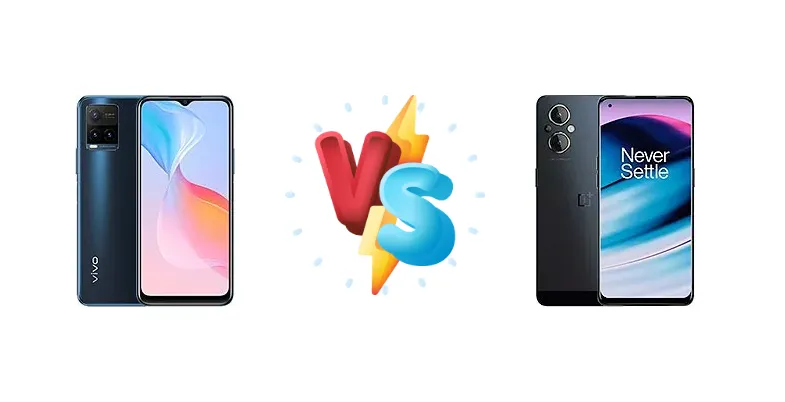
|
🏆 Quick Verdict
For most users, the OnePlus Nord N20 5G is the superior choice. Its Snapdragon 695 chipset, built on a more efficient 6nm process, provides a noticeable performance advantage and better long-term efficiency. While both phones boast a 129-hour endurance rating, the Nord N20 5G’s 33W charging significantly reduces downtime.
| PHONES | ||
|---|---|---|
| Phone Names | vivo Y21s | OnePlus Nord N20 5G |
| Network | ||
|---|---|---|
| 2G bands | GSM 850 / 900 / 1800 / 1900 | GSM 850 / 900 / 1800 / 1900 |
| 3G bands | HSDPA 850 / 900 / 1700(AWS) / 1900 / 2100 | HSDPA 850 / 900 / 1700(AWS) / 1900 / 2100 |
| 4G bands | 1, 2, 3, 4, 5, 7, 8, 20, 28, 38, 40, 41, 66 | 1, 2, 3, 4, 5, 7, 8, 12, 13, 17, 20, 25, 26, 28, 38, 39, 40, 41, 66, 71 |
| 5G bands | - | 2, 25, 41, 66, 71 SA/NSA |
| Speed | HSPA, LTE | HSPA 42.2/5.76 Mbps, LTE Cat15 800/200 Mbps, 5G |
| Technology | GSM / HSPA / LTE | GSM / HSPA / LTE / 5G |
| 1, 3, 5, 8, 40 | - | |
| Launch | ||
|---|---|---|
| Announced | 2021, September 21 | 2022, April 28 |
| Status | Available. Released 2021, September 21 | Available. Released 2022, April 28 |
| Body | ||
|---|---|---|
| Build | - | Glass front (Schott Xensation Up), plastic frame, plastic back |
| Dimensions | 164.3 x 76.1 x 8 mm (6.47 x 3.00 x 0.31 in) | 159.9 x 73.2 x 7.5 mm (6.30 x 2.88 x 0.30 in) |
| SIM | Nano-SIM + Nano-SIM | Nano-SIM |
| Weight | 182 g (6.42 oz) | 173 g (6.10 oz) |
| Display | ||
|---|---|---|
| Protection | - | Schott Xensation Up |
| Resolution | 720 x 1600 pixels, 20:9 ratio (~270 ppi density) | 1080 x 2400 pixels, 20:9 ratio (~409 ppi density) |
| Size | 6.51 inches, 102.3 cm2 (~81.8% screen-to-body ratio) | 6.43 inches, 99.8 cm2 (~85.3% screen-to-body ratio) |
| Type | IPS LCD | AMOLED |
| - | Always-on display | |
| Platform | ||
|---|---|---|
| CPU | Octa-core (2x2.0 GHz Cortex-A75 & 6x1.8 GHz Cortex-A55) | Octa-core (2x2.2 GHz Kryo 660 Gold & 6x1.7 GHz Kryo 660 Silver) |
| Chipset | Mediatek MT6769V/CU Helio G80 (12 nm) | Qualcomm SM6375 Snapdragon 695 5G (6 nm) |
| GPU | Mali-G52 MC2 | Adreno 619 |
| OS | Android 11, Funtouch 11.1 | Android 11, OxygenOS 11 |
| Memory | ||
|---|---|---|
| Card slot | microSDXC (dedicated slot) | microSDXC (dedicated slot) |
| Internal | 128GB 4GB RAM, 128GB 6GB RAM | 128GB 6GB RAM |
| - | UFS 2.2 | |
| Main Camera | ||
|---|---|---|
| Features | LED flash | LED flash, HDR, panorama |
| Single | 8 MP, f/2.0, (wide) | 16 MP, f/2.4, (wide) |
| Triple | 50 MP, f/1.8, 24mm (wide), PDAF 2 MP (macro) Auxiliary lens | 64 MP, f/1.8, (wide), PDAF 2 MP (macro) Auxiliary lens |
| Video | 1080p@30fps | 1080p@30fps |
| Selfie camera | ||
|---|---|---|
| Features | HDR | HDR |
| Single | 8 MP, f/2.0, (wide) | 16 MP, f/2.4, (wide) |
| Video | 1080p@30fps | 1080p@30fps |
| Sound | ||
|---|---|---|
| 3.5mm jack | Yes | Yes |
| 35mm jack | Yes | Yes |
| Loudspeaker | Yes | Yes |
| Comms | ||
|---|---|---|
| Bluetooth | 5.0, A2DP, LE | 5.1, A2DP, LE |
| NFC | Yes (market/region dependent) | Yes |
| Positioning | GPS, GLONASS, GALILEO, BDS | GPS (L1+L5), GLONASS, GALILEO, BDS |
| Radio | FM radio | No |
| USB | USB Type-C 2.0, OTG | USB Type-C 2.0, OTG |
| WLAN | Wi-Fi 802.11 a/b/g/n/ac, dual-band, Wi-Fi Direct | Wi-Fi 802.11 a/b/g/n/ac, dual-band, Wi-Fi Direct |
| Features | ||
|---|---|---|
| Sensors | Fingerprint (side-mounted), accelerometer, proximity, compass | Fingerprint (under display, optical), accelerometer, gyro, proximity, compass, barometer |
| Battery | ||
|---|---|---|
| Charging | 18W wired 2.5W reverse wired | 33W wired |
| Type | 5000 mAh | Li-Po 4500 mAh |
| Misc | ||
|---|---|---|
| Colors | Midnight Blue, Pearl White | Blue |
| Models | V2110 | GN2200, CPH2459 |
| Price | - | About 120 EUR |
| SAR | 0.83 W/kg (head) 1.09 W/kg (body) | - |
| Tests | ||
|---|---|---|
| Battery life | - | Endurance rating 129h |
| Display | - | Contrast ratio: Infinite (nominal) |
| Performance | - | AnTuTu: 316974 (v8), 380672 (v9) GeekBench: 1945 (v5.1) GFXBench: 16fps (ES 3.1 onscreen) |
vivo Y21s
- Faster Snapdragon 695 processor for smoother performance
- Brighter display for better outdoor visibility
- 33W fast charging for quicker top-ups
- Potentially higher price point
- Limited camera details available
OnePlus Nord N20 5G
- Potentially lower upfront cost
- Reverse wired charging for accessories
- Acceptable battery life
- Slower Helio G80 processor
- Less efficient 12nm process
- Dimmer display
Display Comparison
The OnePlus Nord N20 5G boasts a significantly brighter display, reaching a measured 647 nits, compared to an unspecified brightness for the vivo Y21s. This translates to better visibility outdoors. While both displays are described as having an 'infinite' contrast ratio (typical for OLED/AMOLED panels), the Nord N20 5G’s higher peak brightness is a tangible advantage. The Y21s’ display specifications are less detailed, suggesting a potentially lower-quality panel overall. The lack of refresh rate information for the Y21s further suggests a more basic display experience.
Camera Comparison
Detailed camera specifications for both phones are limited. However, the focus should be on the main sensors. Without specific sensor size information, it’s difficult to definitively declare a winner. The image processing capabilities of Qualcomm’s ISP (Image Signal Processor) within the Snapdragon 695 generally provide better dynamic range and noise reduction compared to MediaTek’s ISP in the Helio G80. The prevalence of low-resolution auxiliary cameras (often 2MP) on both devices suggests these are primarily for marketing purposes and offer limited real-world benefit. Focusing on the primary sensor’s quality is crucial.
Performance
The core difference lies in the chipsets. The OnePlus Nord N20 5G’s Qualcomm Snapdragon 695 (6nm) offers a clear architectural advantage over the vivo Y21s’ MediaTek Helio G80 (12nm). The 6nm process node is inherently more power-efficient, leading to less heat generation and sustained performance. The Snapdragon 695’s Kryo 660 Gold cores, clocked at 2.2 GHz, outperform the Helio G80’s Cortex-A75 cores (2.0 GHz) in both single-core and multi-core tasks. This difference is particularly noticeable in demanding applications and games. While both are octa-core CPUs, the Snapdragon 695’s architecture is more modern and efficient.
Battery Life
Both phones achieve an endurance rating of 129 hours, indicating similar overall battery life under standardized testing conditions. However, the charging speeds differ dramatically. The OnePlus Nord N20 5G supports 33W wired charging, allowing for significantly faster top-ups compared to the vivo Y21s’ 18W charging. The Y21s does offer 2.5W reverse wired charging, a niche feature for topping up accessories, but this is unlikely to be a deciding factor for most users. The faster charging on the Nord N20 5G mitigates any potential battery life differences, providing a more convenient user experience.
Buying Guide
Buy the vivo Y21s if your primary need is a functional, affordable 5G phone for basic tasks like calling, texting, and light social media use, and you prioritize a potentially lower upfront cost. Buy the OnePlus Nord N20 5G if you value smoother performance for multitasking and gaming, faster charging speeds, and a brighter, more usable display, even if it means spending slightly more.