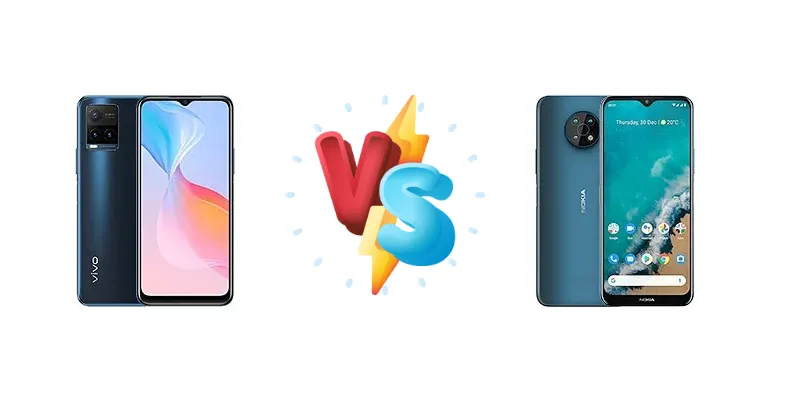
The sub-$200 smartphone market is fiercely competitive, and the vivo Y21s and Nokia G50 represent two compelling options for users seeking 5G connectivity without breaking the bank. While both aim for affordability, they take different approaches to achieving it, primarily through chipset selection. This comparison dissects the key differences between the MediaTek Helio G80-powered vivo Y21s and the Qualcomm Snapdragon 480-equipped Nokia G50, revealing which device delivers the best value.
🏆 Quick Verdict
For the average user prioritizing 5G connectivity and a more efficient processor, the Nokia G50 emerges as the better choice. Its Snapdragon 480, built on an 8nm process, offers superior power efficiency and 5G modem integration compared to the vivo Y21s’ Helio G80. However, the Y21s remains a viable option for those focused on a slightly more mature software experience and potentially lower initial cost.
| Network |
|---|
| 2G bands | GSM 850 / 900 / 1800 / 1900 | GSM 850 / 900 / 1800 / 1900 |
| 3G bands | HSDPA 850 / 900 / 1700(AWS) / 1900 / 2100 | HSDPA 850 / 900 / 1900 / 2100 - EU, ROW, China |
| 4G bands | 1, 2, 3, 4, 5, 7, 8, 20, 28, 38, 40, 41, 66 | 1, 3, 5, 7, 8, 20, 28, 38, 39, 40, 41 - EU, ROW, China |
| 5G bands | - | 1, 3, 5, 7, 28, 38, 40, 41, 78 SA/NSA/Sub6 - EU, ROW, China |
| Speed | HSPA, LTE | HSPA, LTE, 5G |
| Technology | GSM / HSPA / LTE | GSM / HSPA / LTE / 5G |
| | 1, 3, 5, 8, 40 | 2, 5, 7, 38, 41, 66, 71, 78 SA/NSA/Sub6 - NA |
| Launch |
|---|
| Announced | 2021, September 21 | 2021, September 22 |
| Status | Available. Released 2021, September 21 | Available. Released 2021, October 13 |
| Body |
|---|
| Dimensions | 164.3 x 76.1 x 8 mm (6.47 x 3.00 x 0.31 in) | 173.8 x 77.7 x 8.9 mm (6.84 x 3.06 x 0.35 in) |
| SIM | Nano-SIM + Nano-SIM | · Nano-SIM· Nano-SIM + Nano-SIM |
| Weight | 182 g (6.42 oz) | 220 g (7.76 oz) |
| Display |
|---|
| Resolution | 720 x 1600 pixels, 20:9 ratio (~270 ppi density) | 720 x 1560 pixels, 19.5:9 ratio (~252 ppi density) |
| Size | 6.51 inches, 102.3 cm2 (~81.8% screen-to-body ratio) | 6.82 inches, 114.2 cm2 (~84.5% screen-to-body ratio) |
| Type | IPS LCD | IPS LCD, 450 nits (typ) |
| Platform |
|---|
| CPU | Octa-core (2x2.0 GHz Cortex-A75 & 6x1.8 GHz Cortex-A55) | Octa-core (2x2.0 GHz Kryo 460 & 6x1.8 GHz Kryo 460) |
| Chipset | Mediatek MT6769V/CU Helio G80 (12 nm) | Qualcomm SM4350 Snapdragon 480 5G (8 nm) |
| GPU | Mali-G52 MC2 | Adreno 619 |
| OS | Android 11, Funtouch 11.1 | Android 11, upgradable to Android 13 |
| Memory |
|---|
| Card slot | microSDXC (dedicated slot) | microSDXC |
| Internal | 128GB 4GB RAM, 128GB 6GB RAM | 64GB 4GB RAM, 128GB 4GB RAM, 128GB 6GB RAM |
| Main Camera |
|---|
| Features | LED flash | LED flash, HDR, panorama |
| Single | 8 MP, f/2.0, (wide) | 8 MP, (wide) |
| Triple | 50 MP, f/1.8, 24mm (wide), PDAF
2 MP (macro)
Auxiliary lens | 48 MP, f/1.8, (wide), PDAF
5 MP, (ultrawide)
Auxiliary lens |
| Video | 1080p@30fps | 1080p@30fps |
| Selfie camera |
|---|
| Features | HDR | - |
| Single | 8 MP, f/2.0, (wide) | 8 MP, (wide) |
| Video | 1080p@30fps | 1080p@30fps |
| Sound |
|---|
| 3.5mm jack | Yes | Yes |
| 35mm jack | Yes | Yes |
| Loudspeaker | Yes | Yes |
| Comms |
|---|
| Bluetooth | 5.0, A2DP, LE | 5.0, A2DP, LE |
| NFC | Yes (market/region dependent) | Yes (market/region dependent) |
| Positioning | GPS, GLONASS, GALILEO, BDS | GPS, GALILEO, BDS |
| Radio | FM radio | FM radio |
| USB | USB Type-C 2.0, OTG | USB Type-C 2.0, OTG |
| WLAN | Wi-Fi 802.11 a/b/g/n/ac, dual-band, Wi-Fi Direct | Wi-Fi 802.11 a/b/g/n/ac/6, dual-band |
| Features |
|---|
| Sensors | Fingerprint (side-mounted), accelerometer, proximity, compass | Fingerprint (side-mounted), accelerometer, gyro, proximity, compass |
| Battery |
|---|
| Charging | 18W wired
2.5W reverse wired | 18W wired |
| Type | 5000 mAh | Li-Po 5000 mAh |
| Misc |
|---|
| Colors | Midnight Blue, Pearl White | Midnight Sun, Ocean Blue |
| Models | V2110 | TA-1358, TA-1390, TA-1370, TA-1367, TA-1361 |
| Price | - | About 180 EUR |
| SAR | 0.83 W/kg (head) 1.09 W/kg (body) | 0.79 W/kg (head) 0.96 W/kg (body) |
| SAR EU | - | 1.15 W/kg (head) 1.13 W/kg (body) |
vivo Y21s
- Potentially lower initial cost
- Mature software experience (depending on Funtouch OS version)
- Established brand presence in some markets
- Less power-efficient Helio G80 chipset
- Larger 12nm process node leads to more heat
- Potentially less optimized 5G performance
Nokia G50
- More efficient Snapdragon 480 chipset (8nm)
- Integrated 5G modem for better power management
- Qualcomm ISP for improved image processing
- May have a less refined software experience (depending on Android One version)
- Potentially higher initial cost
- Nokia's software update commitment can vary
Display Comparison
Neither device boasts a standout display. Both likely utilize LCD panels, a common cost-saving measure in this segment. The focus here isn't on visual fidelity, but functionality. While specific display specs (resolution, brightness) are missing, the real differentiator lies beneath the hood. The Snapdragon 480’s integrated ISP benefits from Qualcomm’s display processing algorithms, potentially offering slightly better color calibration and image sharpness, though this is a subtle advantage.
Camera Comparison
Without detailed camera sensor information, a direct comparison is difficult. However, the Snapdragon 480’s image signal processor (ISP) offers more advanced features like computational photography algorithms and improved low-light performance. While both phones likely feature a multi-camera setup, the Nokia G50 benefits from Qualcomm’s image processing expertise, potentially resulting in more detailed and vibrant photos, especially in challenging lighting conditions. The Y21s will likely rely more heavily on software processing to compensate for any sensor limitations.
Performance
The core of the difference lies in the chipsets. The Nokia G50’s Qualcomm Snapdragon 480 (8nm) is a clear architectural advantage over the vivo Y21s’ MediaTek Helio G80 (12nm). The smaller 8nm node translates to better power efficiency, meaning less heat generation and potentially less performance throttling during sustained tasks like gaming. Both CPUs feature a similar core configuration – 2x2.0 GHz performance cores and 6x1.8 GHz efficiency cores – but the Snapdragon 480’s Kryo cores are generally more efficient per clock cycle. The Snapdragon 480 also integrates a 5G modem directly into the chip, simplifying the design and improving power management compared to a discrete modem solution potentially used in the Y21s.
Battery Life
Both devices feature 18W wired charging, a standard offering in this price range. While battery capacity isn’t specified, the Snapdragon 480’s superior power efficiency in the Nokia G50 means it will likely deliver longer battery life on a single charge. The 8nm process allows the G50 to accomplish the same tasks using less power, extending usage time between charges. While 18W charging isn’t particularly fast, it’s adequate for topping up the battery overnight.
Buying Guide
Buy the vivo Y21s if you need a phone with a proven track record and are comfortable with a slightly less efficient processor in exchange for potentially lower upfront costs. Buy the Nokia G50 if you prioritize 5G performance, future-proofing with a more modern chipset, and a more power-efficient design, even if it means a newer software experience with potential for more updates.
Frequently Asked Questions
❓ Will the Snapdragon 480 in the Nokia G50 handle demanding games like PUBG Mobile smoothly?
The Snapdragon 480 is capable of running PUBG Mobile, but expect to play at medium settings for a consistently smooth experience. While not a gaming powerhouse, its Adreno 610 GPU provides sufficient graphical performance for most mobile games at reasonable settings. The Helio G80 in the Y21s will likely offer similar performance, but may experience more thermal throttling during extended gaming sessions.
❓ How does the 5G performance differ between the Nokia G50 and the vivo Y21s?
The Nokia G50 benefits from having the 5G modem integrated directly into the Snapdragon 480 chipset. This integration leads to more efficient power management and potentially faster 5G speeds compared to the vivo Y21s, which may utilize a discrete 5G modem. The Y21s’ 5G performance will still be functional, but the G50 offers a more streamlined and optimized 5G experience.
❓ Does the Nokia G50 support VoLTE and VoWiFi in all regions?
Support for VoLTE (Voice over LTE) and VoWiFi (Voice over Wi-Fi) varies by carrier and region. It's crucial to check with your mobile carrier to confirm compatibility before purchasing the Nokia G50, as these features are essential for making calls on modern networks.