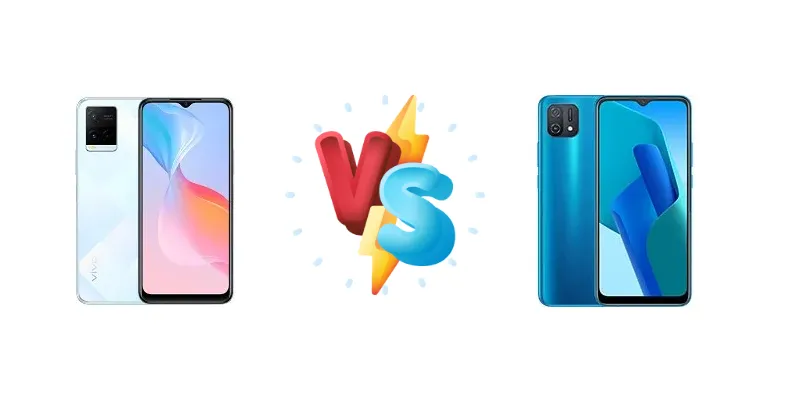
The vivo Y21G and Oppo A16e represent the fiercely competitive entry-level smartphone market. Both aim to deliver essential smartphone functionality at an accessible price point, but they diverge significantly in their internal hardware. This comparison dissects those differences, focusing on how the chipset choices impact performance and daily usability.
🏆 Quick Verdict
For the average user prioritizing responsiveness and future-proofing, the vivo Y21G is the superior choice. Its Mediatek Helio G70 chipset provides a noticeable performance uplift over the Oppo A16e’s Helio P22, making it better suited for multitasking and moderately demanding applications. While the A16e is cheaper, the Y21G’s extra power justifies the price difference.
| Network |
|---|
| 2G bands | GSM 850 / 900 / 1800 / 1900 | GSM 850 / 900 / 1800 / 1900 |
| 3G bands | HSDPA 850 / 900 / 2100 | HSDPA 850 / 900 / 2100 |
| 4G bands | 1, 3, 5, 8, 38, 40, 41 | 1, 3, 5, 8, 38, 40, 41 |
| Speed | HSPA, LTE | HSPA, LTE |
| Technology | GSM / HSPA / LTE | GSM / HSPA / LTE |
| Launch |
|---|
| Announced | 2022, April 07 | 2022, March 21 |
| Status | Available. Released 2022, April 07 | Available. Released 2022, March 24 |
| Body |
|---|
| Build | Glass front, plastic frame, plastic back | Glass front, plastic back, plastic frame |
| Dimensions | 164.3 x 76.1 x 8 mm (6.47 x 3.00 x 0.31 in) | 164 x 75.4 x 7.9 mm (6.46 x 2.97 x 0.31 in) |
| SIM | Nano-SIM + Nano-SIM | Nano-SIM + Nano-SIM |
| Weight | 182 g (6.42 oz) | 175 g (6.17 oz) |
| Display |
|---|
| Protection | - | Corning Gorilla Glass 3 |
| Resolution | 720 x 1600 pixels, 20:9 ratio (~270 ppi density) | 720 x 1600 pixels, 20:9 ratio (~269 ppi density) |
| Size | 6.51 inches, 102.3 cm2 (~81.8% screen-to-body ratio) | 6.52 inches, 102.6 cm2 (~83.0% screen-to-body ratio) |
| Type | IPS LCD | IPS LCD, 480 nits (typ) |
| Platform |
|---|
| CPU | Octa-core (2x2.0 GHz Cortex-A75 & 6x1.7 GHz Cortex-A55) | Octa-core 2.0 GHz Cortex-A53 |
| Chipset | Mediatek MT6769 Helio G70 (12 nm) | Mediatek MT6762D Helio P22 (12 nm) |
| GPU | Mali-G52 2EEMC2 | PowerVR GE8320 |
| OS | Android 11, Funtouch 11.1 | Android 11, ColorOS 11.1 |
| Memory |
|---|
| Card slot | microSDXC (dedicated slot) | microSDXC |
| Internal | 64GB 4GB RAM | 32GB 3GB RAM, 64GB 4GB RAM |
| | - | eMMC 5.1 |
| Main Camera |
|---|
| Dual | 13 MP, f/2.2, (wide), PDAF
2 MP (macro) | - |
| Features | LED flash | LED flash, HDR, panorama |
| Single | 8 MP, f/2.0, (wide) | 13 MP, f/2.2, 26mm (wide), 1/3.1", 1.12µm, PDAF |
| Video | 1080p@30fps | 1080p@30fps |
| Selfie camera |
|---|
| Features | - | HDR |
| Single | 8 MP, f/2.0, (wide) | 5 MP, f/2.4, 27mm (wide) |
| Video | 1080p@30fps | 1080p@30fps |
| Sound |
|---|
| 3.5mm jack | Yes | Yes |
| 35mm jack | Yes | Yes |
| Loudspeaker | Yes | Yes |
| Comms |
|---|
| Bluetooth | 5.0, A2DP, LE | 5.0, A2DP, LE, aptX |
| NFC | No | No |
| Positioning | GPS, GLONASS, GALILEO, BDS | GPS, GLONASS, GALILEO, BDS |
| Radio | FM radio | Unspecified |
| USB | USB Type-C 2.0, OTG | microUSB 2.0, OTG |
| WLAN | Wi-Fi 802.11 a/b/g/n/ac, dual-band, Wi-Fi Direct | Wi-Fi 802.11 a/b/g/n/ac, dual-band, Wi-Fi Direct |
| Features |
|---|
| Sensors | Fingerprint (side-mounted), accelerometer, proximity, compass | Accelerometer, proximity, compass |
| Battery |
|---|
| Charging | 18W wired | 10W wired |
| Type | 5000 mAh | Li-Po 4230 mAh |
| Misc |
|---|
| Colors | Diamond Glow, Midnight Blue | Black, Blue, White |
| Models | V2152 | CPH2421 |
| Price | About 170 EUR | About 120 EUR |
vivo Y21G
- Significantly faster processor (Helio G70)
- Faster 18W charging
- Better multitasking capabilities
- Likely slightly higher price
- May not have a significantly better display
Oppo A16e
- Lower price point
- Functional for basic tasks
- Potentially better battery life (depending on capacity)
- Slow processor (Helio P22)
- Slow 10W charging
- Struggles with multitasking and gaming
Display Comparison
Neither device boasts a standout display. Given the shared 12nm process node, display differences are unlikely to be significant. Both likely feature LCD panels, and without specific brightness or color gamut data, it's reasonable to assume similar viewing experiences. The focus here is on cost reduction, so expect basic display quality.
Camera Comparison
Without detailed camera specs beyond the chipsets, a direct comparison is limited. Both phones likely feature similar budget camera setups. However, the Helio G70’s image signal processor (ISP) within the Y21G is likely more advanced, potentially leading to better image processing and noise reduction. The A16e’s ISP will be more basic, resulting in lower-quality photos, particularly in low-light conditions. The presence of a 2MP macro lens on either device is largely marketing fluff; image quality will be poor.
Performance
The core difference lies in the chipsets. The vivo Y21G’s Mediatek Helio G70, with its octa-core configuration featuring two Cortex-A75 cores clocked at 2.0 GHz and six Cortex-A55 cores at 1.7 GHz, offers a substantial advantage over the Oppo A16e’s Helio P22. The P22 utilizes eight Cortex-A53 cores at 2.0 GHz. The A75 cores in the G70 provide significantly higher single-core performance, crucial for app launch speeds and general responsiveness. This translates to a smoother user experience, especially when multitasking. The G70 also has a more capable GPU, making it better suited for casual gaming. The A16e will struggle with anything beyond the most basic games.
Battery Life
The vivo Y21G’s 18W wired charging is a clear advantage over the Oppo A16e’s 10W charging. While battery capacity isn’t specified, the faster charging speed will significantly reduce the time spent tethered to a power outlet. A full charge on the A16e will take considerably longer, impacting usability for users who rely heavily on their phones throughout the day. The 18W charging on the Y21G offers a more convenient experience.
Buying Guide
Buy the vivo Y21G if you need a phone capable of handling more than basic tasks, such as social media, streaming, and light gaming. The Helio G70 offers a smoother experience and better longevity. Buy the Oppo A16e if your primary needs are limited to calls, texts, and very light app usage, and you are prioritizing the absolute lowest possible price point. It's a functional device, but compromises heavily on performance.
Frequently Asked Questions
❓ Will the Oppo A16e struggle with popular apps like Facebook and WhatsApp?
While the Oppo A16e can *run* these apps, the Helio P22 chipset may result in noticeable lag and slow loading times, especially when switching between apps. The experience won't be as smooth or responsive as on the vivo Y21G.
❓ Is the Helio G70 in the vivo Y21G capable of playing demanding games like PUBG Mobile?
The Helio G70 can handle PUBG Mobile, but you'll likely need to lower the graphics settings to medium or low to achieve a playable frame rate. Don't expect a high-end gaming experience, but it's significantly better than what the Helio P22 can offer.
❓ How long will it take to fully charge the Oppo A16e with its 10W charging?
With 10W charging, a full charge from 0% to 100% on the Oppo A16e will likely take around 3-4 hours, depending on battery capacity. This is considerably slower than the vivo Y21G's 18W charging.
❓ Does the difference in chipsets affect the longevity of the phones?
Yes. The Helio G70 in the Y21G is a more modern and capable chipset, meaning it will likely remain usable for a longer period as app requirements increase. The Helio P22 in the A16e will become increasingly sluggish over time.