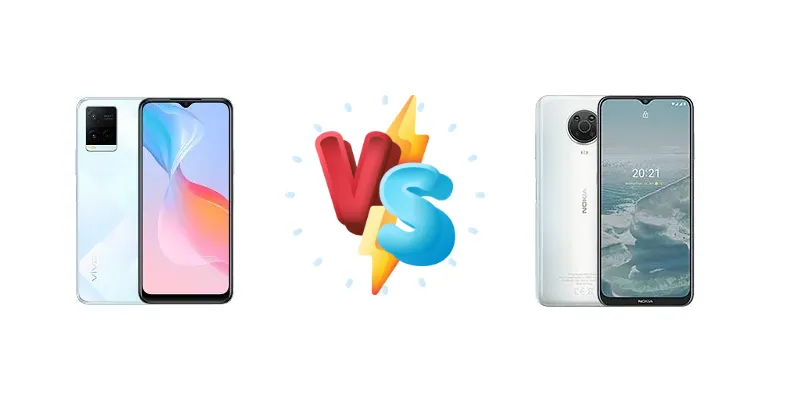
The sub-$200 smartphone market is fiercely competitive. Both the vivo Y21G and Nokia G20 aim to deliver essential smartphone functionality at an accessible price point. However, they diverge significantly in their core processing power, with the vivo Y21G sporting the more capable Mediatek Helio G70, while the Nokia G20 relies on the Helio G35. This comparison will dissect these differences and determine which device offers the best value for your money.
🏆 Quick Verdict
For the average user prioritizing responsiveness and occasional gaming, the vivo Y21G is the clear winner. Its Helio G70 chipset provides a noticeable performance uplift over the Nokia G20’s Helio G35, making everyday tasks smoother and more enjoyable. While the Nokia G20 offers a larger display, the performance trade-off isn't worth it for most.
| Network |
|---|
| 2G bands | GSM 850 / 900 / 1800 / 1900 | GSM 850 / 900 / 1800 / 1900 |
| 3G bands | HSDPA 850 / 900 / 2100 | HSDPA 850 / 900 / 1900 / 2100 - International |
| 4G bands | 1, 3, 5, 8, 38, 40, 41 | 1, 3, 5, 7, 8, 20, 28, 38, 40, 41 - International |
| Speed | HSPA, LTE | HSPA 42.2/5.76 Mbps, LTE Cat4 150/50 Mbps |
| Technology | GSM / HSPA / LTE | GSM / HSPA / LTE |
| | - | 1, 2, 3, 4, 5, 7, 8, 12, 17, 28, 66 - LATAM |
| Launch |
|---|
| Announced | 2022, April 07 | 2021, April 08 |
| Status | Available. Released 2022, April 07 | Available. Released 2021, May 17 |
| Body |
|---|
| Build | Glass front, plastic frame, plastic back | - |
| Dimensions | 164.3 x 76.1 x 8 mm (6.47 x 3.00 x 0.31 in) | 164.9 x 76 x 9.2 mm (6.49 x 2.99 x 0.36 in) |
| SIM | Nano-SIM + Nano-SIM | · Nano-SIM· Nano-SIM + Nano-SIM |
| Weight | 182 g (6.42 oz) | 197 g (6.95 oz) |
| | - | Splash protection |
| Display |
|---|
| Resolution | 720 x 1600 pixels, 20:9 ratio (~270 ppi density) | 720 x 1600 pixels, 20:9 ratio (~269 ppi density) |
| Size | 6.51 inches, 102.3 cm2 (~81.8% screen-to-body ratio) | 6.52 inches, 102.6 cm2 (~81.9% screen-to-body ratio) |
| Type | IPS LCD | IPS LCD |
| Platform |
|---|
| CPU | Octa-core (2x2.0 GHz Cortex-A75 & 6x1.7 GHz Cortex-A55) | Octa-core (4x2.3 GHz Cortex-A53 & 4x1.8 GHz Cortex-A53) |
| Chipset | Mediatek MT6769 Helio G70 (12 nm) | Mediatek MT6765G Helio G35 (12 nm) |
| GPU | Mali-G52 2EEMC2 | PowerVR GE8320 |
| OS | Android 11, Funtouch 11.1 | Android 11, upgradable to Android 13 |
| Memory |
|---|
| Card slot | microSDXC (dedicated slot) | microSDXC (dedicated slot) |
| Internal | 64GB 4GB RAM | 64GB 4GB RAM, 128GB 4GB RAM |
| Main Camera |
|---|
| Dual | 13 MP, f/2.2, (wide), PDAF
2 MP (macro) | - |
| Features | LED flash | LED flash, HDR, panorama |
| Quad | - | 48 MP, f/1.8, (wide), PDAF
5 MP, (ultrawide)
2 MP (macro)
Auxiliary lens |
| Single | 8 MP, f/2.0, (wide) | 8 MP, (wide) |
| Video | 1080p@30fps | 1080p@30fps |
| Selfie camera |
|---|
| Single | 8 MP, f/2.0, (wide) | 8 MP, (wide) |
| Video | 1080p@30fps | 1080p@30fps |
| Sound |
|---|
| 3.5mm jack | Yes | Yes |
| 35mm jack | Yes | Yes |
| Loudspeaker | Yes | Yes |
| Comms |
|---|
| Bluetooth | 5.0, A2DP, LE | 5.0, A2DP, LE |
| NFC | No | Yes (market/region dependent) |
| Positioning | GPS, GLONASS, GALILEO, BDS | GPS, GLONASS, BDS |
| Radio | FM radio | FM radio |
| USB | USB Type-C 2.0, OTG | USB Type-C 2.0, OTG |
| WLAN | Wi-Fi 802.11 a/b/g/n/ac, dual-band, Wi-Fi Direct | Wi-Fi 802.11 b/g/n |
| Features |
|---|
| Sensors | Fingerprint (side-mounted), accelerometer, proximity, compass | Fingerprint (side-mounted), accelerometer, gyro, proximity |
| Battery |
|---|
| Charging | 18W wired | 10W wired |
| Type | 5000 mAh | Li-Po 5050 mAh |
| Misc |
|---|
| Colors | Diamond Glow, Midnight Blue | Glacier, Night |
| Models | V2152 | TA-1336, TA-1343, TA-1347, TA-1372, TA-1365 |
| Price | About 170 EUR | About 90 EUR |
| SAR | - | 1.01 W/kg (head) 1.02 W/kg (body) |
| SAR EU | - | 0.49 W/kg (head) 1.13 W/kg (body) |
vivo Y21G
- Faster processor (Helio G70)
- Faster charging (18W)
- More responsive user experience
- Potentially smaller display
- Camera specs unknown
Nokia G20
- Potentially larger display
- Nokia’s clean Android experience
- Potentially longer battery life (depending on capacity)
- Slower processor (Helio G35)
- Slower charging (10W)
- Laggy performance with demanding apps
Display Comparison
Neither device boasts a particularly impressive display. Both utilize 12nm chipsets, suggesting a focus on cost optimization over display technology. While specific display specs (resolution, panel type) are missing, the Nokia G20’s larger size is its primary advantage. However, a larger screen doesn’t automatically equate to a better viewing experience; the processing power to drive it smoothly is crucial, and that’s where the Y21G excels. The lack of high refresh rates on either device suggests a focus on battery conservation.
Camera Comparison
Without detailed camera specifications, a direct comparison is difficult. However, both phones likely employ similar budget camera sensors. The image signal processor (ISP) within the Helio G70 of the Y21G *may* offer slightly better image processing capabilities, potentially resulting in more detailed and vibrant photos. It’s reasonable to assume both phones will struggle in low-light conditions. The presence of a 2MP macro camera on either device is largely a marketing gimmick and shouldn’t be a deciding factor.
Performance
The core difference lies in the chipsets. The vivo Y21G’s Mediatek Helio G70, with its 2x2.0 GHz Cortex-A75 and 6x1.7 GHz Cortex-A55 cores, offers a significant architectural advantage over the Nokia G20’s Helio G35. The G35 utilizes 4x2.3 GHz Cortex-A53 and 4x1.8 GHz Cortex-A53 cores. The Cortex-A75 cores in the G70 are substantially more powerful than the A53 cores in the G35, resulting in faster app loading times, smoother multitasking, and improved gaming performance. While both are 12nm chips, the G70’s core configuration provides a clear performance edge. The G35’s higher clock speed on the A53 cores doesn’t compensate for the architectural difference.
Battery Life
Battery capacity isn’t specified, but the charging wattage is a key differentiator. The vivo Y21G’s 18W wired charging is significantly faster than the Nokia G20’s 10W charging. This translates to a quicker top-up time, reducing downtime. While a larger battery capacity on the Nokia G20 might offer slightly longer overall battery life, the faster charging of the Y21G provides a more convenient user experience, especially for those who frequently need to recharge their devices.
Buying Guide
Buy the vivo Y21G if you need a phone that can handle multitasking, light gaming, and demanding apps without significant lag. It’s ideal for users who want a responsive experience without breaking the bank. Buy the Nokia G20 if you prioritize a larger screen for media consumption and are willing to accept a slower, more basic user experience. It’s best suited for users who primarily use their phone for calls, texts, and light social media browsing.
Frequently Asked Questions
❓ Will the Nokia G20 struggle with popular apps like Facebook and Instagram?
The Nokia G20’s Helio G35 chipset is a basic processor. While it can handle these apps, you may experience noticeable lag and slowdowns, especially when multitasking or using the apps for extended periods. The vivo Y21G’s Helio G70 will provide a much smoother experience.
❓ Is the 18W charging on the vivo Y21G a significant improvement over the Nokia G20’s 10W charging?
Yes, it is. 18W charging will significantly reduce the time it takes to fully charge the vivo Y21G. Expect a noticeably faster top-up compared to the Nokia G20, which will take considerably longer to reach 100%.
❓ Can either of these phones handle mobile gaming?
The vivo Y21G is the better choice for gaming. The Helio G70 offers a more capable GPU, allowing for playable frame rates in less demanding games. The Nokia G20’s Helio G35 will struggle with most modern mobile games, even at lower settings.
❓ Which phone is likely to receive more software updates?
Nokia generally provides a more consistent and longer-term software update commitment for its devices. While vivo does provide updates, Nokia’s Android One program typically guarantees more frequent security patches and OS upgrades.