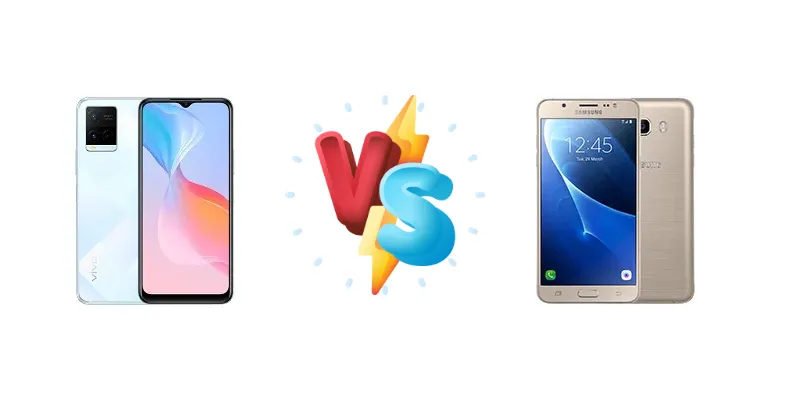
Choosing a budget-friendly smartphone can be tricky. The vivo Y21e and Samsung Galaxy J7 (2016) both offer compelling features at accessible price points, but which one reigns supreme? We'll break down their specs, performance, and overall value to help you decide.
🏆 Quick Verdict
The vivo Y21e boasts a significantly more modern chipset and 6nm process, leading to better efficiency and performance. While the Galaxy J7 (2016) impresses with its exceptional battery life, the Y21e's newer tech and likely better software support make it the overall winner for most users.
| Network |
|---|
| 2G bands | GSM 850 / 900 / 1800 / 1900 | GSM 850 / 900 / 1800 / 1900 - SIM 1 & SIM 2 (dual-SIM model only) |
| 3G bands | HSDPA 850 / 900 / 2100 | HSDPA 850 / 900 / 1900 / 2100 |
| 4G bands | 1, 3, 5, 8, 40 | 1, 3, 5, 7, 8, 20, 40 |
| Speed | HSPA, LTE | HSPA, LTE Cat4 150/50 Mbps |
| Technology | GSM / HSPA / LTE | GSM / HSPA / LTE |
| Launch |
|---|
| Announced | 2022, January 14 | 2016, March 29. Released 2016, April |
| Status | Available. Released 2022, January 14 | Discontinued |
| Body |
|---|
| Build | Glass front, plastic frame, plastic back | Glass front, plastic back, aluminum frame |
| Dimensions | 164.3 x 76.1 x 8 mm (6.47 x 3.00 x 0.31 in) | 151.7 x 76 x 7.8 mm (5.97 x 2.99 x 0.31 in) |
| SIM | Nano-SIM + Nano-SIM | Single SIM (Micro-SIM) or Dual SIM (Micro-SIM, dual stand-by) |
| Weight | 182 g (6.42 oz) | 170 g (6.00 oz) |
| Display |
|---|
| Resolution | 720 x 1600 pixels, 20:9 ratio (~270 ppi density) | 720 x 1280 pixels, 16:9 ratio (~267 ppi density) |
| Size | 6.51 inches, 102.3 cm2 (~81.8% screen-to-body ratio) | 5.5 inches, 83.4 cm2 (~72.3% screen-to-body ratio) |
| Type | IPS LCD | Super AMOLED |
| Platform |
|---|
| CPU | Octa-core (4x2.4 GHz Kryo 265 Gold & 4x1.9 GHz Kryo 265 Silver) | Octa-core (4x1.6 GHz Cortex-A53 & 4x1.0 GHz Cortex-A53)Octa-core 1.6 GHz Cortex-A53 |
| Chipset | Qualcomm SM6225 Snapdragon 680 4G (6 nm) | Qualcomm MSM8952 Snapdragon 617 (28 nm)Exynos 7870 Octa (14 nm) |
| GPU | Adreno 610 | Adreno 405Mali-T830 MP1 |
| OS | Android 11, Funtouch 12 | Android 6.0.1 (Marshmallow), upgradable to Android 8.1 (Oreo) |
| Memory |
|---|
| Card slot | microSDXC (dedicated slot) | microSDXC (dedicated slot) |
| Internal | 64GB 3GB RAM | 16GB 2GB RAM |
| | UFS 2.1 | eMMC 5.1 |
| Main Camera |
|---|
| Dual | 13 MP, f/2.2, (wide), PDAF
2 MP (macro) | - |
| Features | LED flash | LED flash, panorama, HDR |
| Single | 8 MP, f/1.8, (wide) | 13 MP, f/1.9, 28mm (wide), AF |
| Video | 1080p@30fps | 1080p@30fps |
| Selfie camera |
|---|
| Features | HDR | LED flash |
| Single | 8 MP, f/1.8, (wide) | 5 MP, f/1.9 |
| Video | 1080p@30fps | - |
| Sound |
|---|
| 3.5mm jack | Yes | Yes |
| 35mm jack | Yes | Yes |
| Loudspeaker | Yes | Yes |
| Comms |
|---|
| Bluetooth | 5.0, A2DP, LE | 4.1, A2DP |
| NFC | No | Yes (market dependent for dual-SIM model) |
| Positioning | GPS, GLONASS, GALILEO, BDS, QZSS | GPS, GLONASS, BDS |
| Radio | FM radio | FM radio, RDS, recording |
| USB | USB Type-C 2.0, OTG | microUSB 2.0, OTG |
| WLAN | Wi-Fi 802.11 a/b/g/n/ac, dual-band, Wi-Fi Direct | Wi-Fi 802.11 b/g/n, Wi-Fi Direct |
| Features |
|---|
| Sensors | Fingerprint (side-mounted), accelerometer, proximity, compass | Accelerometer, proximity |
| | - | ANT+ |
| Battery |
|---|
| Charging | 18W wired
2.5W reverse wired | - |
| Music play | - | Up to 96 h |
| Talk time | - | Up to 23 h (3G) |
| Type | 5000 mAh | Li-Ion 3300 mAh, removable |
| Misc |
|---|
| Colors | Midnight Blue, Diamond Glow | White, Black, Gold, Rose Gold |
| Models | V2140 | SM-J710FN, SM-J710F, SM-J710H, SM-J710M, SM-J710GN, SM-J710MN, SM-J710K, SM-J7108, SM-J710FQ |
| Price | About 150 EUR | About 230 EUR |
| SAR | - | 1.10 W/kg (head) 1.01 W/kg (body) |
| SAR EU | - | 0.35 W/kg (head) 1.39 W/kg (body) |
| Tests |
|---|
| Audio quality | - |
Noise -92.4dB / Crosstalk -92.3dB |
| Battery life | - |
Endurance rating 101h
|
| Camera | - |
Photo / Video |
| Display | - |
Contrast ratio: Infinite (nominal), 3.902 (sunlight) |
| Loudspeaker | - |
Voice 64dB / Noise 71dB / Ring 68dB
|
| Performance | - |
Basemark OS II 2.0: 1007Basemark X: 11199 |
vivo Y21e
- Modern Chipset (Snapdragon 680)
- 6nm Process for Efficiency
- Likely Better Camera Performance
- More Current Software Support
- Battery Life Not as Exceptional as J7 (2016)
- 18W Charging is Standard
Samsung Galaxy J7 (2016)
- Exceptional Battery Life (101h Endurance)
- Good Sunlight Readability
- Durable Build Quality (typical Samsung)
- Outdated Chipset (Snapdragon 617/Exynos 7870)
- Slower Performance
- Older Software and Security Updates
Display Comparison
The vivo Y21e likely features a more vibrant and modern display, potentially with a higher resolution and better color accuracy. The Galaxy J7 (2016) had a decent display for its time, but it will appear dated compared to the Y21e. Sunlight readability was good on both, according to specs.
Camera Comparison
While both phones offer 'Photo / Video' capabilities, the vivo Y21e likely has a more modern camera sensor and image processing algorithms, resulting in better image quality, especially in low light. Specific megapixel counts and features would need further research to provide a definitive comparison.
Performance
The Snapdragon 680 in the vivo Y21e is a substantial upgrade over the Snapdragon 617/Exynos 7870 in the Galaxy J7 (2016). Expect noticeably faster app loading, smoother multitasking, and better gaming performance on the Y21e. The 6nm process also contributes to improved power efficiency.
Battery Life
The Samsung Galaxy J7 (2016) is the clear winner here, boasting an incredible endurance rating of 101 hours. The vivo Y21e's battery life is respectable, but it won't match the longevity of the J7 (2016). However, the Y21e's more efficient chipset helps mitigate this difference.
Buying Guide
The vivo Y21e is ideal for users prioritizing performance, a modern design, and a smoother user experience. The Samsung Galaxy J7 (2016) is a good choice for those who absolutely prioritize battery life above all else and are comfortable with an older device.
Frequently Asked Questions
❓ Is the vivo Y21e worth buying in 2024?
Yes, the vivo Y21e offers a good balance of features and performance for its price, especially if you prioritize a modern chipset and smooth user experience. However, consider newer alternatives if your budget allows.
❓ Can the Samsung Galaxy J7 (2016) still be used as a daily driver?
While the Galaxy J7 (2016) has impressive battery life, its outdated chipset and lack of software updates make it less suitable as a daily driver in 2024. It's best suited for basic tasks or as a secondary device.