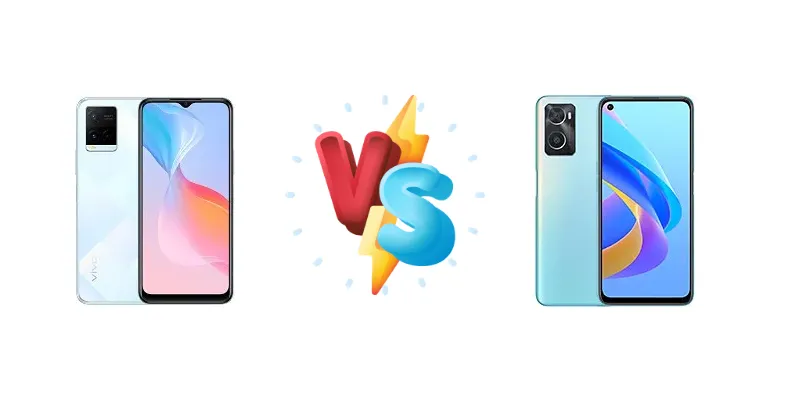
The Oppo A76 and vivo Y21e represent a common scenario in the budget smartphone market: two devices built around the same core chipset, the Qualcomm Snapdragon 680, but differentiated by subtle yet impactful choices in charging technology and potentially other areas. This comparison aims to dissect those differences, helping you determine which phone delivers the best value for your needs.
🏆 Quick Verdict
For most users, the Oppo A76 emerges as the stronger choice. While both phones share the Snapdragon 680, the A76’s 33W charging is a game-changer, drastically reducing charge times compared to the Y21e’s 18W. This convenience outweighs any other minor differences between the two.
| Network |
|---|
| 2G bands | GSM 850 / 900 / 1800 / 1900 | GSM 850 / 900 / 1800 / 1900 |
| 3G bands | HSDPA 850 / 900 / 2100 | HSDPA 850 / 900 / 2100 |
| 4G bands | 1, 3, 5, 8, 40 | LTE |
| Speed | HSPA, LTE | HSPA, LTE |
| Technology | GSM / HSPA / LTE | GSM / HSPA / LTE |
| Launch |
|---|
| Announced | 2022, January 14 | 2022, February 17 |
| Status | Available. Released 2022, January 14 | Available. Released 2022, February 18 |
| Body |
|---|
| Build | Glass front, plastic frame, plastic back | - |
| Dimensions | 164.3 x 76.1 x 8 mm (6.47 x 3.00 x 0.31 in) | 164.4 x 75.7 x 8.4 mm (6.47 x 2.98 x 0.33 in) |
| SIM | Nano-SIM + Nano-SIM | Nano-SIM + Nano-SIM |
| Weight | 182 g (6.42 oz) | 189 g (6.67 oz) |
| Display |
|---|
| Resolution | 720 x 1600 pixels, 20:9 ratio (~270 ppi density) | 720 x 1612 pixels, 20:9 ratio (~269 ppi density) |
| Size | 6.51 inches, 102.3 cm2 (~81.8% screen-to-body ratio) | 6.56 inches, 103.4 cm2 (~83.1% screen-to-body ratio) |
| Type | IPS LCD | IPS LCD, 90Hz, 480 nits (typ), 600 nits (HBM) |
| Platform |
|---|
| CPU | Octa-core (4x2.4 GHz Kryo 265 Gold & 4x1.9 GHz Kryo 265 Silver) | Octa-core (4x2.4 GHz Kryo 265 Gold & 4x1.9 GHz Kryo 265 Silver) |
| Chipset | Qualcomm SM6225 Snapdragon 680 4G (6 nm) | Qualcomm SM6225 Snapdragon 680 4G (6 nm) |
| GPU | Adreno 610 | Adreno 610 |
| OS | Android 11, Funtouch 12 | Android 11, ColorOS 11.1 |
| Memory |
|---|
| Card slot | microSDXC (dedicated slot) | microSDXC |
| Internal | 64GB 3GB RAM | 128GB 4GB RAM, 128GB 6GB RAM |
| | UFS 2.1 | UFS 2.1 |
| Main Camera |
|---|
| Dual | 13 MP, f/2.2, (wide), PDAF
2 MP (macro) | 13 MP, f/2.2, 26mm (wide), 1/3.06", 1.12µm, PDAF
Auxiliary lens |
| Features | LED flash | LED flash, HDR, panorama |
| Single | 8 MP, f/1.8, (wide) | 8 MP, f/2.0, (wide) |
| Video | 1080p@30fps | 1080p@30fps |
| Selfie camera |
|---|
| Features | HDR | HDR |
| Single | 8 MP, f/1.8, (wide) | 8 MP, f/2.0, (wide) |
| Video | 1080p@30fps | 1080p@30fps |
| Sound |
|---|
| 3.5mm jack | Yes | Yes |
| 35mm jack | Yes | Yes |
| Loudspeaker | Yes | Yes |
| Comms |
|---|
| Bluetooth | 5.0, A2DP, LE | 5.0, A2DP, LE, aptX HD |
| NFC | No | No |
| Positioning | GPS, GLONASS, GALILEO, BDS, QZSS | GPS, GLONASS, GALILEO, BDS, QZSS |
| Radio | FM radio | No |
| USB | USB Type-C 2.0, OTG | USB Type-C 2.0, OTG |
| WLAN | Wi-Fi 802.11 a/b/g/n/ac, dual-band, Wi-Fi Direct | Wi-Fi 802.11 a/b/g/n/ac, dual-band, Wi-Fi Direct |
| Features |
|---|
| Sensors | Fingerprint (side-mounted), accelerometer, proximity, compass | Fingerprint (side-mounted), accelerometer, proximity, compass |
| Battery |
|---|
| Charging | 18W wired
2.5W reverse wired | 33W wired |
| Type | 5000 mAh | Li-Po 5000 mAh |
| Misc |
|---|
| Colors | Midnight Blue, Diamond Glow | Glowing Black, Glowing Blue |
| Models | V2140 | CPH2375 |
| Price | About 150 EUR | € 117.99 / £ 162.99 |
vivo Y21e
- Significantly faster 33W charging
- Includes 2.5W reverse wired charging
- Potentially better optimized software (Oppo's ColorOS)
- May be slightly more expensive than the vivo Y21e
- Camera performance dependent on software optimization
Oppo A76
- Potentially lower price point
- Similar performance to the Oppo A76 due to the same chipset
- Reliable brand reputation (vivo)
- Slow 18W charging
- Lacks reverse charging functionality
- May have less refined software experience
Display Comparison
Both the Oppo A76 and vivo Y21e likely feature LCD panels, typical for this price bracket. Specific details like resolution and peak brightness are not provided, but we can assume they are similar, aiming for a 720p+ resolution. The absence of high refresh rate technology is also expected. Bezels are likely comparable, focusing on maximizing screen real estate within the budget constraints. Color accuracy will likely be standard for the segment, prioritizing vibrant visuals over absolute color fidelity.
Camera Comparison
Camera specifications are not detailed enough to draw significant conclusions. Both phones likely feature a multi-camera setup, but the quality will depend heavily on the main sensor and image processing algorithms. The presence of a 2MP macro camera on either device is unlikely to provide substantial photographic value. Without knowing sensor sizes or apertures, it’s difficult to assess low-light performance. Image processing will likely lean towards boosting saturation and contrast for more appealing social media shots.
Performance
The core of both devices is the Qualcomm Snapdragon 680 4G (6 nm) chipset, featuring an octa-core CPU configuration with 4x2.4 GHz Kryo 265 Gold and 4x1.9 GHz Kryo 265 Silver cores. This means performance will be virtually identical for everyday tasks like browsing, social media, and light gaming. The 6nm process node contributes to reasonable power efficiency. RAM configurations are not specified, but the performance will be heavily influenced by the amount of RAM and its speed (LPDDR4X is likely). Thermal management will be adequate for the intended use case, but sustained heavy workloads may lead to some throttling.
Battery Life
Battery capacity is not specified for either device, but both will likely fall in the 5000mAh range, common for budget smartphones. However, the key differentiator is charging speed. The Oppo A76’s 33W wired charging is significantly faster than the vivo Y21e’s 18W. This translates to a much quicker 0-100% charge time – potentially under an hour for the A76 versus over two hours for the Y21e. The A76 also offers 2.5W reverse wired charging, allowing it to act as a power bank for smaller devices, a feature absent on the Y21e.
Buying Guide
Buy the vivo Y21e if you prioritize a slightly lower initial cost and are comfortable with slower charging speeds. It’s a solid option for users who don’t heavily rely on their phone throughout the day and can charge overnight. Buy the Oppo A76 if you value faster charging, minimizing downtime, and appreciate the convenience of getting back to full power quickly – ideal for users who are frequently on the go or dislike long charging cycles.
Frequently Asked Questions
❓ How much faster is the Oppo A76's charging compared to the vivo Y21e in real-world use?
The Oppo A76's 33W charging can realistically cut charging times in half or even more compared to the vivo Y21e's 18W. Expect a full charge in under an hour with the A76, while the Y21e will likely take over two hours. This difference is particularly noticeable for users who frequently need to top up their battery quickly.
❓ Will I notice a performance difference between the Oppo A76 and vivo Y21e when playing games like PUBG Mobile?
No, you likely won't notice a significant performance difference in gaming. Both phones utilize the same Snapdragon 680 chipset and similar CPU/GPU configurations. However, sustained gaming performance might be slightly better on the Oppo A76 if it has a more efficient thermal management system, preventing excessive throttling.
❓ Does the Oppo A76's reverse charging feature work with all devices?
The Oppo A76's 2.5W reverse wired charging is compatible with most devices that charge via USB-C or Micro-USB using a standard cable. However, charging speeds will be very slow, and it's best suited for small accessories like wireless earbuds or smartwatches, not for fully charging another smartphone.