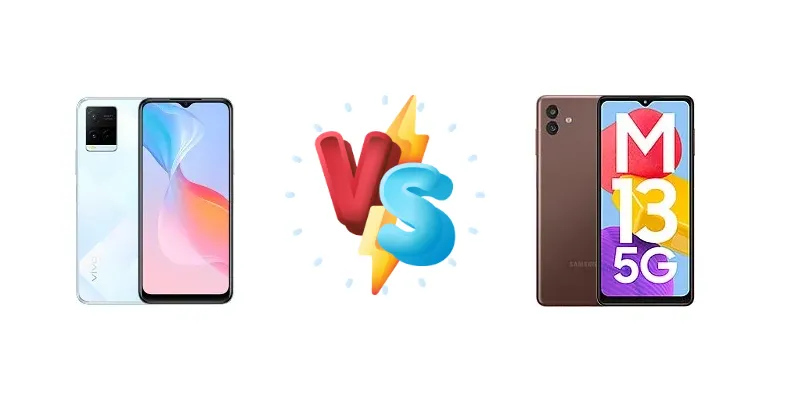
The sub-$200 smartphone market is fiercely competitive. The Samsung Galaxy M13 5G and vivo Y21 both aim to deliver essential smartphone functionality at an accessible price point, but they take drastically different approaches to achieving this. The M13 5G prioritizes 5G connectivity and a more modern chipset, while the Y21 focuses on a streamlined experience with a slightly older, but still capable, processor. This comparison will dissect their key differences to help you choose the right device.
🏆 Quick Verdict
For most users, the Samsung Galaxy M13 5G is the better choice. Its Mediatek Dimensity 700 chipset, built on a 7nm process, offers significantly improved performance and 5G connectivity compared to the vivo Y21’s Helio P35. While the Y21 has a slightly faster-wired charging, the M13 5G’s overall capabilities justify the small price difference.
| Network |
|---|
| 2G bands | GSM 850 / 900 / 1800 / 1900 | GSM 850 / 900 / 1800 / 1900 |
| 3G bands | HSDPA 850 / 900 / 2100 | HSDPA 850 / 900 / 1900 / 2100 |
| 4G bands | 1, 3, 5, 8, 38, 40, 41 | 1, 2, 3, 4, 5, 7, 8, 12, 17, 20, 26, 28, 38, 40, 41, 66 |
| 5G bands | - | 1, 3, 5, 7, 8, 20, 28, 38, 40, 41, 78 SA/NSA/Sub6 |
| Speed | HSPA, LTE | HSPA, LTE, 5G |
| Technology | GSM / HSPA / LTE | GSM / HSPA / LTE / 5G |
| Launch |
|---|
| Announced | 2021, August 20 | 2022, July 14 |
| Status | Available. Released 2021, August 20 | Available. Released 2022, July 23 |
| Body |
|---|
| Build | Glass front, plastic frame, plastic back | Glass front (Gorilla Glass 3), plastic back, plastic frame |
| Dimensions | 164.3 x 76.1 x 8 mm (6.47 x 3.00 x 0.31 in) | 164.5 x 76.5 x 8.8 mm (6.48 x 3.01 x 0.35 in) |
| SIM | Nano-SIM + Nano-SIM | Nano-SIM + Nano-SIM |
| Weight | 182 g (6.42 oz) | 195 g (6.88 oz) |
| Display |
|---|
| Protection | - | Corning Gorilla Glass 3 |
| Resolution | 720 x 1600 pixels, 20:9 ratio (~270 ppi density) | 720 x 1600 pixels, 20:9 ratio (~270 ppi density) |
| Size | 6.51 inches, 102.3 cm2 (~81.8% screen-to-body ratio) | 6.5 inches, 102.0 cm2 (~81.1% screen-to-body ratio) |
| Type | IPS LCD | PLS LCD, 90Hz, 400 nits (typ) |
| Platform |
|---|
| CPU | Octa-core (4x2.35 GHz Cortex-A53 & 4x1.8 GHz Cortex-A53) | Octa-core (2x2.2 GHz Cortex-A76 & 6x2.0 GHz Cortex-A55) |
| Chipset | Mediatek MT6765 Helio P35 (12 nm) | Mediatek Dimensity 700 (7 nm) |
| GPU | PowerVR GE8320 | Mali-G57 MC2 |
| OS | Android 11, Funtouch 11.1 | Android 12, One UI Core 4 |
| Memory |
|---|
| Card slot | microSDXC (dedicated slot) | microSDXC (dedicated slot) |
| Internal | 64GB 4GB RAM, 128GB 4GB RAM | 64GB 4GB RAM, 128GB 6GB RAM |
| Main Camera |
|---|
| Dual | 13 MP, f/2.2, (wide), PDAF
2 MP (macro) | 50 MP, f/1.8, (wide), PDAF
Auxiliary lens |
| Features | LED flash | LED flash, panorama, HDR |
| Single | 8 MP, f/2.0, (wide) | - |
| Video | 1080p@30fps | 1080p@30fps |
| Selfie camera |
|---|
| Features | - | HDR |
| Single | 8 MP, f/2.0, (wide) | 5 MP, f/2.0, (wide) |
| Video | 1080p@30fps | - |
| Sound |
|---|
| 3.5mm jack | Yes | Yes |
| 35mm jack | Yes | Yes |
| Loudspeaker | Yes | Yes |
| Comms |
|---|
| Bluetooth | 5.0, A2DP, LE | 5.0, A2DP, LE |
| NFC | No | No |
| Positioning | GPS, GLONASS, GALILEO, BDS | GPS, GLONASS, BDS, GALILEO, QZSS |
| Radio | FM radio | Unspecified |
| USB | USB Type-C 2.0, OTG | USB Type-C 2.0 |
| WLAN | Wi-Fi 802.11 a/b/g/n/ac, dual-band, Wi-Fi Direct | Wi-Fi 802.11 a/b/g/n/ac, dual-band |
| Features |
|---|
| Sensors | Fingerprint (side-mounted), accelerometer, gyro, proximity, compass | Fingerprint (side-mounted), accelerometer, gyro, compass |
| | - | Virtual proximity sensing |
| Battery |
|---|
| Charging | 18W wired | 15W wired |
| Type | 5000 mAh | Li-Po 5000 mAh |
| Misc |
|---|
| Colors | Diamond Glow, Midnight Blue | Midnight Blue, Aqua Green, Stardust Brown |
| Models | V2111 | SM-M136B, SM-M136B/DS |
| Price | About 180 EUR | About 180 EUR |
| SAR | - | 0.73 W/kg (head) |
| SAR EU | - | 0.84 W/kg (head) 1.33 W/kg (body) |
vivo Y21
- Faster charging (18W)
- Simple and streamlined user experience
- Potentially lower price point
- Significantly weaker processor (Helio P35)
- No 5G connectivity
- Less efficient chipset
Samsung Galaxy M13 5G
- 5G connectivity for faster data speeds
- More powerful processor (Dimensity 700)
- More efficient chipset (7nm process)
- Slower charging (15W)
- Potentially slightly higher price
- Samsung’s software can be bloated
Display Comparison
Neither device boasts a standout display. Both likely utilize LCD panels, common in this price bracket. The key difference lies under the hood. While specific display specs are unavailable, the focus here is on the chipset's ability to drive the display smoothly. The M13 5G’s Dimensity 700, with its more powerful GPU, will handle graphics-intensive tasks and scrolling with greater fluidity. The Y21’s Helio P35 may exhibit occasional stuttering during demanding use.
Camera Comparison
Both phones likely feature basic camera setups geared towards casual photography. Without detailed sensor information, it’s difficult to make a definitive judgment. However, the M13 5G’s more powerful ISP (Image Signal Processor), integrated within the Dimensity 700, will likely result in better image processing, particularly in challenging lighting conditions. The Y21’s Helio P35 has a less capable ISP, potentially leading to softer images and less dynamic range. The presence of a 5G modem in the M13 5G also suggests a more modern overall platform, which often includes improvements in camera software and algorithms.
Performance
The performance gap is the most significant differentiator. The Samsung Galaxy M13 5G’s Mediatek Dimensity 700 (7nm) is a substantial upgrade over the vivo Y21’s Mediatek Helio P35 (12nm). The Dimensity 700 features Cortex-A76 performance cores alongside efficient A55 cores, offering a noticeable boost in CPU performance. The Helio P35 relies solely on Cortex-A53 cores, which are less efficient and slower. This translates to faster app loading times, smoother multitasking, and a more responsive user experience on the M13 5G. The 7nm fabrication process of the Dimensity 700 also contributes to better thermal efficiency, reducing the likelihood of throttling during sustained workloads.
Battery Life
The vivo Y21’s 18W wired charging is faster than the Samsung Galaxy M13 5G’s 15W charging. This means the Y21 will likely reach 100% charge slightly quicker. However, battery life isn’t solely determined by charging speed. The Dimensity 700’s 7nm process is more power-efficient than the Helio P35’s 12nm process. This means the M13 5G could potentially offer comparable, or even better, real-world battery life despite the slower charging speed, especially during demanding tasks. The efficiency gains of the Dimensity 700 will be more noticeable during prolonged use.
Buying Guide
Buy the vivo Y21 if you prioritize a simple, reliable experience for basic tasks like calling, texting, and light social media use, and 18W charging is a must-have. Buy the Samsung Galaxy M13 5G if you want future-proof 5G connectivity, smoother multitasking, and a more responsive experience for demanding apps and occasional gaming. The M13 5G is the better option for users who anticipate needing more processing power or want to take advantage of next-generation networks.
Frequently Asked Questions
❓ Will the Mediatek Helio P35 in the vivo Y21 struggle with modern mobile games like PUBG or Call of Duty?
Yes, the Helio P35 is a relatively weak chipset and will likely struggle to run demanding games like PUBG or Call of Duty at high settings. You’ll likely need to lower the graphics settings significantly and may still experience frame drops and stuttering. The Samsung Galaxy M13 5G’s Dimensity 700 is much better suited for gaming, offering a smoother experience even at medium settings.
❓ Does the Samsung Galaxy M13 5G’s 5G connectivity actually make a noticeable difference in everyday use?
The benefit of 5G depends heavily on your location and carrier coverage. If you live in an area with strong 5G coverage, you’ll experience significantly faster download and upload speeds compared to 4G LTE. This is particularly noticeable when streaming high-resolution video, downloading large files, or playing online games. If 5G coverage is limited in your area, the benefit will be minimal.
❓ Is the difference in charging speed between 18W and 15W really that significant?
While 18W is faster than 15W, the difference in charging time isn’t massive. Expect the vivo Y21 to charge slightly quicker, perhaps by 15-20 minutes for a full charge. However, the overall impact on daily use is relatively small, especially considering the Dimensity 700’s power efficiency in the M13 5G.