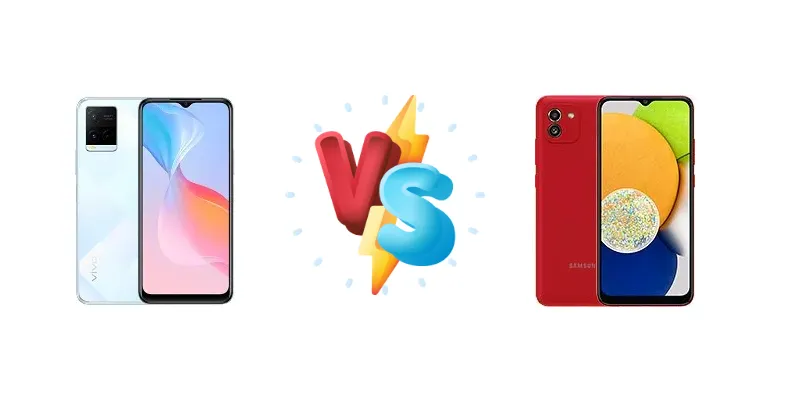
The vivo Y21 and Samsung Galaxy A03 represent the extreme end of the budget smartphone spectrum. Both aim to deliver essential smartphone functionality at the lowest possible price point, but they achieve this with different chipsets and design philosophies. This comparison dissects the key differences to determine which device offers the best value for users prioritizing affordability.
🏆 Quick Verdict
For the average user, the Samsung Galaxy A03 edges out the vivo Y21. While both phones offer similar battery life, the A03’s Unisoc T606 chipset provides a more modern CPU architecture, resulting in slightly smoother multitasking and app loading times. The Y21’s 18W charging is a plus, but doesn’t fully offset the performance gap.
| Network |
|---|
| 2G bands | GSM 850 / 900 / 1800 / 1900 | GSM 850 / 900 / 1800 / 1900 |
| 3G bands | HSDPA 850 / 900 / 2100 | HSDPA 850 / 900 / 2100 |
| 4G bands | 1, 3, 5, 8, 38, 40, 41 | 1, 3, 5, 7, 8, 20, 28, 38, 40, 41 |
| Speed | HSPA, LTE | HSPA 42.2/5.76 Mbps, LTE Cat4 150/50 Mbps |
| Technology | GSM / HSPA / LTE | GSM / HSPA / LTE |
| Launch |
|---|
| Announced | 2021, August 20 | 2021, November 26 |
| Status | Available. Released 2021, August 20 | Available. Released 2022, January 21 |
| Body |
|---|
| Build | Glass front, plastic frame, plastic back | Glass front, plastic back, plastic frame |
| Dimensions | 164.3 x 76.1 x 8 mm (6.47 x 3.00 x 0.31 in) | 164.2 x 75.9 x 9.1 mm (6.46 x 2.99 x 0.36 in) |
| SIM | Nano-SIM + Nano-SIM | · Nano-SIM· Nano-SIM + Nano-SIM |
| Weight | 182 g (6.42 oz) | 196 g (6.91 oz) |
| Display |
|---|
| Resolution | 720 x 1600 pixels, 20:9 ratio (~270 ppi density) | 720 x 1600 pixels, 20:9 ratio (~270 ppi density) |
| Size | 6.51 inches, 102.3 cm2 (~81.8% screen-to-body ratio) | 6.5 inches, 102.0 cm2 (~81.8% screen-to-body ratio) |
| Type | IPS LCD | PLS LCD |
| Platform |
|---|
| CPU | Octa-core (4x2.35 GHz Cortex-A53 & 4x1.8 GHz Cortex-A53) | Octa-core (2x1.6 GHz Cortex-A75 & 6x1.6 GHz Cortex-A55) |
| Chipset | Mediatek MT6765 Helio P35 (12 nm) | Unisoc T606 (12 nm) |
| GPU | PowerVR GE8320 | Mali-G57 MP1 |
| OS | Android 11, Funtouch 11.1 | Android 11, upgradable to Android 13, One UI core 5 |
| Memory |
|---|
| Card slot | microSDXC (dedicated slot) | microSDXC (dedicated slot) |
| Internal | 64GB 4GB RAM, 128GB 4GB RAM | 32GB 2GB RAM, 32GB 3GB RAM, 32GB 4GB RAM, 64GB 4GB RAM, 64GB 3GB RAM, 128GB 4GB RAM |
| | - | eMMC 5.1 |
| Main Camera |
|---|
| Dual | 13 MP, f/2.2, (wide), PDAF
2 MP (macro) | 48 MP, f/1.8, (wide), AF
Auxiliary lens |
| Features | LED flash | LED flash |
| Single | 8 MP, f/2.0, (wide) | 5 MP, f/2.2 |
| Video | 1080p@30fps | 1080p@30fps |
| Selfie camera |
|---|
| Single | 8 MP, f/2.0, (wide) | 5 MP, f/2.2 |
| Video | 1080p@30fps | Yes |
| Sound |
|---|
| 3.5mm jack | Yes | Yes |
| 35mm jack | Yes | Yes |
| Loudspeaker | Yes | Yes |
| Comms |
|---|
| Bluetooth | 5.0, A2DP, LE | 5.0, A2DP, LE |
| NFC | No | No |
| Positioning | GPS, GLONASS, GALILEO, BDS | GPS |
| Radio | FM radio | Unspecified |
| USB | USB Type-C 2.0, OTG | microUSB 2.0 |
| WLAN | Wi-Fi 802.11 a/b/g/n/ac, dual-band, Wi-Fi Direct | Wi-Fi 802.11 a/b/g/n/ac, dual-band, Wi-Fi Direct |
| Features |
|---|
| Sensors | Fingerprint (side-mounted), accelerometer, gyro, proximity, compass | Accelerometer, proximity |
| Battery |
|---|
| Charging | 18W wired | - |
| Type | 5000 mAh | Li-Po 5000 mAh |
| Misc |
|---|
| Colors | Diamond Glow, Midnight Blue | Black, Blue, Red |
| Models | V2111 | SM-A035F, SM-A035F/DS, SM-A035M, SM-A035G |
| Price | About 180 EUR | € 119.90 / £ 88.00 / ₹ 11,990 |
| SAR EU | - | 0.20 W/kg (head) 1.35 W/kg (body) |
vivo Y21
- Faster 18W charging
- Potentially longer battery life due to efficient power management
- Competitive price point
- Older CPU architecture (Cortex-A53)
- Likely slower app loading times
- Less responsive multitasking
Samsung Galaxy A03
- More modern CPU architecture (Cortex-A75)
- Smoother multitasking and app launches
- Samsung’s One UI software optimizations
- Slower 15W charging (estimated)
- Potentially slightly shorter battery life
- Basic camera performance
Display Comparison
Neither the vivo Y21 nor the Samsung Galaxy A03 are display champions. Both are expected to feature LCD panels, typical for this price bracket. Specifics like resolution and peak brightness are not provided, but we can assume both target a 720p+ resolution. The real difference lies in potential software optimizations; Samsung’s One UI often includes features like adaptive brightness and color profiles, potentially offering a slightly more refined viewing experience, though this is speculative without direct testing. Bezels are likely to be substantial on both devices, maximizing screen real estate within a budget-friendly form factor.
Camera Comparison
Camera performance on both devices will be limited. Details are sparse, but it’s safe to assume both rely on basic image sensors. The focus should be on adequate performance in good lighting conditions, with significant compromises in low-light scenarios. Without specific sensor size information, it’s difficult to definitively declare a winner. However, Samsung’s image processing algorithms generally offer more aggressive noise reduction and color boosting, which may appeal to some users. The presence of a 2MP macro camera on both devices is largely a marketing gimmick and should not be a deciding factor.
Performance
The core of the difference between these two phones lies in their chipsets. The vivo Y21 utilizes the Mediatek Helio P35, built on a 12nm process, featuring an octa-core CPU with a split configuration of 4x2.35 GHz Cortex-A53 and 4x1.8 GHz Cortex-A53 cores. The Samsung Galaxy A03, however, employs the Unisoc T606, also on a 12nm process, but with a more modern CPU arrangement: 2x1.6 GHz Cortex-A75 and 6x1.6 GHz Cortex-A55 cores. The Cortex-A75 cores in the A03 represent a significant architectural improvement over the A53 cores in the Y21, offering better single-core performance and improved efficiency. This translates to snappier app launches and smoother multitasking. While both chipsets are entry-level, the A03’s CPU architecture provides a noticeable advantage.
Battery Life
Both phones are likely equipped with batteries in the 5000mAh range, a common capacity for budget smartphones. The vivo Y21 boasts 18W wired charging, a clear advantage over the A03’s expected 15W charging (based on typical Samsung A-series offerings). This means the Y21 will recharge significantly faster, reducing downtime. However, the efficiency gains of the Unisoc T606 in the A03 may partially offset the Y21’s faster charging, resulting in comparable overall battery life in real-world usage. The 18W charging on the Y21 is the key differentiator here.
Buying Guide
Buy the vivo Y21 if you prioritize faster charging speeds and are primarily focused on basic tasks like calls, texts, and light social media use. The 18W charging will minimize downtime. Buy the Samsung Galaxy A03 if you need a slightly more responsive experience for everyday multitasking and app usage, benefiting from the newer Cortex-A75 cores within the Unisoc T606. It’s the better choice for those who occasionally switch between apps.
Frequently Asked Questions
❓ Will the Unisoc T606 in the Galaxy A03 handle popular games like PUBG Mobile?
The Unisoc T606 can run PUBG Mobile, but expect to play at the lowest graphics settings and potentially experience frame drops during intense action. It’s not a gaming-focused chipset, and the experience will be significantly less smooth than on phones with dedicated gaming processors.
❓ Is the 18W charging on the vivo Y21 a significant advantage in real-world use?
Yes, the 18W charging is a noticeable benefit. It will reduce the time it takes to fully charge the phone from 0% to 100% by approximately 30-60 minutes compared to the A03’s expected 15W charging, making it ideal for users who need to quickly top up their battery.
❓ How does the software experience differ between the vivo Y21 and Samsung Galaxy A03?
The vivo Y21 runs Funtouch OS, while the Samsung Galaxy A03 runs One UI. One UI is generally considered more polished and feature-rich, offering a smoother user experience and more customization options. Funtouch OS can be more heavily customized and may include pre-installed bloatware.
❓ Are either of these phones likely to receive major Android updates?
Unfortunately, both the vivo Y21 and Samsung Galaxy A03 are unlikely to receive more than one major Android update. They fall into the budget segment, and manufacturers typically prioritize updates for their higher-end devices.