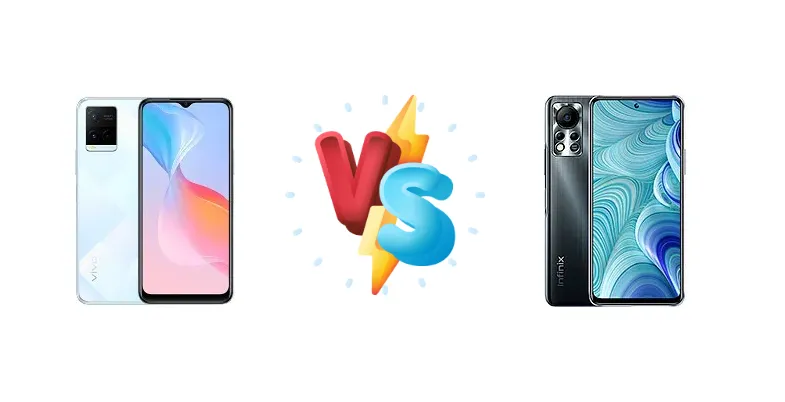
Both the vivo Y21 and the Infinix Hot 11s NFC target the ultra-budget smartphone market, but they approach it with different silicon. The vivo Y21 relies on the older Mediatek Helio P35, while the Infinix Hot 11s NFC boasts the newer Helio G88. This comparison dissects the implications of this core difference, alongside other key features, to determine which device offers the best value.
🏆 Quick Verdict
For the average user prioritizing responsiveness and occasional gaming, the Infinix Hot 11s NFC is the clear winner. Its Helio G88 chipset provides a significant performance uplift over the vivo Y21’s Helio P35, making everyday tasks and light gaming noticeably smoother. Both offer 18W charging, making the performance advantage the deciding factor.
| Network |
|---|
| 2G bands | GSM 850 / 900 / 1800 / 1900 | GSM 850 / 900 / 1800 / 1900 |
| 3G bands | HSDPA 850 / 900 / 2100 | HSDPA 850 / 900 / 2100 |
| 4G bands | 1, 3, 5, 8, 38, 40, 41 | 1, 3, 5, 8, 38, 40, 41 |
| Speed | HSPA, LTE | HSPA 42.2/5.76 Mbps, LTE Cat4 150/50 Mbps |
| Technology | GSM / HSPA / LTE | GSM / HSPA / LTE |
| | - | 1, 3, 7, 8, 20 |
| Launch |
|---|
| Announced | 2021, August 20 | 2022, February 18 |
| Status | Available. Released 2021, August 20 | Available. Released 2022, February 18 |
| Body |
|---|
| Build | Glass front, plastic frame, plastic back | Glass front, plastic back, plastic frame |
| Dimensions | 164.3 x 76.1 x 8 mm (6.47 x 3.00 x 0.31 in) | 168.9 x 77 x 8.8 mm (6.65 x 3.03 x 0.35 in) |
| SIM | Nano-SIM + Nano-SIM | Nano-SIM + Nano-SIM |
| Weight | 182 g (6.42 oz) | - |
| Display |
|---|
| Resolution | 720 x 1600 pixels, 20:9 ratio (~270 ppi density) | 1080 x 2460 pixels (~396 ppi density) |
| Size | 6.51 inches, 102.3 cm2 (~81.8% screen-to-body ratio) | 6.78 inches, 109.2 cm2 (~83.9% screen-to-body ratio) |
| Type | IPS LCD | IPS LCD, 90Hz, 500 nits (peak) |
| Platform |
|---|
| CPU | Octa-core (4x2.35 GHz Cortex-A53 & 4x1.8 GHz Cortex-A53) | Octa-core (2x2.0 GHz Cortex-A75 & 6x1.8 GHz Cortex-A55) |
| Chipset | Mediatek MT6765 Helio P35 (12 nm) | Mediatek MT6769H Helio G88 (12 nm) |
| GPU | PowerVR GE8320 | Mali-G52 MC2 |
| OS | Android 11, Funtouch 11.1 | Android 11, XOS 7.6 |
| Memory |
|---|
| Card slot | microSDXC (dedicated slot) | microSDXC (dedicated slot) |
| Internal | 64GB 4GB RAM, 128GB 4GB RAM | 64GB 4GB RAM, 128GB 4GB RAM, 128GB 6GB RAM |
| | - | eMMC 5.1 |
| Main Camera |
|---|
| Dual | 13 MP, f/2.2, (wide), PDAF
2 MP (macro) | - |
| Features | LED flash | Quad-LED flash, HDR, panorama |
| Single | 8 MP, f/2.0, (wide) | - |
| Triple | - | 50 MP, f/1.6, (wide), PDAF
Auxiliary lenses |
| Video | 1080p@30fps | 1440p@30fps |
| Selfie camera |
|---|
| Features | - | Dual-LED flash |
| Single | 8 MP, f/2.0, (wide) | 8 MP, f/2.0, (wide) |
| Video | 1080p@30fps | 1440p@30fps |
| Sound |
|---|
| 3.5mm jack | Yes | Yes |
| 35mm jack | Yes | Yes |
| Loudspeaker | Yes | Yes, with dual speakers |
| Comms |
|---|
| Bluetooth | 5.0, A2DP, LE | 5.0, A2DP, LE |
| NFC | No | Yes |
| Positioning | GPS, GLONASS, GALILEO, BDS | GPS |
| Radio | FM radio | FM radio |
| USB | USB Type-C 2.0, OTG | USB Type-C 2.0, OTG |
| WLAN | Wi-Fi 802.11 a/b/g/n/ac, dual-band, Wi-Fi Direct | Wi-Fi 802.11 a/b/g/n |
| Features |
|---|
| Sensors | Fingerprint (side-mounted), accelerometer, gyro, proximity, compass | Fingerprint (rear-mounted), accelerometer, gyro, proximity, compass |
| Battery |
|---|
| Charging | 18W wired | 18W wired |
| Type | 5000 mAh | 5000 mAh |
| Misc |
|---|
| Colors | Diamond Glow, Midnight Blue | Polar Black, Green Wave, Purple |
| Models | V2111 | - |
| Price | About 180 EUR | About 230 EUR |
vivo Y21
- Potentially simpler software experience (depending on FunTouch OS version)
- May be slightly more affordable (depending on regional pricing)
- Reliable brand reputation
- Significantly weaker performance due to the Helio P35 chipset
- Less responsive user experience
- Limited gaming capabilities
Infinix Hot 11s NFC
- Superior performance with the Helio G88 chipset
- Smoother multitasking and app loading
- NFC support for contactless payments and pairing
- Better gaming performance
- XOS software may contain bloatware
- Potentially slightly higher price point
Display Comparison
Neither device boasts a standout display. Both likely utilize LCD panels, common in this price bracket. Without specific brightness or color gamut data, it’s difficult to declare a winner. However, the focus should be on the performance difference, as display quality is often a secondary concern for budget buyers. Bezels are likely comparable, and color accuracy will be standard for the segment.
Camera Comparison
Without detailed camera specs beyond the chipsets, a direct comparison is limited. Both phones likely feature a primary camera and multiple secondary sensors (depth, macro). The image signal processor (ISP) within the Helio G88 likely offers better image processing capabilities than the P35’s ISP, potentially resulting in slightly better image quality in various lighting conditions. However, the quality will heavily depend on the sensor used, which is unknown. The presence of NFC in the Hot 11s NFC suggests a slightly more feature-rich overall package.
Performance
The core difference lies in the chipsets. The Infinix Hot 11s NFC’s Mediatek Helio G88 (12nm) features two Cortex-A75 cores clocked at 2.0 GHz, paired with six Cortex-A55 cores at 1.8 GHz. This contrasts with the vivo Y21’s Helio P35 (12nm) which uses four Cortex-A53 cores at 2.35 GHz and four at 1.8 GHz. While the P35 has a higher clock speed on its prime cores, the G88’s newer architecture (A75 vs A53) provides a substantial real-world performance advantage. The A75 cores are significantly more efficient and powerful, resulting in faster app loading times and smoother multitasking. This translates to a better user experience, especially for demanding apps. The G88 also benefits from a more modern GPU, improving gaming performance.
Battery Life
Both devices feature 18W wired charging, suggesting similar charging speeds. Without knowing the battery capacity of the vivo Y21, it’s difficult to assess battery life. However, the Helio G88’s improved efficiency could potentially offset a slightly smaller battery capacity in the Infinix Hot 11s NFC, leading to comparable real-world battery performance. The 18W charging will likely deliver a full charge in around 2-3 hours for both devices.
Buying Guide
Buy the vivo Y21 if your primary need is a basic smartphone for essential communication – calls, texts, and light social media – and you prioritize a potentially simpler software experience. Buy the Infinix Hot 11s NFC if you want a more responsive device capable of handling multitasking, streaming, and light gaming without significant lag, and if NFC functionality is a must-have for mobile payments or quick pairing.
Frequently Asked Questions
❓ Will the Infinix Hot 11s NFC struggle with popular apps like Facebook and WhatsApp?
No, the Helio G88 chipset in the Infinix Hot 11s NFC is more than capable of handling everyday apps like Facebook, WhatsApp, and browsing. The A75 cores provide a noticeable performance boost over the vivo Y21’s Helio P35, ensuring a smoother and more responsive experience.
❓ Is the NFC feature on the Infinix Hot 11s NFC useful for everyday use?
Yes, NFC is incredibly convenient. It allows for contactless payments via Google Pay or other mobile payment services, and simplifies pairing with Bluetooth devices like headphones and speakers. The vivo Y21 lacks this feature, making the Hot 11s NFC a more versatile option.
❓ Can I play PUBG Mobile on the Infinix Hot 11s NFC, and if so, at what settings?
You can play PUBG Mobile on the Infinix Hot 11s NFC, but you'll likely need to stick to low or medium graphics settings and a balanced frame rate to maintain a playable experience. The Helio G88 isn't a gaming powerhouse, but it's significantly better than the Helio P35 in the vivo Y21 for gaming.
❓ Does the Infinix Hot 11s NFC have a lot of bloatware pre-installed?
Infinix's XOS software is known to include some pre-installed apps (bloatware). However, many of these can be uninstalled, freeing up storage space and reducing clutter. The amount of bloatware can vary depending on the region and carrier.