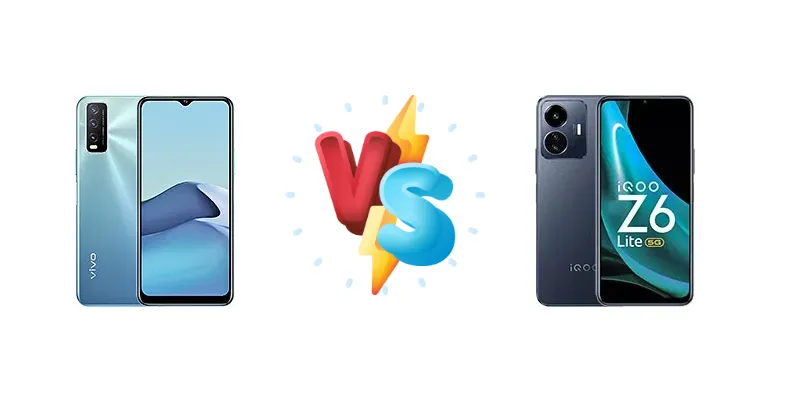
The vivo Y20t and iQOO Z6 Lite represent vivo’s approach to the budget smartphone market, but they target slightly different priorities. The Y20t, with its Snapdragon 662, is an established player, while the iQOO Z6 Lite introduces the newer, more efficient Snapdragon 4 Gen 1. This comparison dissects the key differences to help you determine which device best suits your needs.
🏆 Quick Verdict
For most users, the iQOO Z6 Lite emerges as the better choice. Its Snapdragon 4 Gen 1, built on a 6nm process, delivers a noticeable performance uplift and improved efficiency compared to the Y20t’s Snapdragon 662, despite both having similar CPU clock speeds. While both offer 18W charging, the Z6 Lite’s more modern architecture provides a better long-term user experience.
| Network |
|---|
| 2G bands | GSM 850 / 900 / 1800 / 1900 | GSM 850 / 900 / 1800 / 1900 |
| 3G bands | HSDPA 850 / 900 / 2100 | HSDPA 850 / 900 / 2100 |
| 4G bands | 1, 3, 5, 8, 38, 40, 41 | 1, 3, 5, 8, 38, 40, 41 |
| 5G bands | - | 77, 78 SA/NSA |
| Speed | HSPA, LTE | HSPA, LTE, 5G |
| Technology | GSM / HSPA / LTE | GSM / HSPA / LTE / 5G |
| Launch |
|---|
| Announced | 2021, October 11 | 2022, September 14 |
| Status | Available. Released 2021, October 11 | Available. Released 2022, September 14 |
| Body |
|---|
| Build | Glass front, plastic back, plastic frame | Glass front, plastic frame, plastic back |
| Dimensions | 164.4 x 76.3 x 8.4 mm (6.47 x 3.00 x 0.33 in) | 164 x 75.8 x 8.3 mm (6.46 x 2.98 x 0.33 in) |
| SIM | Nano-SIM + Nano-SIM | Nano-SIM + Nano-SIM |
| Weight | 192 g (6.77 oz) | 194 g (6.84 oz) |
| Display |
|---|
| Resolution | 720 x 1600 pixels, 20:9 ratio (~270 ppi density) | 1080 x 2408 pixels, 20:9 ratio (~401 ppi density) |
| Size | 6.51 inches, 102.3 cm2 (~81.6% screen-to-body ratio) | 6.58 inches, 104.3 cm2 (~83.9% screen-to-body ratio) |
| Type | IPS LCD | IPS LCD, 120Hz |
| Platform |
|---|
| CPU | Octa-core (4x2.0 GHz Kryo 260 Gold & 4x1.8 GHz Kryo 260 Silver) | Octa-core (2x2.0 GHz Cortex-A78 & 6x1.8 GHz Cortex-A55) |
| Chipset | Qualcomm SM6115 Snapdragon 662 (11 nm) | Qualcomm SM4375 Snapdragon 4 Gen 1 (6 nm) |
| GPU | Adreno 610 | Adreno 619 |
| OS | Android 11, Funtouch 11.1 | Android 12, Funtouch 12 |
| Memory |
|---|
| Card slot | microSDXC (dedicated slot) | microSDXC (uses shared SIM slot) |
| Internal | 64GB 6GB RAM | 64GB 4GB RAM, 128GB 6GB RAM |
| | eMMC 5.1 | - |
| Main Camera |
|---|
| Dual | - | 50 MP, f/1.8, (wide), PDAF
2 MP (macro) |
| Features | LED flash, HDR | Dual-LED dual-tone flash, HDR, panorama |
| Single | 8 MP, f/1.8, (wide) | 8 MP, f/2.0, (wide) |
| Triple | 13 MP, f/2.2, (wide), PDAF
2 MP (macro)
Auxiliary lens | - |
| Video | 1080p@30fps | 1080p@30fps |
| Selfie camera |
|---|
| Single | 8 MP, f/1.8, (wide) | 8 MP, f/2.0, (wide) |
| Video | 1080p@30fps | 1080p@30fps |
| Sound |
|---|
| 3.5mm jack | Yes | Yes |
| 35mm jack | Yes | Yes |
| Loudspeaker | Yes | Yes |
| Comms |
|---|
| Bluetooth | 5.0, A2DP, LE | 5.1, A2DP, LE |
| NFC | No | No |
| Positioning | GPS, GLONASS, BDS, GALILEO | GPS, GLONASS, GALILEO, BDS, QZSS |
| Radio | FM radio | FM radio |
| USB | microUSB 2.0, OTG | USB Type-C 2.0, OTG |
| WLAN | Wi-Fi 802.11 a/b/g/n/ac, dual-band, Wi-Fi Direct | Wi-Fi 802.11 a/b/g/n/ac, dual-band, Wi-Fi Direct |
| Features |
|---|
| Sensors | Fingerprint (side-mounted), accelerometer, proximity, compass | Fingerprint (side-mounted), accelerometer, proximity, compass |
| Battery |
|---|
| Charging | 18W wired | 18W wired |
| Type | 5000 mAh | 5000 mAh |
| Misc |
|---|
| Colors | Obsidian Black, Purist Blue | Mystic Night, Stellar Green |
| Models | V2129 | I2208 |
| Price | About 180 EUR | About 180 EUR |
vivo Y20t
- Proven reliability of the Snapdragon 662 platform.
- Potentially lower price point due to being an older model.
- Familiar software experience for existing vivo users.
- Less efficient 11nm manufacturing process.
- Older CPU architecture with less single-core performance.
- Potentially slower app loading times and multitasking.
vivo iQOO Z6 Lite
- More efficient Snapdragon 4 Gen 1 (6nm).
- Improved CPU architecture with Cortex-A78 cores.
- Better multitasking and gaming performance.
- Likely better image processing capabilities.
- May be slightly more expensive than the Y20t.
- Newer chipset may have initial software bugs (though unlikely).
- Potentially less established user base.
Display Comparison
Neither device’s display specifications are provided, so a direct comparison is limited. However, given their price points, both likely utilize LCD panels. The iQOO Z6 Lite’s newer chipset *could* suggest a slightly more advanced display controller, potentially leading to better color accuracy or viewing angles, but this is speculative. Bezels are likely comparable, focusing on maximizing screen real estate within the budget constraints.
Camera Comparison
Without detailed camera specifications, a precise comparison is difficult. However, it’s reasonable to assume both phones feature a primary camera and supporting lenses. The iQOO Z6 Lite’s newer image signal processor (ISP), integrated within the Snapdragon 4 Gen 1, likely offers improved image processing capabilities, potentially resulting in better dynamic range and noise reduction. The Y20t’s older ISP may struggle in low-light conditions compared to the Z6 Lite.
Performance
The core difference lies in the chipsets. The iQOO Z6 Lite’s Snapdragon 4 Gen 1 (6nm) boasts a more modern architecture than the Y20t’s Snapdragon 662 (11nm). While both are octa-core CPUs with similar peak clock speeds (2.0 GHz), the Z6 Lite utilizes 2x Cortex-A78 cores alongside 6x A55 cores, offering a significant advantage in single-core performance compared to the Y20t’s 4x Kryo 260 Gold and 4x Kryo 260 Silver configuration. The 6nm process also translates to better thermal efficiency, reducing the likelihood of throttling during sustained workloads. This benefits gamers and users running multiple apps simultaneously.
Battery Life
Both devices feature 18W wired charging, suggesting similar charging speeds. The actual battery capacity isn’t specified, but the Snapdragon 4 Gen 1’s superior power efficiency in the iQOO Z6 Lite means it will likely deliver longer battery life on a single charge, even with a comparable battery size. The 6nm process inherently consumes less power than the 11nm process of the Snapdragon 662, extending usage time between charges.
Buying Guide
Buy the vivo Y20t if you prioritize a proven track record and are looking for a reliable, basic smartphone for everyday tasks like calling, texting, and light social media use. Buy the vivo iQOO Z6 Lite if you want a more responsive experience, better multitasking capabilities, and a chipset designed for improved power efficiency, making it ideal for moderate gaming and demanding applications.
Frequently Asked Questions
❓ Will the iQOO Z6 Lite handle demanding games like PUBG Mobile smoothly?
The Snapdragon 4 Gen 1 in the iQOO Z6 Lite is capable of running PUBG Mobile, but likely at medium settings to maintain a stable frame rate. The improved CPU and GPU architecture compared to the Y20t’s Snapdragon 662 will result in a smoother gaming experience, though it won’t match the performance of higher-end chipsets.
❓ Does the Snapdragon 4 Gen 1 in the iQOO Z6 Lite get noticeably warmer than the Snapdragon 662 during extended use?
No, the Snapdragon 4 Gen 1 is actually *less* likely to overheat. Its 6nm manufacturing process is more efficient, generating less heat than the 11nm process used in the Snapdragon 662. This translates to better sustained performance and reduced thermal throttling.
❓ Is the difference in performance between these two phones noticeable for everyday tasks like browsing and social media?
Yes, the iQOO Z6 Lite will feel snappier and more responsive for everyday tasks. The faster CPU cores and improved architecture of the Snapdragon 4 Gen 1 result in quicker app loading times, smoother scrolling, and a more fluid overall user experience.