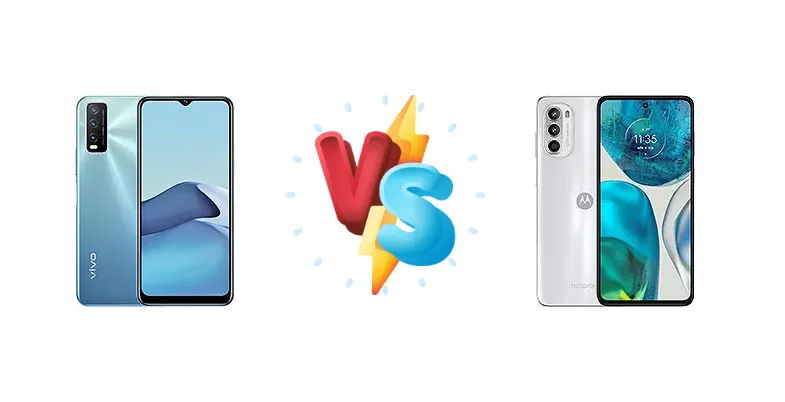
The sub-$200 smartphone market is fiercely competitive. Both the Motorola Moto G52 and the vivo Y20t aim to deliver a solid experience without breaking the bank. However, they take different approaches, primarily revolving around their chipsets and charging capabilities. This comparison dissects the key differences to determine which device offers the best value.
🏆 Quick Verdict
For most users, the Motorola Moto G52 emerges as the better choice. Its Snapdragon 680, built on a more efficient 6nm process, provides a noticeable performance uplift and improved power efficiency compared to the vivo Y20t’s Snapdragon 662. The 30W charging is a significant advantage, offsetting the potentially smaller battery capacity (not specified in provided data).
| Network |
|---|
| 2G bands | GSM 850 / 900 / 1800 / 1900 | GSM 850 / 900 / 1800 / 1900 |
| 3G bands | HSDPA 850 / 900 / 2100 | HSDPA 850 / 900 / 1700(AWS) / 1900 / 2100 |
| 4G bands | 1, 3, 5, 8, 38, 40, 41 | LTE |
| Speed | HSPA, LTE | HSPA, LTE |
| Technology | GSM / HSPA / LTE | GSM / HSPA / LTE |
| Launch |
|---|
| Announced | 2021, October 11 | 2022, April 12 |
| Status | Available. Released 2021, October 11 | Available. Released 2022, April 20 |
| Body |
|---|
| Build | Glass front, plastic back, plastic frame | - |
| Dimensions | 164.4 x 76.3 x 8.4 mm (6.47 x 3.00 x 0.33 in) | 160.1 x 74.5 x 8 mm (6.30 x 2.93 x 0.31 in) |
| SIM | Nano-SIM + Nano-SIM | Nano-SIM + Nano-SIM |
| Weight | 192 g (6.77 oz) | 169 g (5.96 oz) |
| | - | Water-repellent design |
| Display |
|---|
| Resolution | 720 x 1600 pixels, 20:9 ratio (~270 ppi density) | 1080 x 2400 pixels, 20:9 ratio (~402 ppi density) |
| Size | 6.51 inches, 102.3 cm2 (~81.6% screen-to-body ratio) | 6.6 inches, 103.6 cm2 (~86.9% screen-to-body ratio) |
| Type | IPS LCD | AMOLED, 90Hz |
| Platform |
|---|
| CPU | Octa-core (4x2.0 GHz Kryo 260 Gold & 4x1.8 GHz Kryo 260 Silver) | Octa-core (4x2.4 GHz Kryo 265 Gold & 4x1.9 GHz Kryo 265 Silver) |
| Chipset | Qualcomm SM6115 Snapdragon 662 (11 nm) | Qualcomm SM6225 Snapdragon 680 4G (6 nm) |
| GPU | Adreno 610 | Adreno 610 |
| OS | Android 11, Funtouch 11.1 | Android 12, planned upgrade to Android 13 |
| Memory |
|---|
| Card slot | microSDXC (dedicated slot) | microSDXC (uses shared SIM slot) |
| Internal | 64GB 6GB RAM | 64GB 4GB RAM, 128GB 4GB RAM, 128GB 6GB RAM, 256GB 6GB RAM |
| | eMMC 5.1 | - |
| Main Camera |
|---|
| Features | LED flash, HDR | LED flash, HDR, panorama |
| Single | 8 MP, f/1.8, (wide) | - |
| Triple | 13 MP, f/2.2, (wide), PDAF
2 MP (macro)
Auxiliary lens | 50 MP, f/1.8 (wide), 1/2.76", 0.64µm, PDAF
8 MP, f/2.2, 118˚ (ultrawide), 1/4.0", 1.12µm
2 MP (macro) |
| Video | 1080p@30fps | 1080p@30fps |
| Selfie camera |
|---|
| Single | 8 MP, f/1.8, (wide) | 16 MP, f/2.5, (wide), 1.0µm |
| Video | 1080p@30fps | 1080p@30fps |
| Sound |
|---|
| 3.5mm jack | Yes | Yes |
| 35mm jack | Yes | Yes |
| Loudspeaker | Yes | Yes, with stereo speakers |
| Comms |
|---|
| Bluetooth | 5.0, A2DP, LE | 5.0, A2DP, LE |
| NFC | No | Yes (market/region dependent) |
| Positioning | GPS, GLONASS, BDS, GALILEO | GPS, GLONASS, GALILEO |
| Radio | FM radio | Unspecified |
| USB | microUSB 2.0, OTG | USB Type-C 2.0 |
| WLAN | Wi-Fi 802.11 a/b/g/n/ac, dual-band, Wi-Fi Direct | Wi-Fi 802.11 a/b/g/n/ac, dual-band, Wi-Fi Direct |
| Features |
|---|
| Sensors | Fingerprint (side-mounted), accelerometer, proximity, compass | Fingerprint (side-mounted), accelerometer, gyro, proximity, compass |
| Battery |
|---|
| Charging | 18W wired | 30W wired |
| Type | 5000 mAh | Li-Po 5000 mAh |
| Misc |
|---|
| Colors | Obsidian Black, Purist Blue | Charcoal Gray, Porcelain White |
| Models | V2129 | XT2221-1, XT2221-2 |
| Price | About 180 EUR | About 470 EUR |
vivo Y20t
- Potentially lower price point
- Familiar vivo software experience
- Reliable Snapdragon 662 performance for basic tasks
- Less efficient Snapdragon 662 chipset
- Slower 18W charging
- Likely to throttle under heavy load
Motorola Moto G52
- More efficient Snapdragon 680 chipset (6nm)
- Faster 30W charging
- Improved performance for multitasking and gaming
- Potentially better thermal management
- May be slightly more expensive
- Motorola's software can be perceived as 'bloated' by some
Display Comparison
Neither device's display specifications were provided. However, given their price points, we can expect both to feature LCD panels with 1080p+ resolution. The Moto G52, being a slightly newer device, *may* benefit from improved color accuracy and viewing angles. Bezels are likely comparable, and neither is expected to feature high refresh rates or advanced panel technologies like LTPO.
Camera Comparison
Without detailed camera specifications, a direct comparison is difficult. However, both phones likely employ a multi-camera setup with a primary sensor and supporting lenses. The absence of information regarding sensor size and aperture makes it impossible to determine which phone captures better images in low light. It's reasonable to assume both will include a standard, and likely underwhelming, 2MP macro camera. Image processing style will also play a role, with Motorola typically favoring a more natural look while vivo often boosts saturation.
Performance
The core difference lies in the chipsets. The Motorola Moto G52’s Snapdragon 680 (6nm) is a clear upgrade over the vivo Y20t’s Snapdragon 662 (11nm). The 6nm process inherently offers better thermal efficiency, meaning the G52 is less likely to throttle under sustained load. While both are octa-core CPUs with a similar core configuration (4x performance, 4x efficiency), the G52’s Kryo 265 cores operate at a higher clock speed (2.4 GHz vs 2.0 GHz), translating to snappier application launches and smoother multitasking. The G52 will handle graphically intensive tasks with more ease.
Battery Life
The vivo Y20t features 18W wired charging, while the Motorola Moto G52 boasts 30W wired charging. This is a substantial difference. While battery capacity isn't specified for either device, the faster charging on the G52 significantly reduces downtime. Expect a full charge on the G52 to take considerably less time than the Y20t. The Snapdragon 680’s improved efficiency also contributes to potentially longer battery life on the G52, even with a similar capacity.
Buying Guide
Buy the vivo Y20t if your primary concern is brand familiarity within the vivo ecosystem and you prioritize a potentially lower initial cost. However, buy the Motorola Moto G52 if you value a more modern and efficient chipset, faster charging speeds, and a generally smoother user experience, even if it means spending slightly more upfront. The G52 is ideal for users who frequently stream video or play casual games.
Frequently Asked Questions
❓ Will the Snapdragon 680 in the Moto G52 handle demanding games like PUBG Mobile?
While the Snapdragon 680 isn't a flagship chipset, it's capable of running PUBG Mobile at medium settings with a stable frame rate. The 6nm process and improved CPU/GPU clock speeds over the Snapdragon 662 will provide a smoother experience, though you shouldn't expect maximum graphical fidelity.
❓ How much faster is the 30W charging on the Moto G52 compared to the 18W charging on the vivo Y20t?
The 30W charging on the Moto G52 will significantly reduce charging times. While exact 0-100% times depend on battery capacity (not specified), expect the G52 to charge at least 40-50% faster than the Y20t. This translates to less time tethered to a wall charger.
❓ Does the Snapdragon 680 in the Moto G52 get hot during prolonged use?
The Snapdragon 680's 6nm process is designed for improved thermal efficiency. While it will generate heat during intensive tasks, it's less prone to overheating and throttling compared to the Snapdragon 662 in the vivo Y20t. This means sustained performance will be more consistent.