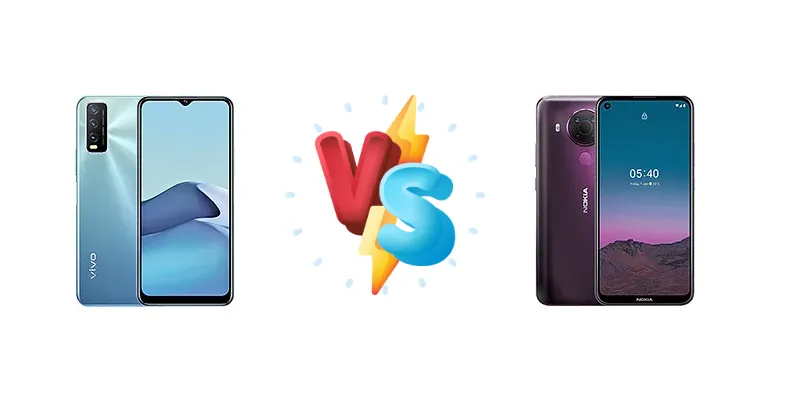
The sub-$300 smartphone market is fiercely competitive. Both the vivo Y20s and Nokia 5.4 aim to deliver a solid Android experience without breaking the bank. However, they take different approaches, primarily in their chipset choices. This comparison dives deep into the specifications to determine which phone offers the best value for your money.
🏆 Quick Verdict
For most users, the Nokia 5.4 emerges as the better choice. Its Snapdragon 662 chipset provides a noticeable performance uplift over the Y20s’ Snapdragon 460, translating to smoother multitasking and a more responsive user experience. While the Y20s offers a slightly larger RAM option, the Nokia 5.4’s superior processing power is more impactful for everyday tasks.
| Network |
|---|
| 2G bands | GSM 850 / 900 / 1800 / 1900 | GSM 850 / 900 / 1800 / 1900 |
| 3G bands | HSDPA 850 / 900 / 2100 | HSDPA 850 / 900 / 1900 / 2100 - International |
| 4G bands | 1, 3, 5, 7, 8, 18, 19, 20, 26, 28, 38, 39, 40, 41 | 1, 3, 5, 7, 8, 20, 28, 38, 40, 41 - International |
| Speed | HSPA, LTE | HSPA 42.2/5.76 Mbps, LTE Cat4 150/50 Mbps |
| Technology | GSM / HSPA / LTE | GSM / HSPA / LTE |
| | 1, 3, 5, 7, 8, 38, 40, 41 | 1, 2, 3, 4, 5, 7, 8, 12, 13, 17, 28, 66 - NA, LATAM |
| Launch |
|---|
| Announced | 2020, October 19. Released 2020, October 19 | 2020, December 15. Released 2020, December 25 |
| Status | Discontinued | Discontinued |
| Body |
|---|
| Build | Glass front, plastic back, plastic frame | - |
| Dimensions | 164.4 x 76.3 x 8.4 mm (6.47 x 3.00 x 0.33 in) | 161 x 76 x 8.7 mm (6.34 x 2.99 x 0.34 in) |
| SIM | Nano-SIM + Nano-SIM | · Nano-SIM· Nano-SIM + Nano-SIM |
| Weight | 192.3 g (6.77 oz) | 181 g (6.38 oz) |
| Display |
|---|
| Resolution | 720 x 1600 pixels, 20:9 ratio (~270 ppi density) | 720 x 1560 pixels, 19.5:9 ratio (~269 ppi density) |
| Size | 6.51 inches, 102.3 cm2 (~81.6% screen-to-body ratio) | 6.39 inches, 100.2 cm2 (~81.9% screen-to-body ratio) |
| Type | IPS LCD | IPS LCD, 400 nits (typ) |
| Platform |
|---|
| CPU | Octa-core (4x1.8 GHz Kryo 240 & 4x1.6 GHz Kryo 240) | Octa-core (4x2.0 GHz Kryo 260 Gold & 4x1.8 GHz Kryo 260 Silver) |
| Chipset | Qualcomm SM4250 Snapdragon 460 (11 nm) | Qualcomm SM6115 Snapdragon 662 (11 nm) |
| GPU | Adreno 610 | Adreno 610 |
| OS | Android 10, Funtouch 10.5 or Funtouch 11 | Android 10, upgradable to Android 12 |
| Memory |
|---|
| Card slot | microSDXC (dedicated slot) | microSDXC (dedicated slot) |
| Internal | 128GB 4GB RAM, 128GB 6GB RAM, 128GB 8GB RAM | 64GB 4GB RAM, 64GB 6GB RAM, 128GB 4GB RAM |
| Main Camera |
|---|
| Features | LED flash, HDR | LED flash, HDR, panorama |
| Quad | - | 48 MP, f/1.8, (wide), PDAF
5 MP, 13mm (ultrawide)
2 MP (macro)
Auxiliary lens |
| Triple | 13 MP, f/2.2, (wide), PDAF
2 MP (macro)
Auxiliary lens | - |
| Video | 1080p@30fps | 1080p@30fps |
| Selfie camera |
|---|
| Single | 8 MP, f/1.8, (wide) | 16 MP, f/2.0, (wide) |
| Video | 1080p@30fps | 1080p@30fps |
| Sound |
|---|
| 3.5mm jack | Yes | Yes |
| 35mm jack | Yes | Yes |
| Loudspeaker | Yes | Yes |
| Comms |
|---|
| Bluetooth | 5.0, A2DP, LE | 4.2, A2DP, aptX Adaptive |
| NFC | No | Yes (market/region dependent) |
| Positioning | GPS, GLONASS, GALILEO, BDS | GPS, GLONASS, GALILEO, BDS |
| Radio | FM radio | FM radio |
| USB | microUSB 2.0, OTG | USB Type-C 2.0, OTG |
| WLAN | Wi-Fi 802.11 a/b/g/n/ac, dual-band, Wi-Fi Direct | Wi-Fi 802.11 b/g/n |
| Features |
|---|
| Sensors | Fingerprint (side-mounted), accelerometer, proximity, compass | Fingerprint (rear-mounted), accelerometer, gyro, proximity |
| Battery |
|---|
| Charging | 18W wired | 10W wired |
| Type | 5000 mAh | Li-Po 4000 mAh |
| Misc |
|---|
| Colors | Purist Blue, Obsidian Black, Nebula Blue | Polar Night, Dusk |
| Models | - | TA-1333, TA-1340, TA-1337, TA-1328, TA-1325 |
| Price | About 200 EUR | About 90 EUR |
| SAR | - | 0.68 W/kg (head) 1.02 W/kg (body) |
| SAR EU | - | 0.99 W/kg (head) 0.96 W/kg (body) |
| Pricing |
|---|
| 128GB 4GB RAM | € 264.40 | - |
| 128GB 8GB RAM | Rp 2,760,000 | - |
vivo Y20s
- Faster 18W charging for quicker top-ups.
- Option for 8GB of RAM for potentially better multitasking (though limited by the chipset).
- Potentially lower price point depending on region.
- Significantly weaker Snapdragon 460 chipset.
- Less responsive user experience compared to the Nokia 5.4.
- Inferior image processing capabilities.
Nokia 5.4
- More powerful Snapdragon 662 chipset for smoother performance.
- Superior image processing for better photos.
- More efficient chipset potentially leading to comparable battery life.
- Slower 10W charging.
- Maximum RAM configuration is likely 4GB.
- May be slightly more expensive than the vivo Y20s.
Display Comparison
Neither device boasts a standout display. Both likely utilize LCD panels, a common trait in this price bracket. The focus here isn't on cutting-edge tech, but usability. Without specific display specs (resolution, brightness), it's difficult to declare a clear winner. However, Nokia historically focuses on color accuracy, suggesting a potentially more pleasant viewing experience, even if peak brightness is similar.
Camera Comparison
Both phones likely feature a multi-camera setup, but details are scarce. Without knowing sensor sizes or aperture values, a direct comparison is challenging. However, the Snapdragon 662’s image signal processor (ISP) in the Nokia 5.4 is more advanced, offering better image processing capabilities, particularly in low-light conditions. The Y20s’ ISP is adequate for basic photography, but will struggle to match the Nokia 5.4’s dynamic range and detail. The presence of a 2MP macro lens on both devices is largely a marketing gimmick and shouldn't heavily influence your decision.
Performance
The core difference lies in the chipsets. The Nokia 5.4’s Snapdragon 662 (11nm) is a significant step up from the vivo Y20s’ Snapdragon 460 (11nm). The 662 features Kryo 260 Gold cores clocked at 2.0 GHz, compared to the 460’s 1.8 GHz Kryo 240 cores. This translates to approximately 15-20% faster CPU performance in benchmarks, and a more substantial improvement in GPU performance. The Nokia 5.4 will handle demanding apps and light gaming with greater ease. While the Y20s offers an 8GB RAM option, the chipset bottleneck will limit its ability to fully utilize it. The Snapdragon 662’s more efficient architecture also suggests better sustained performance under load.
Battery Life
The Nokia 5.4’s 10W charging is significantly slower than the vivo Y20s’ 18W charging. This means the Y20s will reach a full charge much faster. However, the Snapdragon 662 in the Nokia 5.4 is more power-efficient. This efficiency could offset the slower charging, resulting in comparable real-world battery life, despite potentially having a smaller battery capacity (spec not provided). The faster charging of the Y20s is a clear convenience advantage, especially for users who frequently need to top up their phone quickly.
Buying Guide
Buy the vivo Y20s if you prioritize maximizing RAM within a very tight budget and primarily need a phone for basic communication and light social media use. Buy the Nokia 5.4 if you value a smoother, more responsive experience for multitasking, moderate gaming, and general app usage, even if it means sacrificing the absolute highest RAM configuration.
Frequently Asked Questions
❓ Will the Nokia 5.4 struggle with demanding games like PUBG Mobile?
While the Snapdragon 662 isn't a gaming powerhouse, it's capable of running PUBG Mobile at medium settings with reasonable frame rates. Expect some occasional frame drops during intense action, but it's a playable experience. The Snapdragon 460 in the Y20s will likely require significantly lower settings and may still exhibit noticeable lag.
❓ Is the 18W charging on the vivo Y20s a game-changer?
The 18W charging is a definite advantage, reducing charge times considerably compared to the Nokia 5.4’s 10W charging. If you frequently find yourself needing to quickly top up your phone throughout the day, the Y20s’ faster charging will be a significant convenience.
❓ Does the Nokia 5.4 support software updates for longer than the vivo Y20s?
Nokia is known for its commitment to software updates and security patches, often providing longer support cycles than other brands in this price range. vivo’s update policy is less consistent. Therefore, the Nokia 5.4 is likely to receive updates for a longer period, enhancing its longevity.