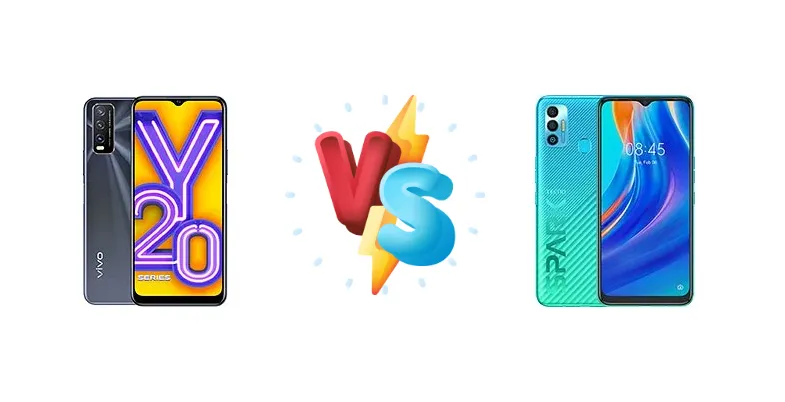
The vivo Y20i and Tecno Spark 7T represent the fiercely competitive sub-$150 smartphone market. Both aim to deliver essential smartphone functionality at an accessible price point, but they take different approaches to achieving this. The Y20i leverages Qualcomm's Snapdragon 460, while the Spark 7T opts for MediaTek's Helio G35. This comparison dissects these key differences to determine which device offers the best value.
🏆 Quick Verdict
For the average user prioritizing consistent performance and a slightly more efficient processor, the vivo Y20i emerges as the better choice. Its Snapdragon 460, built on an 11nm process, offers a more refined experience than the Tecno Spark 7T’s 12nm Helio G35, despite the latter’s higher clock speeds.
| Network |
|---|
| 2G bands | GSM 850 / 900 / 1800 / 1900 | GSM 850 / 900 / 1800 / 1900 |
| 3G bands | HSDPA 850 / 900 / 2100 | HSDPA 850 / 900 / 2100 |
| 4G bands | 1, 3, 5, 7, 8, 38, 40, 41 | LTE |
| Speed | HSPA, LTE | HSPA 42.2/5.76 Mbps, LTE Cat4 150/50 Mbps |
| Technology | GSM / HSPA / LTE | GSM / HSPA / LTE |
| Launch |
|---|
| Announced | 2020, August 26. Released 2020, September 03 | 2021, June 11 |
| Status | Discontinued | Available. Released 2021, June 12 |
| Body |
|---|
| Build | Glass front, plastic back, plastic frame | - |
| Dimensions | 164.4 x 76.3 x 8.4 mm (6.47 x 3.00 x 0.33 in) | 164.8 x 76.1 x 9.5 mm (6.49 x 3.00 x 0.37 in) |
| SIM | Nano-SIM + Nano-SIM | Nano-SIM + Nano-SIM |
| Weight | 192.3 g (6.77 oz) | - |
| Display |
|---|
| Resolution | 720 x 1600 pixels, 20:9 ratio (~270 ppi density) | 720 x 1600 pixels, 20:9 ratio (~269 ppi density) |
| Size | 6.51 inches, 102.3 cm2 (~81.6% screen-to-body ratio) | 6.52 inches, 102.6 cm2 (~81.8% screen-to-body ratio) |
| Type | IPS LCD | IPS LCD |
| Platform |
|---|
| CPU | Octa-core (4x1.8 GHz Kryo 240 & 4x1.6 GHz Kryo 240) | Octa-core (4x2.3 GHz Cortex-A53 & 4x1.8 GHz Cortex-A53) |
| Chipset | Qualcomm SM4250 Snapdragon 460 (11 nm) | Mediatek MT6765G Helio G35 (12 nm) |
| GPU | Adreno 610 | PowerVR GE8320 |
| OS | Android 10, Funtouch 10.5 | Android 11, HIOS 7.6 |
| Memory |
|---|
| Card slot | microSDXC (dedicated slot) | microSDXC |
| Internal | 64GB 3GB RAM, 64GB 4GB RAM | 64GB 4GB RAM, 128GB 4GB RAM |
| | eMMC 5.1 | eMMC 5.1 |
| Main Camera |
|---|
| Dual | - | 48 MP, AF
Secondary unknown camera |
| Features | LED flash, HDR | Quad-LED flash |
| Single | 3.15 MP | 8 MP |
| Triple | 13 MP, f/1.8, (wide), PDAF
2 MP (macro)
Auxiliary lens | - |
| Video | 1080p@30fps | 1080p@30fps |
| Selfie camera |
|---|
| Features | - | Dual-LED flash |
| Single | 8 MP, (wide) | 8 MP |
| Video | 1080p@30fps | 1080p@30fps |
| Sound |
|---|
| 3.5mm jack | Yes | Yes |
| 35mm jack | Yes | Yes |
| Loudspeaker | Yes | Yes |
| Comms |
|---|
| Bluetooth | 5.0, A2DP, LE | Yes |
| NFC | No | No |
| Positioning | GPS, GLONASS, BDS | GPS |
| Radio | FM radio | FM radio |
| USB | microUSB 2.0, OTG | microUSB 2.0, OTG |
| WLAN | Wi-Fi 802.11 a/b/g/n/ac, dual-band, Wi-Fi Direct | Wi-Fi 802.11 b/g/n |
| Features |
|---|
| Browser | WAP 2.0/xHTML, HTML (PocketIE) | - |
| Sensors | Fingerprint (side-mounted), accelerometer, proximity | Fingerprint (rear-mounted), accelerometer, proximity |
| Battery |
|---|
| Charging | 18W wired | - |
| Stand-by | Up to 450 h | - |
| Talk time | Up to 6 h 30 min | - |
| Type | 5000 mAh | 6000 mAh |
| Misc |
|---|
| Colors | Dawn White, Nebula Blue | Nebula orange, Magnet Black, Jewel Blue |
| Models | V2027, V2032 | KF6p |
| Price | About 130 EUR | About 100 EUR |
| SAR | 0.61 W/kg (head) 1.81 W/kg (body) | - |
vivo Y20i
- More efficient Snapdragon 460 processor
- Faster 18W charging
- Potentially better thermal management
- May have a slightly lower peak CPU clock speed
- Likely similar display quality to the competition
Tecno Spark 7T
- Higher CPU clock speeds on paper
- Potentially larger display size
- Aggressive pricing
- Less efficient Helio G35 processor
- Likely slower charging speeds
- Potential for thermal throttling
Display Comparison
Neither device boasts a standout display. Given the context data focuses on processing, we can infer both likely utilize standard LCD panels. The Tecno Spark 7T, typical of the brand, may prioritize screen size over resolution, while the vivo Y20i might lean towards a slightly more color-accurate panel. However, without specific display specs, it's reasonable to assume both offer a similar viewing experience geared towards basic content consumption.
Camera Comparison
Without detailed camera specifications, a direct comparison is difficult. However, both phones likely feature a primary camera paired with auxiliary lenses of limited utility (often 2MP macro or depth sensors). The image processing capabilities will heavily influence the final image quality. Tecno often emphasizes camera features in its marketing, so the Spark 7T might offer more software-based enhancements, but the underlying sensor quality is likely comparable. The Snapdragon 460’s ISP (Image Signal Processor) is generally considered more capable than the Helio G35’s, potentially leading to slightly better dynamic range and noise reduction in the Y20i.
Performance
The core difference lies in the chipsets. The vivo Y20i’s Qualcomm Snapdragon 460 (11nm) features a more modern architecture than the Tecno Spark 7T’s MediaTek Helio G35 (12nm). While the G35 boasts higher clock speeds (2.3 GHz vs 1.8 GHz), the Snapdragon 460’s Kryo cores and smaller manufacturing process generally translate to better sustained performance and thermal management. The 11nm process allows for greater transistor density and efficiency, meaning the Y20i is less likely to throttle under prolonged use. This benefits users engaging in extended gaming sessions or multitasking. The CPU configuration of the Spark 7T, using only Cortex-A53 cores, is less efficient than the Kryo cores in the Snapdragon 460.
Battery Life
Both devices likely feature batteries in the 5000mAh range, typical for this price segment. The vivo Y20i’s 18W charging is a notable advantage. While not exceptionally fast, it’s faster than the charging speeds commonly found on Tecno Spark series phones. The Snapdragon 460’s greater power efficiency also contributes to potentially longer battery life, offsetting any capacity differences. Users prioritizing all-day battery life and quicker top-ups will benefit from the Y20i’s charging capabilities.
Buying Guide
Buy the vivo Y20i if you need a phone for everyday tasks like browsing, social media, and light multitasking, and value a processor known for its stability and power efficiency. Buy the Tecno Spark 7T if you prioritize potentially higher peak CPU performance for short bursts of activity, and are comfortable with a chipset that may exhibit more thermal throttling under sustained load.
Frequently Asked Questions
❓ Will the Helio G35 in the Tecno Spark 7T struggle with demanding games like PUBG Mobile?
While the Helio G35 can run PUBG Mobile, expect to use lower graphics settings and potentially experience frame drops during intense gameplay. The Snapdragon 460 in the vivo Y20i will offer a more stable gaming experience, even if it doesn't reach high frame rates.
❓ Does the Snapdragon 460 in the vivo Y20i offer noticeable improvements in app loading times compared to the Helio G35?
Yes, the Snapdragon 460’s more modern architecture and efficient processing will result in faster app loading times and smoother multitasking. The difference won’t be dramatic, but it will be noticeable in everyday use.
❓ Is the 18W charging on the vivo Y20i significantly faster than what the Tecno Spark 7T offers?
The Tecno Spark 7T likely supports standard 10W charging. The 18W charging on the vivo Y20i will reduce charging times by a considerable margin, allowing you to get back up and running quicker.