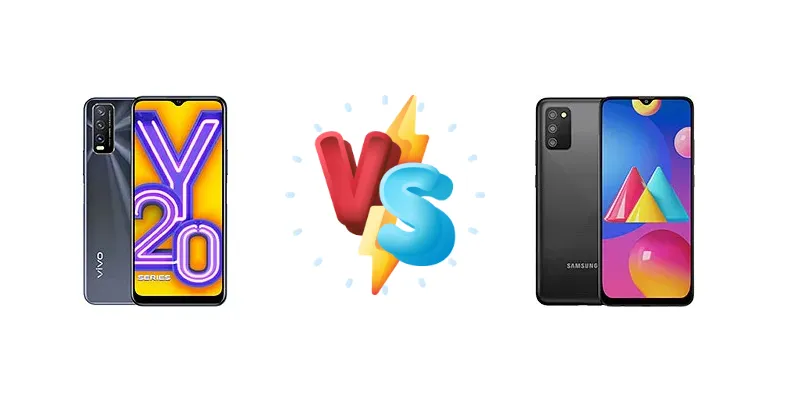
The vivo Y20i and Samsung Galaxy M02s represent the fiercely competitive entry-level smartphone market. Both aim to deliver essential smartphone functionality at an accessible price point, but they achieve this with different approaches to chipset technology and charging capabilities. This comparison dissects the core differences to determine which device offers the best value for budget-conscious consumers.
🏆 Quick Verdict
For the average user prioritizing responsiveness and future-proofing, the vivo Y20i is the better choice. Its Snapdragon 460, built on an 11nm process, offers a noticeable performance advantage over the Samsung Galaxy M02s’ Snapdragon 450, despite the similar clock speeds. While the M02s is still functional, the Y20i provides a smoother experience for everyday tasks.
| Network |
|---|
| 2G bands | GSM 850 / 900 / 1800 / 1900 | GSM 850 / 900 / 1800 / 1900 |
| 3G bands | HSDPA 850 / 900 / 2100 | HSDPA 850 / 900 / 2100 |
| 4G bands | 1, 3, 5, 7, 8, 38, 40, 41 | 1, 3, 5, 7, 8, 20, 28, 38, 40, 41 |
| Speed | HSPA, LTE | HSPA 42.2/5.76 Mbps, LTE Cat4 150/50 Mbps |
| Technology | GSM / HSPA / LTE | GSM / HSPA / LTE |
| Launch |
|---|
| Announced | 2020, August 26. Released 2020, September 03 | 2021, January 07 |
| Status | Discontinued | Available. Released 2021, January 19 |
| Body |
|---|
| Build | Glass front, plastic back, plastic frame | Glass front, plastic back, plastic frame |
| Dimensions | 164.4 x 76.3 x 8.4 mm (6.47 x 3.00 x 0.33 in) | 164.2 x 75.9 x 9.1 mm (6.46 x 2.99 x 0.36 in) |
| SIM | Nano-SIM + Nano-SIM | · Nano-SIM· Nano-SIM + Nano-SIM |
| Weight | 192.3 g (6.77 oz) | 196 g (6.91 oz) |
| Display |
|---|
| Resolution | 720 x 1600 pixels, 20:9 ratio (~270 ppi density) | 720 x 1600 pixels, 20:9 ratio (~270 ppi density) |
| Size | 6.51 inches, 102.3 cm2 (~81.6% screen-to-body ratio) | 6.5 inches, 102.0 cm2 (~81.8% screen-to-body ratio) |
| Type | IPS LCD | PLS LCD |
| Platform |
|---|
| CPU | Octa-core (4x1.8 GHz Kryo 240 & 4x1.6 GHz Kryo 240) | Octa-core 1.8 GHz Cortex-A53 |
| Chipset | Qualcomm SM4250 Snapdragon 460 (11 nm) | Qualcomm SDM450 Snapdragon 450 (14 nm) |
| GPU | Adreno 610 | Adreno 506 |
| OS | Android 10, Funtouch 10.5 | Android 10 |
| Memory |
|---|
| Card slot | microSDXC (dedicated slot) | microSDXC (dedicated slot) |
| Internal | 64GB 3GB RAM, 64GB 4GB RAM | 32GB 3GB RAM, 64GB 4GB RAM |
| | eMMC 5.1 | eMMC 5.1 |
| Main Camera |
|---|
| - | Go |
| Features | LED flash, HDR | LED flash |
| Single | 3.15 MP | - |
| Triple | 13 MP, f/1.8, (wide), PDAF
2 MP (macro)
Auxiliary lens | 13 MP, f/2.2, (wide), AF
2 MP (macro)
Auxiliary lens |
| Video | 1080p@30fps | 1080p@30fps |
| Selfie camera |
|---|
| Single | 8 MP, (wide) | 5 MP, f/2.2 |
| Video | 1080p@30fps | - |
| Sound |
|---|
| 3.5mm jack | Yes | Yes |
| 35mm jack | Yes | Yes |
| Loudspeaker | Yes | Yes |
| Comms |
|---|
| Bluetooth | 5.0, A2DP, LE | Yes |
| NFC | No | No |
| Positioning | GPS, GLONASS, BDS | GPS, GLONASS, GALILEO, BDS |
| Radio | FM radio | FM radio |
| USB | microUSB 2.0, OTG | Yes |
| WLAN | Wi-Fi 802.11 a/b/g/n/ac, dual-band, Wi-Fi Direct | Wi-Fi 802.11 b/g/n, Wi-Fi Direct |
| Features |
|---|
| Browser | WAP 2.0/xHTML, HTML (PocketIE) | - |
| Sensors | Fingerprint (side-mounted), accelerometer, proximity | Accelerometer, proximity |
| Battery |
|---|
| Charging | 18W wired | 15W wired |
| Stand-by | Up to 450 h | - |
| Talk time | Up to 6 h 30 min | - |
| Type | 5000 mAh | Li-Po 5000 mAh |
| Misc |
|---|
| Colors | Dawn White, Nebula Blue | Black, Blue, Red |
| Models | V2027, V2032 | SM-M025F/DS, SM-M025F |
| Price | About 130 EUR | About 100 EUR |
| SAR | 0.61 W/kg (head) 1.81 W/kg (body) | 0.52 W/kg (head) |
| SAR EU | - | 0.40 W/kg (head) 1.37 W/kg (body) |
vivo Y20i
- More powerful Snapdragon 460 chipset
- Faster 18W wired charging
- Potentially better power efficiency
- Brand recognition isn't as strong as Samsung
- Camera quality likely similar to M02s without further specs
Samsung Galaxy M02s
- Established Samsung brand reputation
- Potentially lower price point
- Wide availability
- Older Snapdragon 450 chipset
- Slower 15W wired charging
- Less efficient processor
Display Comparison
Neither device boasts a standout display. Both likely feature LCD panels, typical for this price bracket. The focus here isn't on visual fidelity, but on basic usability. Without specific display specs, it's reasonable to assume similar resolutions and brightness levels. The real difference lies elsewhere.
Camera Comparison
Both phones likely feature basic camera setups geared towards casual photography. Without detailed sensor information, it’s difficult to make a definitive judgment. However, the market segment suggests both will rely heavily on software processing to enhance image quality. The presence of a 2MP macro lens on both devices is largely a marketing tactic, offering limited practical benefit due to the small sensor size and lack of optical image stabilization. The primary sensor quality will be the deciding factor, but without specific details, it's a toss-up.
Performance
The core distinction between these phones is the chipset. The vivo Y20i’s Qualcomm SM4250 Snapdragon 460 (11nm) represents a generational leap over the Samsung Galaxy M02s’ Snapdragon 450 (14nm). The 11nm fabrication process allows for greater transistor density and improved power efficiency, translating to better sustained performance and potentially less thermal throttling. While both CPUs are octa-core and share a similar peak clock speed of 1.8 GHz, the Snapdragon 460’s Kryo 240 cores are architecturally more advanced than the Cortex-A53 cores in the Snapdragon 450. This means the Y20i will handle multitasking and app launches more smoothly. The Snapdragon 460 also features an upgraded GPU, offering a better gaming experience, though still limited to less demanding titles.
Battery Life
Battery life will be heavily influenced by usage patterns, but the vivo Y20i’s 18W wired charging offers a slight advantage over the Samsung Galaxy M02s’ 15W charging. While neither offers incredibly fast charging, the Y20i will replenish its battery more quickly. The actual battery capacity is not specified, but given the price point, both are likely in the 4000-5000 mAh range. The Snapdragon 460’s improved power efficiency may also contribute to slightly longer battery life on the Y20i, offsetting any potential capacity differences.
Buying Guide
Buy the vivo Y20i if you need a phone that feels more responsive for multitasking and light gaming, and if you value slightly faster charging speeds. It’s ideal for users who want a device that won’t feel outdated quickly. Buy the Samsung Galaxy M02s if you prioritize brand recognition and are looking for the absolute lowest possible price, understanding that performance will be more limited and the phone may struggle with demanding applications.
Frequently Asked Questions
❓ Will the Snapdragon 460 in the vivo Y20i handle popular games like PUBG Mobile?
The Snapdragon 460 can run PUBG Mobile, but you'll likely need to play on lower graphics settings to maintain a stable frame rate. It's not a gaming powerhouse, but it's a step up from the Snapdragon 450 in the M02s, offering a slightly smoother experience.
❓ Is the 18W charging on the vivo Y20i significantly faster than the 15W charging on the Samsung Galaxy M02s?
While not a massive difference, the 18W charging on the Y20i will noticeably reduce charging times. Expect a roughly 15-20% faster 0-100% charge compared to the M02s, which can be convenient for users who need to quickly top up their battery.
❓ Does the Samsung Galaxy M02s have any advantages over the vivo Y20i besides brand recognition?
The M02s may be available at a slightly lower price point in some markets. However, this price difference is often offset by the Y20i's superior performance and faster charging capabilities. Availability and specific carrier deals could also be a factor.