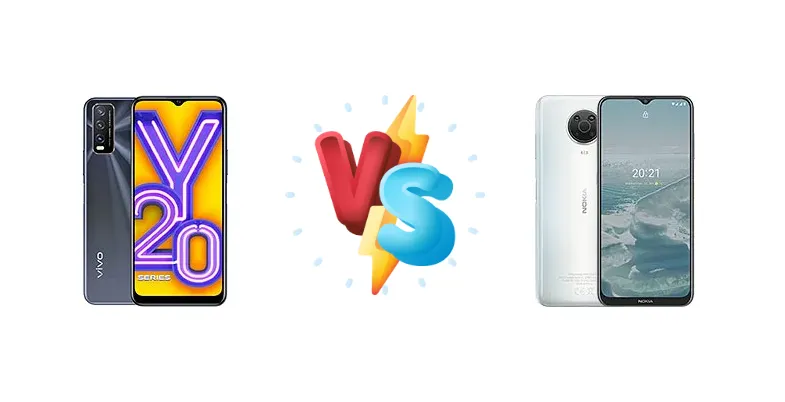
The sub-$150 smartphone market is fiercely competitive. The vivo Y20i and Nokia G20 both aim to deliver essential smartphone functionality at an accessible price point, but they take different approaches to achieving this. The Y20i leverages Qualcomm's Snapdragon 460, while the G20 opts for MediaTek's Helio G35. This comparison dissects the key differences to determine which device offers the best value.
🏆 Quick Verdict
For most users, the vivo Y20i emerges as the stronger choice. Its Snapdragon 460 chipset, built on a more efficient 11nm process, provides a noticeable performance advantage over the Nokia G20’s Helio G35. While the Nokia G20 offers a slightly larger battery, the Y20i’s faster 18W charging mitigates this difference, making it the more practical option.
| Network |
|---|
| 2G bands | GSM 850 / 900 / 1800 / 1900 | GSM 850 / 900 / 1800 / 1900 |
| 3G bands | HSDPA 850 / 900 / 2100 | HSDPA 850 / 900 / 1900 / 2100 - International |
| 4G bands | 1, 3, 5, 7, 8, 38, 40, 41 | 1, 3, 5, 7, 8, 20, 28, 38, 40, 41 - International |
| Speed | HSPA, LTE | HSPA 42.2/5.76 Mbps, LTE Cat4 150/50 Mbps |
| Technology | GSM / HSPA / LTE | GSM / HSPA / LTE |
| | - | 1, 2, 3, 4, 5, 7, 8, 12, 17, 28, 66 - LATAM |
| Launch |
|---|
| Announced | 2020, August 26. Released 2020, September 03 | 2021, April 08 |
| Status | Discontinued | Available. Released 2021, May 17 |
| Body |
|---|
| Build | Glass front, plastic back, plastic frame | - |
| Dimensions | 164.4 x 76.3 x 8.4 mm (6.47 x 3.00 x 0.33 in) | 164.9 x 76 x 9.2 mm (6.49 x 2.99 x 0.36 in) |
| SIM | Nano-SIM + Nano-SIM | · Nano-SIM· Nano-SIM + Nano-SIM |
| Weight | 192.3 g (6.77 oz) | 197 g (6.95 oz) |
| | - | Splash protection |
| Display |
|---|
| Resolution | 720 x 1600 pixels, 20:9 ratio (~270 ppi density) | 720 x 1600 pixels, 20:9 ratio (~269 ppi density) |
| Size | 6.51 inches, 102.3 cm2 (~81.6% screen-to-body ratio) | 6.52 inches, 102.6 cm2 (~81.9% screen-to-body ratio) |
| Type | IPS LCD | IPS LCD |
| Platform |
|---|
| CPU | Octa-core (4x1.8 GHz Kryo 240 & 4x1.6 GHz Kryo 240) | Octa-core (4x2.3 GHz Cortex-A53 & 4x1.8 GHz Cortex-A53) |
| Chipset | Qualcomm SM4250 Snapdragon 460 (11 nm) | Mediatek MT6765G Helio G35 (12 nm) |
| GPU | Adreno 610 | PowerVR GE8320 |
| OS | Android 10, Funtouch 10.5 | Android 11, upgradable to Android 13 |
| Memory |
|---|
| Card slot | microSDXC (dedicated slot) | microSDXC (dedicated slot) |
| Internal | 64GB 3GB RAM, 64GB 4GB RAM | 64GB 4GB RAM, 128GB 4GB RAM |
| | eMMC 5.1 | - |
| Main Camera |
|---|
| Features | LED flash, HDR | LED flash, HDR, panorama |
| Quad | - | 48 MP, f/1.8, (wide), PDAF
5 MP, (ultrawide)
2 MP (macro)
Auxiliary lens |
| Single | 3.15 MP | 8 MP, (wide) |
| Triple | 13 MP, f/1.8, (wide), PDAF
2 MP (macro)
Auxiliary lens | - |
| Video | 1080p@30fps | 1080p@30fps |
| Selfie camera |
|---|
| Single | 8 MP, (wide) | 8 MP, (wide) |
| Video | 1080p@30fps | 1080p@30fps |
| Sound |
|---|
| 3.5mm jack | Yes | Yes |
| 35mm jack | Yes | Yes |
| Loudspeaker | Yes | Yes |
| Comms |
|---|
| Bluetooth | 5.0, A2DP, LE | 5.0, A2DP, LE |
| NFC | No | Yes (market/region dependent) |
| Positioning | GPS, GLONASS, BDS | GPS, GLONASS, BDS |
| Radio | FM radio | FM radio |
| USB | microUSB 2.0, OTG | USB Type-C 2.0, OTG |
| WLAN | Wi-Fi 802.11 a/b/g/n/ac, dual-band, Wi-Fi Direct | Wi-Fi 802.11 b/g/n |
| Features |
|---|
| Browser | WAP 2.0/xHTML, HTML (PocketIE) | - |
| Sensors | Fingerprint (side-mounted), accelerometer, proximity | Fingerprint (side-mounted), accelerometer, gyro, proximity |
| Battery |
|---|
| Charging | 18W wired | 10W wired |
| Stand-by | Up to 450 h | - |
| Talk time | Up to 6 h 30 min | - |
| Type | 5000 mAh | Li-Po 5050 mAh |
| Misc |
|---|
| Colors | Dawn White, Nebula Blue | Glacier, Night |
| Models | V2027, V2032 | TA-1336, TA-1343, TA-1347, TA-1372, TA-1365 |
| Price | About 130 EUR | About 90 EUR |
| SAR | 0.61 W/kg (head) 1.81 W/kg (body) | 1.01 W/kg (head) 1.02 W/kg (body) |
| SAR EU | - | 0.49 W/kg (head) 1.13 W/kg (body) |
vivo Y20i
- More efficient Snapdragon 460 chipset
- Faster 18W charging
- Likely smoother multitasking experience
- Potentially smaller battery capacity
- May lack some software features found on Nokia
Nokia G20
- Potentially longer battery life (depending on usage)
- Clean Android experience (typical of Nokia)
- Generally lower price point
- Less powerful Helio G35 chipset
- Slower 10W charging
- May struggle with demanding apps
Display Comparison
Neither device boasts a standout display. Both likely utilize LCD panels, a common cost-saving measure in this segment. However, the focus here is on the underlying processors, as display specs are not provided. The absence of high refresh rates or advanced panel technologies like AMOLED is expected at this price point. Bezels are likely comparable, prioritizing affordability over a premium aesthetic.
Camera Comparison
Without detailed sensor information, a direct camera comparison is difficult. However, it’s safe to assume both phones feature basic camera setups geared towards casual photography. The market segment suggests both will include a primary sensor, likely around 13MP, and potentially depth or macro sensors of lower resolution. Image processing will likely be the differentiating factor, with vivo often prioritizing vibrant, social media-ready images, while Nokia tends towards a more natural color profile. The absence of Optical Image Stabilization (OIS) is expected on both devices.
Performance
The core difference lies in the chipsets. The vivo Y20i’s Qualcomm Snapdragon 460 (11nm) offers a significant architectural advantage over the Nokia G20’s MediaTek Helio G35 (12nm). The 11nm process generally translates to better power efficiency and thermal performance. While both are octa-core CPUs, the Snapdragon 460’s Kryo 240 cores, split into 1.8GHz and 1.6GHz clusters, are generally more efficient than the G20’s Cortex-A53 configuration (2.3GHz & 1.8GHz). The G35’s higher clock speed doesn’t necessarily equate to better real-world performance due to the less efficient architecture. This means the Y20i will likely handle multitasking and app loading with greater ease.
Battery Life
The Nokia G20 likely has a larger battery capacity than the Y20i, but this advantage is partially offset by the Y20i’s faster 18W charging compared to the G20’s 10W charging. While a larger battery *can* translate to longer runtime, the Snapdragon 460’s superior power efficiency in the Y20i narrows the gap. The 18W charging on the Y20i will significantly reduce the time spent tethered to a wall outlet, offering a more convenient user experience. A full charge on the G20 will take considerably longer.
Buying Guide
Buy the vivo Y20i if you prioritize responsiveness and smoother multitasking, even if it means slightly less battery capacity. This phone is ideal for users who frequently switch between apps, browse the web, or enjoy casual gaming. Buy the Nokia G20 if maximizing battery life is your absolute top priority and you primarily use your phone for basic tasks like calls, texts, and light social media. The G20 is best suited for users who rarely plug in their phone and need it to last through multiple days on a single charge.
Frequently Asked Questions
❓ Will the Nokia G20 struggle with popular apps like Facebook or WhatsApp?
While the Nokia G20 can run these apps, the Helio G35 chipset may exhibit noticeable lag when switching between them or when using multiple apps simultaneously. The Snapdragon 460 in the vivo Y20i will provide a smoother experience for these common tasks.
❓ How long will it take to fully charge each phone?
The vivo Y20i’s 18W charging will likely take around 2-2.5 hours for a full charge. The Nokia G20’s 10W charging will take significantly longer, potentially 3.5-4 hours or more, depending on battery capacity.
❓ Is the performance difference between the Snapdragon 460 and Helio G35 noticeable in everyday use?
Yes, the difference is noticeable. The Snapdragon 460’s more efficient architecture and optimized cores result in snappier app launches, smoother scrolling, and a more responsive overall user experience. The Helio G35 may feel sluggish in comparison, especially when multitasking.
❓ Which phone is better for playing mobile games?
The vivo Y20i is the better choice for gaming. The Snapdragon 460 offers superior GPU performance compared to the Helio G35, allowing for smoother frame rates and a more enjoyable gaming experience, even on less demanding titles. Don't expect high-end gaming performance from either device, however.