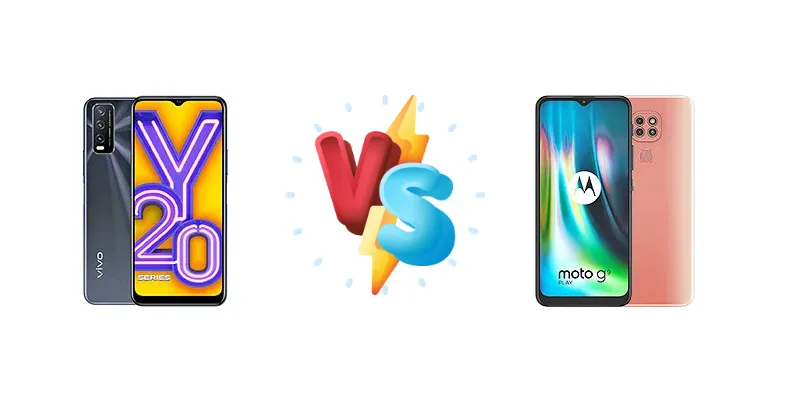
The sub-$200 smartphone market is fiercely competitive. Both the vivo Y20i and Motorola Moto G9 Play aim to deliver essential features at an accessible price point. However, they take different approaches, with Motorola prioritizing display quality and vivo focusing on a streamlined experience. This comparison dissects their key specifications to determine which device offers the best overall value.
🏆 Quick Verdict
For most users, the Motorola Moto G9 Play emerges as the stronger choice. Its Snapdragon 662 chipset provides a noticeable performance uplift over the Y20i’s Snapdragon 460, and the measured 465 nits of brightness makes it more usable outdoors. While the Y20i is a capable device, the G9 Play offers a better balance of power and usability.
| Network |
|---|
| 2G bands | GSM 850 / 900 / 1800 / 1900 | GSM 850 / 900 / 1800 / 1900 |
| 3G bands | HSDPA 850 / 900 / 2100 | HSDPA 850 / 900 / 1900 / 2100 |
| 4G bands | 1, 3, 5, 7, 8, 38, 40, 41 | 1, 2, 3, 5, 7, 8, 18, 19, 20, 26, 28, 38, 40, 41 |
| EDGE | - | Class 10 |
| GPRS | - | Class 10 |
| Speed | HSPA, LTE | HSPA 42.2/5.76 Mbps, LTE Cat4 150/50 Mbps |
| Technology | GSM / HSPA / LTE | GSM / HSPA / LTE |
| Launch |
|---|
| Announced | 2020, August 26. Released 2020, September 03 | 2020, August 24. Released 2020, August 28 |
| Status | Discontinued | Discontinued |
| Body |
|---|
| Build | Glass front, plastic back, plastic frame | Glass front, plastic back, plastic frame |
| Dimensions | 164.4 x 76.3 x 8.4 mm (6.47 x 3.00 x 0.33 in) | 165.2 x 75.7 x 9.2 mm (6.50 x 2.98 x 0.36 in) |
| Keyboard | - | QWERTY |
| SIM | Nano-SIM + Nano-SIM | · Nano-SIM· Nano-SIM + Nano-SIM |
| Weight | 192.3 g (6.77 oz) | 200 g (7.05 oz) |
| | - | Water-repellent coating |
| Display |
|---|
| Resolution | 720 x 1600 pixels, 20:9 ratio (~270 ppi density) | 720 x 1600 pixels, 20:9 ratio (~269 ppi density) |
| Size | 6.51 inches, 102.3 cm2 (~81.6% screen-to-body ratio) | 6.5 inches, 102.8 cm2 (~82.2% screen-to-body ratio) |
| Type | IPS LCD | IPS LCD |
| Platform |
|---|
| CPU | Octa-core (4x1.8 GHz Kryo 240 & 4x1.6 GHz Kryo 240) | Octa-core (4x2.0 GHz Kryo 260 Gold & 4x1.8 GHz Kryo 260 Silver) |
| Chipset | Qualcomm SM4250 Snapdragon 460 (11 nm) | Qualcomm SM6115 Snapdragon 662 (11 nm) |
| GPU | Adreno 610 | Adreno 610 |
| OS | Android 10, Funtouch 10.5 | Android 10, upgradable to Android 11 |
| Memory |
|---|
| Card slot | microSDXC (dedicated slot) | microSDXC (uses shared SIM slot) |
| Internal | 64GB 3GB RAM, 64GB 4GB RAM | 64GB 4GB RAM, 128GB 4GB RAM |
| | eMMC 5.1 | - |
| Main Camera |
|---|
| Features | LED flash, HDR | LED flash, HDR, panorama |
| Single | 3.15 MP | 1.3 MP |
| Triple | 13 MP, f/1.8, (wide), PDAF
2 MP (macro)
Auxiliary lens | 48 MP, f/1.7, (wide), 1/2.0", 0.8µm, PDAF
2 MP (macro)
Auxiliary lens |
| Video | 1080p@30fps | 1080p@30/60fps |
| Selfie camera |
|---|
| Features | - | HDR |
| Single | 8 MP, (wide) | 8 MP, f/2.2, 1.12µm |
| Video | 1080p@30fps | 1080p@30fps |
| Sound |
|---|
| 3.5mm jack | Yes | Yes |
| 35mm jack | Yes | Yes |
| Loudspeaker | Yes | Yes |
| Comms |
|---|
| Bluetooth | 5.0, A2DP, LE | 5.0, A2DP, LE |
| Infrared port | - | Yes |
| NFC | No | Yes |
| Positioning | GPS, GLONASS, BDS | GPS, GLONASS, GALILEO |
| Radio | FM radio | FM radio |
| USB | microUSB 2.0, OTG | USB Type-C 2.0 |
| WLAN | Wi-Fi 802.11 a/b/g/n/ac, dual-band, Wi-Fi Direct | Wi-Fi 802.11 a/b/g/n/ac, dual-band, Wi-Fi Direct |
| Features |
|---|
| Browser | WAP 2.0/xHTML, HTML (PocketIE) | WAP 2.0/xHTML, HTML (PocketIE) |
| Sensors | Fingerprint (side-mounted), accelerometer, proximity | Fingerprint (rear-mounted), accelerometer, gyro, proximity |
| Battery |
|---|
| Charging | 18W wired | 20W wired |
| Stand-by | Up to 450 h | - |
| Talk time | Up to 6 h 30 min | - |
| Type | 5000 mAh | Li-Po 5000 mAh |
| Misc |
|---|
| Colors | Dawn White, Nebula Blue | Forest Green, Sapphire Blue, Spring Pink |
| Models | V2027, V2032 | XT2083, XT2083-1 |
| Price | About 130 EUR | About 430 EUR |
| SAR | 0.61 W/kg (head) 1.81 W/kg (body) | - |
| Tests |
|---|
| Camera | - |
Photo / Video |
| Display | - |
Contrast ratio: 1944:1 |
| Loudspeaker | - |
-27.6 LUFS (Good)
|
| Performance | - |
AnTuTu: 170064 (v8)
GeekBench: 1402 (v5.1)
GFXBench: 13fps (ES 3.1 onscreen) |
vivo Y20i
- Potentially lower price point
- Simple and streamlined user experience
- Qualcomm Snapdragon 460 is power efficient
- Less powerful Snapdragon 460 chipset
- Display specifications are unknown and likely inferior
- Limited performance for demanding tasks
Motorola Moto G9 Play
- More powerful Snapdragon 662 chipset
- Brighter display (465 nits)
- Faster 20W wired charging
- May be slightly more expensive
- Motorola’s software can include bloatware
- Camera specs are not detailed
Display Comparison
The Motorola Moto G9 Play boasts a significant advantage in display quality, achieving a measured peak brightness of 465 nits. This is crucial for outdoor visibility, a common pain point in this price segment. Both phones share a 1944:1 contrast ratio, suggesting similar color reproduction capabilities, but the G9 Play’s higher brightness translates to a more vibrant and engaging viewing experience. The Y20i’s display specifications are not provided, making a direct comparison difficult, but it’s reasonable to assume it falls behind the G9 Play in brightness.
Camera Comparison
Both devices list 'Photo / Video' capabilities, but lack specific details regarding sensor size or megapixel count. Given the price bracket, it’s unlikely either phone features a particularly impressive camera system. The absence of detailed camera specs suggests that image quality is not a primary selling point for either device. Focusing on the chipset, the Snapdragon 662 in the Moto G9 Play benefits from a more capable ISP (Image Signal Processor), potentially leading to slightly better image processing and noise reduction compared to the Snapdragon 460 in the Y20i. However, without further information, a definitive comparison is impossible.
Performance
The core difference between these two devices lies in their chipsets. The Motorola Moto G9 Play is powered by the Qualcomm Snapdragon 662 (11nm), featuring a more powerful CPU configuration – octa-core (4x2.0 GHz Kryo 260 Gold & 4x1.8 GHz Kryo 260 Silver) – compared to the vivo Y20i’s Snapdragon 460 (11nm) with its octa-core (4x1.8 GHz Kryo 240 & 4x1.6 GHz Kryo 240). The Snapdragon 662’s Kryo 260 Gold cores offer a performance boost for demanding applications, resulting in smoother multitasking and a more responsive user interface. While both are 11nm chips, the architectural improvements in the 662 provide a tangible advantage. The Y20i will handle basic tasks adequately, but the G9 Play is better equipped for more intensive workloads.
Battery Life
The Motorola Moto G9 Play supports 20W wired charging, while the vivo Y20i offers 18W wired charging. While the difference of 2W may seem minor, it can translate to a slightly faster charging time. Battery capacity is not specified for either device, but the faster charging speed of the G9 Play provides a convenience advantage. The actual 0-100% charging time will depend on the battery capacity, but the G9 Play is likely to reach full charge quicker. The Snapdragon 662’s efficiency, combined with the 20W charging, gives the G9 Play a slight edge in battery management.
Buying Guide
Buy the vivo Y20i if you prioritize a simple, uncluttered Android experience and are primarily focused on basic tasks like calling, texting, and light social media use. Its lower price point makes it ideal for first-time smartphone users or those on a very tight budget. Buy the Motorola Moto G9 Play if you value performance for occasional gaming, streaming, or multitasking, and appreciate a brighter, more visible display for outdoor use. The G9 Play is the better option for users who demand more from their smartphone.
Frequently Asked Questions
❓ Will the Motorola Moto G9 Play struggle with graphically intensive games like PUBG Mobile?
While the Snapdragon 662 isn't a gaming powerhouse, it's capable of running PUBG Mobile at medium settings with reasonable frame rates. Expect some occasional frame drops during intense action, but it's a playable experience. The Y20i's Snapdragon 460 will likely require even lower settings and may exhibit more noticeable lag.
❓ Does the Motorola Moto G9 Play's software come with a lot of pre-installed bloatware?
Motorola has historically included some pre-installed apps, often referred to as bloatware. However, the amount has decreased in recent years. Many of these apps can be uninstalled, freeing up storage space and reducing clutter. The Y20i's software experience is likely to be cleaner, but may lack some of the customization options found in Motorola's software.
❓ How significant is the difference in charging speed between 18W and 20W?
The difference between 18W and 20W charging isn't massive, but it's noticeable. Expect the Moto G9 Play to charge approximately 10-15% faster than the Y20i, assuming similar battery capacities. This translates to less time tethered to a wall charger.