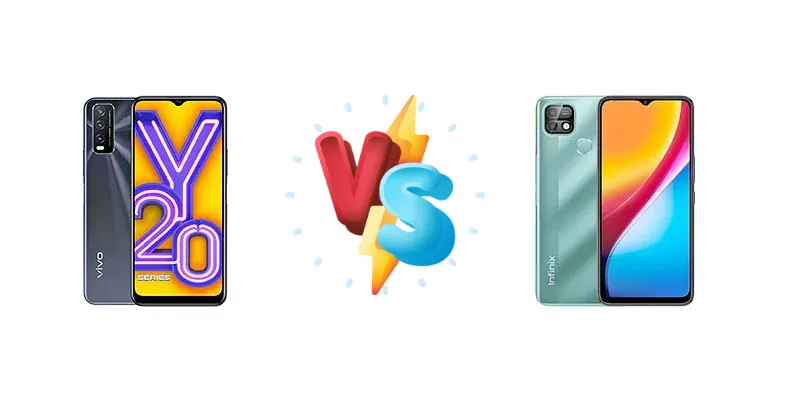
The sub-$150 smartphone market is fiercely competitive. Both the vivo Y20i and the Infinix Smart 5 Pro aim to deliver essential smartphone functionality at an accessible price point. However, they take drastically different approaches to achieving this, primarily through their chipset choices. This comparison dissects those differences, revealing which phone offers the best balance of performance, features, and value.
🏆 Quick Verdict
For the average user prioritizing responsiveness and future-proofing, the vivo Y20i emerges as the stronger choice. Its Qualcomm Snapdragon 460, built on an 11nm process, provides a noticeable performance advantage over the Infinix Smart 5 Pro’s older, 28nm Unisoc SC9863A, despite the latter’s lower price.
| Network |
|---|
| 2G bands | GSM 850 / 900 / 1800 / 1900 | GSM 850 / 900 / 1800 / 1900 |
| 3G bands | HSDPA 850 / 900 / 2100 | HSDPA 850 / 900 / 2100 |
| 4G bands | 1, 3, 5, 7, 8, 38, 40, 41 | 1, 3, 5, 8, 38, 40, 41 |
| Speed | HSPA, LTE | HSPA 21.1/5.76 Mbps, LTE Cat4 150/50 Mbps |
| Technology | GSM / HSPA / LTE | GSM / HSPA / LTE |
| | - | 1, 2, 3, 4, 5, 7, 8, 20, 28, 38, 41, 40, 66 |
| Launch |
|---|
| Announced | 2020, August 26. Released 2020, September 03 | 2021, November 17 |
| Status | Discontinued | Available. Released 2021, November 17 |
| Body |
|---|
| Build | Glass front, plastic back, plastic frame | Glass front, plastic back, plastic frame |
| Dimensions | 164.4 x 76.3 x 8.4 mm (6.47 x 3.00 x 0.33 in) | 164.4 x 75.6 x 9.5 mm (6.47 x 2.98 x 0.37 in) |
| SIM | Nano-SIM + Nano-SIM | Nano-SIM + Nano-SIM |
| Weight | 192.3 g (6.77 oz) | - |
| Display |
|---|
| Resolution | 720 x 1600 pixels, 20:9 ratio (~270 ppi density) | 720 x 1600 pixels, 20:9 ratio (~269 ppi density) |
| Size | 6.51 inches, 102.3 cm2 (~81.6% screen-to-body ratio) | 6.52 inches, 102.6 cm2 (~82.6% screen-to-body ratio) |
| Type | IPS LCD | IPS LCD, 500 nits (peak) |
| Platform |
|---|
| CPU | Octa-core (4x1.8 GHz Kryo 240 & 4x1.6 GHz Kryo 240) | Octa-core (4x1.6 GHz Cortex-A55 & 4x1.2 GHz Cortex-A55) |
| Chipset | Qualcomm SM4250 Snapdragon 460 (11 nm) | Unisoc SC9863A (28 nm) |
| GPU | Adreno 610 | IMG8322 |
| OS | Android 10, Funtouch 10.5 | Android 11 (Go edition), XOS 7.6 |
| Memory |
|---|
| Card slot | microSDXC (dedicated slot) | microSDXC (dedicated slot) |
| Internal | 64GB 3GB RAM, 64GB 4GB RAM | 32GB 2GB RAM |
| | eMMC 5.1 | eMMC 5.1 |
| Main Camera |
|---|
| Dual | - | 13 MP, f/1.8, AF
Auxiliary lens |
| Features | LED flash, HDR | Quad-LED flash |
| Single | 3.15 MP | 8 MP |
| Triple | 13 MP, f/1.8, (wide), PDAF
2 MP (macro)
Auxiliary lens | - |
| Video | 1080p@30fps | 1440p@30fps |
| Selfie camera |
|---|
| Features | - | Dual-LED flash |
| Single | 8 MP, (wide) | 8 MP |
| Video | 1080p@30fps | 1080p@30fps |
| Sound |
|---|
| 3.5mm jack | Yes | Yes |
| 35mm jack | Yes | Yes |
| Loudspeaker | Yes | Yes |
| Comms |
|---|
| Bluetooth | 5.0, A2DP, LE | 4.2, A2DP |
| NFC | No | No |
| Positioning | GPS, GLONASS, BDS | GPS |
| Radio | FM radio | FM radio |
| USB | microUSB 2.0, OTG | microUSB 2.0 |
| WLAN | Wi-Fi 802.11 a/b/g/n/ac, dual-band, Wi-Fi Direct | Wi-Fi 802.11 b/g/n |
| Features |
|---|
| Browser | WAP 2.0/xHTML, HTML (PocketIE) | - |
| Sensors | Fingerprint (side-mounted), accelerometer, proximity | Fingerprint (rear-mounted), accelerometer, proximity |
| Battery |
|---|
| Charging | 18W wired | 10W wired |
| Stand-by | Up to 450 h | - |
| Talk time | Up to 6 h 30 min | - |
| Type | 5000 mAh | 6000 mAh |
| Misc |
|---|
| Colors | Dawn White, Nebula Blue | Morandi Green, Heart of Ocean |
| Models | V2027, V2032 | - |
| Price | About 130 EUR | About 70 EUR |
| SAR | 0.61 W/kg (head) 1.81 W/kg (body) | - |
vivo Y20i
- More powerful Snapdragon 460 chipset
- Faster 18W charging
- Potentially better thermal management
- Likely slightly higher price
- May lack advanced features found on more expensive phones
Infinix Smart 5 Pro
- Lower price point
- Acceptable for basic smartphone tasks
- Large battery capacity (estimated)
- Less powerful Unisoc SC9863A chipset
- Slower 10W charging
- Potential for performance throttling
Display Comparison
Neither device boasts a standout display. Both likely utilize LCD panels, a common cost-saving measure in this segment. However, details regarding resolution and brightness are missing. The key difference lies under the hood: processing power impacts UI smoothness, which is more noticeable than minor display variations. The absence of high refresh rates on either device is expected at this price point.
Camera Comparison
Camera performance is likely to be similar, leaning towards basic functionality on both devices. Without sensor size or aperture information, it’s difficult to make definitive claims. However, the prevalence of 2MP macro and depth sensors on both phones suggests these are largely marketing features. Image quality will heavily rely on software processing, and neither device is expected to excel in low-light conditions. The Snapdragon 460’s ISP (Image Signal Processor) *may* offer slightly better processing capabilities, but the difference will likely be marginal.
Performance
The performance gap is the most significant differentiator. The vivo Y20i’s Qualcomm Snapdragon 460, fabricated on an 11nm process, offers a substantial advantage over the Infinix Smart 5 Pro’s Unisoc SC9863A (28nm). The Snapdragon 460’s Kryo 240 cores, with their split clock speeds (1.8GHz and 1.6GHz), provide a more efficient and powerful architecture. The Unisoc chip, while an octa-core design, utilizes less efficient Cortex-A55 cores across the board, and the larger 28nm node translates to higher power consumption and potentially more thermal throttling. This means the Y20i will handle multitasking and moderately demanding apps with greater ease.
Battery Life
While battery capacity isn’t specified, both phones likely feature around 5000mAh batteries, standard for this price range. The crucial difference is charging speed. The vivo Y20i supports 18W wired charging, allowing for significantly faster top-ups compared to the Infinix Smart 5 Pro’s slower 10W charging. This means the Y20i can recover from low battery levels much quicker, a practical advantage for users on the go. The more efficient Snapdragon 460 also contributes to potentially longer battery life during typical usage.
Buying Guide
Buy the vivo Y20i if you need a phone that feels responsive for everyday tasks like browsing, social media, and light gaming, and if you value a more efficient processor that won't overheat as quickly. Buy the Infinix Smart 5 Pro if your primary concern is absolute affordability and you only need a phone for very basic communication – calls, texts, and minimal app usage – and are willing to accept slower performance and potentially shorter battery life under load.
Frequently Asked Questions
❓ Will the Infinix Smart 5 Pro struggle with popular apps like WhatsApp and Facebook?
The Unisoc SC9863A chipset is designed for basic tasks. While it can run apps like WhatsApp and Facebook, you may experience noticeable lag and slower loading times, especially with multiple apps open simultaneously. The vivo Y20i’s Snapdragon 460 will provide a smoother experience.
❓ How long will it take to fully charge the vivo Y20i with the 18W charger?
While a precise time isn't available, the 18W charging should fully charge the vivo Y20i in approximately 2-3 hours, depending on the battery's initial state. This is considerably faster than the Infinix Smart 5 Pro, which will likely take 4+ hours with its 10W charger.
❓ Is the Snapdragon 460 in the vivo Y20i capable of playing mobile games?
The Snapdragon 460 can handle less demanding mobile games at lower settings. However, don't expect a high-framerate experience in graphically intensive titles like PUBG Mobile or Call of Duty. The Unisoc SC9863A will struggle even more with gaming.
❓ Does either phone support dual SIM functionality?
While not explicitly stated, both the vivo Y20i and Infinix Smart 5 Pro, given their target market, almost certainly support dual SIM functionality. This allows users to utilize two SIM cards simultaneously.