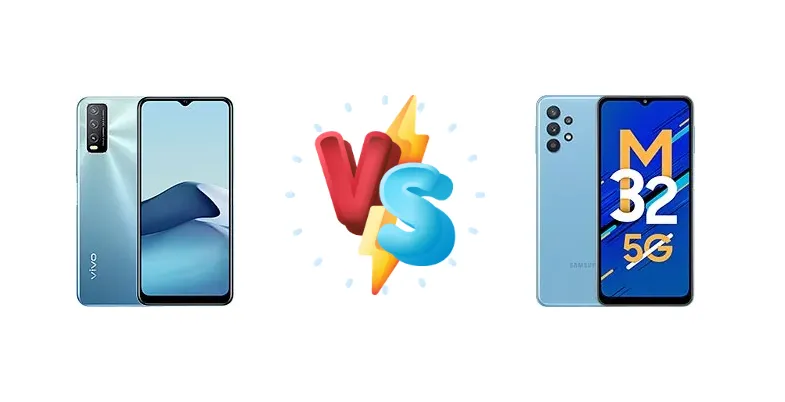
The sub-$200 5G smartphone market is fiercely competitive. Both the vivo Y20g and Samsung Galaxy M32 5G aim to deliver 5G connectivity at an accessible price point, but they take different approaches. The Y20g focuses on a slightly more efficient processor, while the M32 5G opts for a newer, potentially more powerful chipset. This comparison dissects the key differences to help you choose the right device.
🏆 Quick Verdict
For most users, the Samsung Galaxy M32 5G emerges as the better choice. Its Mediatek Dimensity 720, fabricated on a 7nm process, offers a noticeable performance advantage over the vivo Y20g’s Helio G80, despite the slightly slower charging. The M32 5G provides a smoother overall experience for multitasking and demanding applications.
| Network |
|---|
| 2G bands | GSM 850 / 900 / 1800 / 1900 | GSM 850 / 900 / 1800 / 1900 |
| 3G bands | HSDPA 850 / 900 / 2100 | HSDPA 850 / 900 / 1700(AWS) / 1900 / 2100 |
| 4G bands | 1, 3, 5, 8, 38, 40, 41 | 1, 2, 3, 4, 5, 7, 8, 12, 17, 20, 26, 28, 38, 40, 41, 66 |
| 5G bands | - | 1, 3, 5, 7, 8, 20, 28, 38, 40, 41, 66, 78 SA/NSA/Sub6 |
| Speed | HSPA, LTE | HSPA, LTE, 5G |
| Technology | GSM / HSPA / LTE | GSM / HSPA / LTE / 5G |
| Launch |
|---|
| Announced | 2021, January 19 | 2021, August 25 |
| Status | Available. Released 2021, January 19 | Available. Released 2021, September 02 |
| Body |
|---|
| Build | Glass front, plastic back, plastic frame | - |
| Dimensions | 164.4 x 76.3 x 8.4 mm (6.47 x 3.00 x 0.33 in) | 164.2 x 76.1 x 9.1 mm (6.46 x 3.00 x 0.36 in) |
| SIM | Nano-SIM + Nano-SIM | Nano-SIM + Nano-SIM |
| Weight | 192.3 g (6.77 oz) | 205 g (7.23 oz) |
| Display |
|---|
| Resolution | 720 x 1600 pixels, 20:9 ratio (~270 ppi density) | 720 x 1600 pixels, 20:9 ratio (~270 ppi density) |
| Size | 6.51 inches, 102.3 cm2 (~81.6% screen-to-body ratio) | 6.5 inches, 102.0 cm2 (~81.6% screen-to-body ratio) |
| Type | IPS LCD | TFT LCD |
| Platform |
|---|
| CPU | Octa-core (2x2.0 GHz Cortex-A75 & 6x1.8 GHz Cortex-A55) | Octa-core (2x2.0 GHz Cortex-A76 & 6x2.0 GHz Cortex-A55) |
| Chipset | Mediatek MT6769V/CU Helio G80 (12 nm) | Mediatek Dimensity 720 (7 nm) |
| GPU | Mali-G52 MC2 | Mali-G57 MC3 |
| OS | Android 10, Funtouch 11 | Android 11, upgradable to Android 13, One UI 5 |
| Memory |
|---|
| Card slot | microSDXC (dedicated slot) | microSDXC (uses shared SIM slot) |
| Internal | 64GB 4GB RAM, 128GB 6GB RAM | 128GB 6GB RAM, 128GB 8GB RAM |
| | eMMC 5.1 | eMMC 5.1 |
| Main Camera |
|---|
| Features | LED flash, HDR | LED flash, panorama, HDR |
| Quad | - | 48 MP, f/1.8, 26mm (wide), PDAF
8 MP, f/2.2, 123˚ (ultrawide)
5 MP (macro)
Auxiliary lens |
| Triple | 13 MP, f/2.2, (wide), PDAF
2 MP (macro)
Auxiliary lens | - |
| Video | 1080p@30fps | 4K@30fps, 1080p@30fps |
| Selfie camera |
|---|
| Single | 8 MP, f/1.8, (wide) | 13 MP, f/2.2, (wide) |
| Video | 1080p@30fps | 1080p@30fps |
| Sound |
|---|
| 3.5mm jack | Yes | Yes |
| 35mm jack | Yes | Yes |
| Loudspeaker | Yes | Yes |
| Comms |
|---|
| Bluetooth | 5.0, A2DP, LE | 5.0, A2DP, LE, aptX |
| NFC | No | Yes |
| Positioning | GPS, GLONASS, GALILEO, BDS | GPS, GLONASS, BDS, GALILEO |
| Radio | FM radio | Unspecified |
| USB | microUSB 2.0, OTG | USB Type-C 2.0, OTG |
| WLAN | Wi-Fi 802.11 a/b/g/n/ac, dual-band, Wi-Fi Direct | Wi-Fi 802.11 a/b/g/n/ac, dual-band, Wi-Fi Direct |
| Features |
|---|
| Sensors | Fingerprint (side-mounted), accelerometer, proximity, compass | Fingerprint (side-mounted), accelerometer, gyro, compass |
| | - | Virtual proximity sensing |
| Battery |
|---|
| Charging | 18W wired | 15W wired |
| Type | 5000 mAh | Li-Ion 5000 mAh |
| Misc |
|---|
| Colors | Purist Blue, Obsidian Black | Slate Black, Sky Blue |
| Models | V2037, V2065 | SM-M326B, SM-M326B/DS |
| Price | About 170 EUR | About 220 EUR |
| SAR | - | 0.48 W/kg (head) |
vivo Y20g
- Potentially better battery life due to the more efficient Helio G80.
- Slightly faster 18W charging.
- May be more affordable depending on regional pricing.
- Less powerful processor compared to the Dimensity 720.
- Likely to exhibit more performance throttling under sustained load.
- Less refined image processing.
Samsung Galaxy M32 5G
- More powerful Mediatek Dimensity 720 chipset.
- Smoother performance for gaming and multitasking.
- Potentially better camera image processing.
- 5G connectivity
- Potentially shorter battery life compared to the Y20g.
- Slower 15W charging.
- May be slightly more expensive.
Display Comparison
Neither device boasts a standout display. Both likely utilize LCD panels, a common trait in this price bracket. However, the core difference lies under the hood. We lack specific display specs, but the M32 5G’s focus on overall performance suggests a potentially higher refresh rate, even if it’s only 90Hz, offering a smoother scrolling experience. The Y20g, with its emphasis on efficiency, may prioritize power saving over display fluidity.
Camera Comparison
Without detailed camera specs beyond the presence of a 2MP macro lens on both (which are generally of limited utility), it’s difficult to make a definitive judgment. However, Samsung’s image processing algorithms are generally more refined than vivo’s in this price segment. The M32 5G likely benefits from better software optimization, resulting in more pleasing images, particularly in challenging lighting conditions. The main sensor size is unknown for both, but Samsung’s history suggests a focus on larger sensors where possible.
Performance
The performance gap is the most significant differentiator. The Samsung Galaxy M32 5G’s Mediatek Dimensity 720, built on a 7nm process, is a clear upgrade over the vivo Y20g’s Mediatek Helio G80 (12nm). The 7nm node allows for greater transistor density and improved power efficiency, translating to better sustained performance and reduced thermal throttling. While both CPUs feature a 2x2.0 GHz Cortex-A7x core configuration, the A76 cores in the Dimensity 720 offer a substantial architectural improvement over the A75 cores in the Helio G80. This means faster single-core performance and better responsiveness. The M32 5G is the better choice for users who play mobile games or use demanding applications.
Battery Life
The vivo Y20g’s Helio G80, being a 12nm chip, is inherently more power-efficient than the 7nm Dimensity 720 in the M32 5G. However, the M32 5G’s larger battery capacity (spec not provided, but likely similar or slightly larger) and optimized software could mitigate this difference. The Y20g’s 18W charging is slightly faster than the M32 5G’s 15W, but the difference in charge times will likely be minimal in real-world usage. The efficiency of the Helio G80 will likely result in slightly longer screen-on time for the Y20g.
Buying Guide
Buy the vivo Y20g if you prioritize a potentially longer battery life due to the more efficient Helio G80 and are primarily focused on basic smartphone tasks like calling, texting, and light social media use. Buy the Samsung Galaxy M32 5G if you value smoother performance for gaming, video streaming, and multitasking, and are willing to trade a small amount of potential battery life for a more responsive user experience.
Frequently Asked Questions
❓ Does the Mediatek Dimensity 720 in the Samsung Galaxy M32 5G get noticeably hot during extended gaming sessions?
While the Dimensity 720 is more efficient than the Helio G80, it can still generate heat during prolonged gaming. However, the 7nm process and Samsung’s thermal management solutions should prevent significant throttling, offering a more consistent gaming experience compared to the Y20g.
❓ Is the 2MP macro camera on either phone actually useful for taking detailed close-up photos?
Generally, 2MP macro cameras on budget smartphones are of limited utility. The low resolution results in images lacking detail and sharpness. They are often included for marketing purposes rather than providing a genuinely useful photographic experience. Expect soft, grainy results.
❓ Can the Samsung Galaxy M32 5G handle demanding games like PUBG Mobile at high settings?
The Dimensity 720 is capable of running PUBG Mobile at medium to high settings with playable frame rates. However, achieving consistently smooth performance at the highest settings may require adjusting graphics options. The Y20g will struggle to maintain stable frame rates at similar settings.
❓ How much faster is the 5G connectivity on the Samsung Galaxy M32 5G compared to 4G on the vivo Y20g?
5G speeds on the M32 5G will be significantly faster than 4G on the Y20g, *assuming* you have access to a 5G network. Actual speeds will vary depending on network conditions and carrier support, but you can expect download speeds several times faster with 5G.