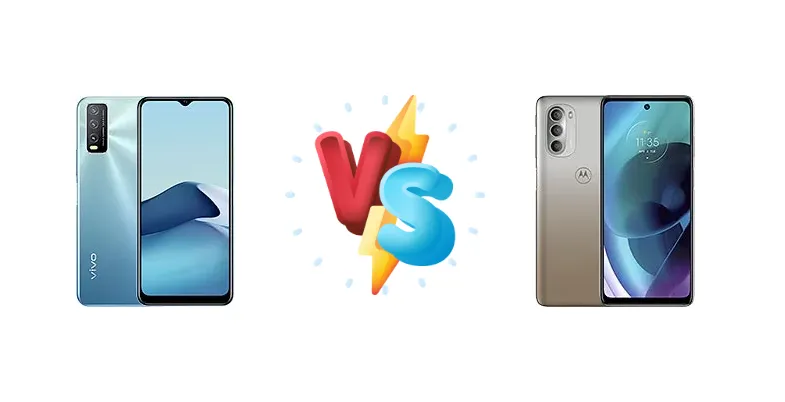
The sub-$200 5G smartphone market is heating up, with the vivo Y20g and Motorola Moto G51 5G vying for attention. While both offer 5G connectivity at an accessible price point, they take distinctly different approaches to achieving it. The Y20g relies on MediaTek’s Helio G80, while the Moto G51 5G leverages Qualcomm’s Snapdragon 480+ – a difference that significantly impacts performance and efficiency.
🏆 Quick Verdict
For the average user prioritizing consistent performance and a brighter display, the Motorola Moto G51 5G is the better choice. Its Snapdragon 480+ chipset, built on an 8nm process, offers a noticeable performance edge over the Y20g’s Helio G80, despite similar CPU core configurations. While both boast comparable battery endurance, the G51’s faster charging (in some regions) adds convenience.
| Network |
|---|
| 2G bands | GSM 850 / 900 / 1800 / 1900 | GSM 850 / 900 / 1800 / 1900 |
| 3G bands | HSDPA 850 / 900 / 2100 | HSDPA 800 / 850 / 900 / 1900 / 2100 - Europe, Asia, Saudi Arabia |
| 4G bands | 1, 3, 5, 8, 38, 40, 41 | 1, 2, 3, 5, 7, 8, 18, 20, 26, 28, 32, 38, 40, 41, 42, 43 - Europe/Asia |
| 5G bands | - | 1, 3, 5, 7, 8, 20, 28, 38, 40, 41, 77, 78 SA/NSA/Sub6 - Europe/Asia |
| Speed | HSPA, LTE | HSPA 42.2/5.76 Mbps, LTE Cat18 1200/150 Mbps, 5G |
| Technology | GSM / HSPA / LTE | GSM / HSPA / LTE / 5G |
| | - | 1, 5, 8, 28, 41, 78 SA/NSA/Sub6 - China |
| Launch |
|---|
| Announced | 2021, January 19 | 2021, November 03 |
| Status | Available. Released 2021, January 19 | Available. Released 2021, December 16 |
| Body |
|---|
| Build | Glass front, plastic back, plastic frame | Glass front, plastic frame, plastic back |
| Dimensions | 164.4 x 76.3 x 8.4 mm (6.47 x 3.00 x 0.33 in) | 170.5 x 76.5 x 9.1 mm (6.71 x 3.01 x 0.36 in) |
| SIM | Nano-SIM + Nano-SIM | Nano-SIM + Nano-SIM |
| Weight | 192.3 g (6.77 oz) | 208 g (7.34 oz) |
| | - | Water-repellent design |
| Display |
|---|
| Resolution | 720 x 1600 pixels, 20:9 ratio (~270 ppi density) | 1080 x 2400 pixels, 20:9 ratio (~387 ppi density) |
| Size | 6.51 inches, 102.3 cm2 (~81.6% screen-to-body ratio) | 6.8 inches, 111.6 cm2 (~85.6% screen-to-body ratio) |
| Type | IPS LCD | IPS LCD, 120Hz |
| Platform |
|---|
| CPU | Octa-core (2x2.0 GHz Cortex-A75 & 6x1.8 GHz Cortex-A55) | Octa-core (2x2.2 GHz Kryo 460 & 6x1.8 GHz Kryo 460) |
| Chipset | Mediatek MT6769V/CU Helio G80 (12 nm) | Qualcomm SM4350-AC Snapdragon 480+ 5G (8 nm) |
| GPU | Mali-G52 MC2 | Adreno 619 |
| OS | Android 10, Funtouch 11 | Android 11, upgradable to Android 12 |
| Memory |
|---|
| Card slot | microSDXC (dedicated slot) | microSDXC (uses shared SIM slot) |
| Internal | 64GB 4GB RAM, 128GB 6GB RAM | 64GB 4GB RAM, 64GB 6GB RAM 128GB 4GB RAM, 128GB 6GB RAM, 128GB 8GB RAM |
| | eMMC 5.1 | - |
| Main Camera |
|---|
| Features | LED flash, HDR | LED flash, HDR, panorama |
| Triple | 13 MP, f/2.2, (wide), PDAF
2 MP (macro)
Auxiliary lens | 50 MP, f/1.8 (wide), 1/2.76", 0.64µm, PDAF
8 MP, f/2.2, 118˚ (ultrawide), 1/4.0", 1.12µm
2 MP (macro) |
| Video | 1080p@30fps | 1080p@30/60/240fps |
| Selfie camera |
|---|
| Single | 8 MP, f/1.8, (wide) | 13 MP, f/2.2, (wide), 1.12µm - Global
or
16 MP, f/2.2, (wide), 1.12µm - China only |
| Video | 1080p@30fps | 1080p@30fps |
| Sound |
|---|
| 3.5mm jack | Yes | Yes |
| 35mm jack | Yes | Yes |
| Loudspeaker | Yes | Yes |
| Comms |
|---|
| Bluetooth | 5.0, A2DP, LE | 5.1, A2DP, LE, aptX HD/Adaptive |
| NFC | No | Yes (market/region dependent) |
| Positioning | GPS, GLONASS, GALILEO, BDS | GPS, GLONASS, GALILEO |
| Radio | FM radio | FM radio |
| USB | microUSB 2.0, OTG | USB Type-C 2.0 |
| WLAN | Wi-Fi 802.11 a/b/g/n/ac, dual-band, Wi-Fi Direct | Wi-Fi 802.11 a/b/g/n/ac, dual-band, Wi-Fi Direct |
| Features |
|---|
| Sensors | Fingerprint (side-mounted), accelerometer, proximity, compass | Fingerprint (side-mounted), accelerometer, gyro, proximity, compass |
| Battery |
|---|
| Charging | 18W wired | 20W wired (India)
10W wired (Global) |
| Type | 5000 mAh | Li-Po 5000 mAh |
| Misc |
|---|
| Colors | Purist Blue, Obsidian Black | Indigo Blue, Bright Silver, Aqua Blue |
| Models | V2037, V2065 | XT2171-2, XT2171-1 |
| Price | About 170 EUR | About 210 EUR |
| Tests |
|---|
| Battery life | - |
Endurance rating 124h
|
| Camera | - |
Photo / Video |
| Display | - |
Contrast ratio: 1634:1 |
| Loudspeaker | - |
-28.3 LUFS (Average)
|
| Performance | - |
AnTuTu: 302859 (v9)
GeekBench: 1696 (v5.1)
GFXBench: 26fps (ES 3.1 onscreen) |
vivo Y20g
- Affordable 5G connectivity
- Familiar Android experience
- Decent battery life
- Less powerful processor
- Likely lower display brightness
- Potentially limited camera performance
Motorola Moto G51 5G
- More powerful Snapdragon 480+ chipset
- Brighter display for outdoor visibility
- Faster charging (in some regions)
- May be slightly more expensive
- Software experience can vary by region
- 10W charging in global markets is slow
Display Comparison
The Motorola Moto G51 5G boasts a significantly more viewable display, achieving a measured peak brightness of 595 nits. While both phones share the same 1634:1 contrast ratio, the higher brightness of the G51 makes it far more usable outdoors. The Y20g’s display specifications are not provided, making a direct comparison difficult, but it’s reasonable to assume it falls short of the G51’s brightness level. Neither phone is expected to feature high refresh rate panels, focusing instead on maximizing battery life.
Camera Comparison
Both devices are listed as having 'Photo / Video' capabilities, offering minimal insight. Without specific sensor details, it’s difficult to make a meaningful comparison. However, given the price point, it’s likely both phones rely on relatively basic camera setups. The Y20g’s camera is likely to be the weaker of the two, given the focus on cost reduction. Users should temper expectations regarding low-light performance and image detail on both devices.
Performance
The core difference lies in the chipsets. The Motorola Moto G51 5G’s Qualcomm Snapdragon 480+ (8nm) is a clear upgrade over the vivo Y20g’s MediaTek Helio G80 (12nm). The 8nm process node translates to improved power efficiency and thermal management, meaning the G51 is less likely to throttle under sustained load. Both CPUs feature an octa-core configuration with 2x high-performance cores (2.2 GHz Kryo 460 in the G51 vs. 2.0 GHz Cortex-A75 in the Y20g) and 6x efficiency cores (1.8 GHz Kryo 460 vs. 1.8 GHz Cortex-A55). The G51’s Kryo cores, coupled with the more efficient process, will deliver a smoother experience in demanding applications.
Battery Life
Both the vivo Y20g and Motorola Moto G51 5G achieve an endurance rating of 124 hours, suggesting comparable battery life under typical usage. However, the G51 offers a charging advantage, supporting 20W wired charging in India, while the global version is limited to 10W. The Y20g is capped at 18W. This faster charging capability, where available, can significantly reduce downtime, allowing users to quickly top up their battery when needed.
Buying Guide
Buy the vivo Y20g if you need a basic, functional smartphone with 5G connectivity and prioritize a familiar Android experience. It’s a solid option for users who primarily use their phone for calls, texts, and light social media. Buy the Motorola Moto G51 5G if you prefer a smoother, more responsive experience, especially when multitasking or playing mobile games. The Snapdragon 480+ provides a tangible performance boost, and the brighter display enhances visibility in outdoor conditions.
Frequently Asked Questions
❓ Does the Snapdragon 480+ in the Moto G51 5G struggle with demanding games like PUBG Mobile?
While not a flagship-level processor, the Snapdragon 480+ is capable of running PUBG Mobile at medium settings with reasonable frame rates. The 8nm process helps mitigate thermal throttling, allowing for sustained performance during gaming sessions. However, users should expect some compromises in graphical fidelity compared to higher-end devices.
❓ Is the 18W charging on the vivo Y20g fast enough for quick top-ups?
18W charging is adequate for a phone in this price range, but it's not particularly fast by modern standards. Expect a full charge to take around 2-3 hours. The Moto G51 5G, with its 20W charging (in India), offers a noticeably quicker charging experience.
❓ Which phone is likely to receive more software updates?
Motorola's software update track record is generally better than vivo's in the budget segment. While neither phone is guaranteed long-term support, the Moto G51 5G is more likely to receive at least one major Android version update and regular security patches.
❓ How does the Helio G80 handle multitasking compared to the Snapdragon 480+?
The Snapdragon 480+ offers a more fluid multitasking experience due to its superior processing power and memory management capabilities. The Helio G80 can handle basic multitasking, but you may experience occasional lag or slowdowns when running multiple apps simultaneously.