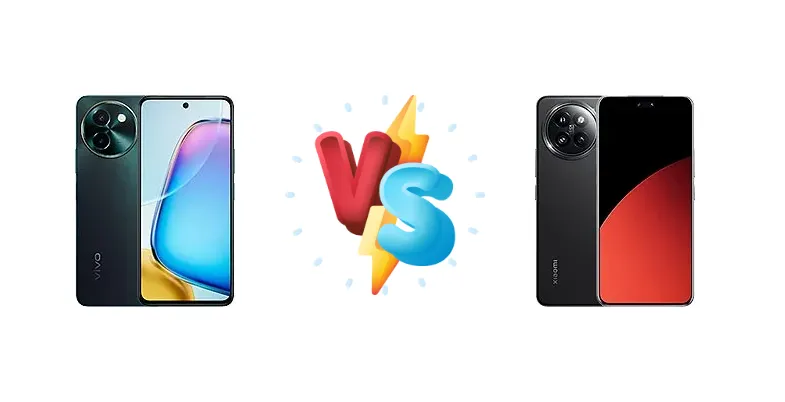
The vivo Y200t and Xiaomi Civi 4 Pro represent distinct approaches to the mid-range smartphone market. The Y200t focuses on delivering a solid all-around experience at a competitive price, while the Civi 4 Pro aims for a more premium feel with a significantly more powerful chipset. This comparison dissects their key differences to determine which phone best suits your needs.
🏆 Quick Verdict
For the average user prioritizing performance and future-proofing, the Xiaomi Civi 4 Pro is the clear winner. Its Snapdragon 8s Gen 3 offers a substantial leap in processing power over the Y200t’s Snapdragon 6 Gen 1. However, the vivo Y200t remains a compelling option for budget-conscious buyers who don't demand top-tier performance.
| Network |
|---|
| 2G bands | GSM 850 / 900 / 1800 / 1900 | GSM 850 / 900 / 1800 / 1900 |
| 3G bands | HSDPA 850 / 900 / 2100 | HSDPA 800 / 850 / 900 / 1700(AWS) / 1900 / 2100 |
| 4G bands | 1, 3, 5, 8, 28, 34, 38, 39, 40, 41 | 1, 3, 4, 5, 8, 18, 19, 26, 28, 34, 38, 39, 40, 41, 42, 48, 66 |
| 5G bands | 1, 3, 5, 8, 28, 41, 77, 78 SA/NSA | 1, 3, 5, 8, 28, 38, 40, 41, 48, 66, 77, 78 SA/NSA |
| Speed | HSPA, LTE, 5G | HSPA, LTE, 5G |
| Technology | GSM / CDMA / HSPA / LTE / 5G | GSM / CDMA / HSPA / CDMA2000 / LTE / 5G |
| Launch |
|---|
| Announced | 2024, May 20 | 2024, March 21 |
| Status | Available. Released 2024, May 20 | Available. Released 2024, March 21 |
| Body |
|---|
| Build | Glass front, plastic frame, plastic back | Glass front (Gorilla Glass Victus 2), glass back or silicone polymer back (eco leather), aluminum frame |
| Dimensions | 165.7 x 76 x 8 mm (6.52 x 2.99 x 0.31 in) | 157.2 x 72.8 x 7.5 mm or 7.8 mm |
| SIM | Nano-SIM + Nano-SIM | Nano-SIM + Nano-SIM |
| Weight | 199 g (7.02 oz) | 177.6 or 179.3 g or 180.9 g (6.28 oz) |
| Display |
|---|
| Protection | - | Corning Gorilla Glass Victus 2 |
| Resolution | 1080 x 2408 pixels, 20:9 ratio (~393 ppi density) | 1236 x 2750 pixels, 20:9 ratio (~460 ppi density) |
| Size | 6.72 inches, 108.8 cm2 (~86.4% screen-to-body ratio) | 6.55 inches, 103.5 cm2 (~90.4% screen-to-body ratio) |
| Type | IPS LCD, 120Hz, 1000 nits (peak) | AMOLED, 68B colors, 120Hz, Dolby Vision, HDR10+, 3000 nits (peak) |
| Platform |
|---|
| CPU | Octa-core (4x2.2 GHz Cortex-A78 & 4x1.8 GHz Cortex-A55) | Octa-core (1x3.0 GHz Cortex-X4 & 4x2.8 GHz Cortex-A720 & 3x2.0 GHz Cortex-A520) |
| Chipset | Qualcomm SM6450 Snapdragon 6 Gen 1 (4 nm) | Qualcomm SM8635 Snapdragon 8s Gen 3 (4 nm) |
| GPU | Adreno 710 | Adreno 735 |
| OS | Android 14, OriginOS 4 | Android 14, HyperOS |
| Memory |
|---|
| Card slot | No | No |
| Internal | 128GB 8GB RAM, 256GB 8GB RAM, 256GB 12GB RAM, 512GB 12GB RAM | 256GB 12GB RAM, 512GB 12GB RAM, 512GB 16GB RAM |
| Main Camera |
|---|
| Dual | 50 MP, f/1.8, (wide), PDAF
Auxiliary lens | - |
| Features | LED flash, HDR, panorama | Color spectrum sensor, Dual-LED flash, HDR, panorama, Leica lenses |
| Triple | - | 50 MP, f/1.6, 25mm (wide), 1/1.55", 1.0µm, PDAF, OIS
50 MP, f/2.0, 50mm (telephoto), 0.64µm, PDAF, 2x optical zoom
12 MP, f/2.2, 15mm, 120˚ (ultrawide), 1.12µm |
| Video | 4K@30fps, 1080p@30fps | 4K@24/30/60fps, 1080p@30/60/120/240/960fps, 720p@1920fps, HDR10+, BT.2020, 10-bit video, gyro-EIS |
| Selfie camera |
|---|
| Dual | - | 32 MP, f/2.0, 26mm (wide), 1/2.8", 0.8µm, AF
32 MP, f/2.4, 100˚ (ultrawide), 1/2.8", 0.8µm |
| Features | - | HDR, panorama |
| Single | 8 MP, f/2.1, (wide) | - |
| Video | 1080p@30fps | 4K@30fps, 1080p@30/60fps; gyro-EIS |
| Sound |
|---|
| 35mm jack | Yes | No |
| Loudspeaker | Yes, with stereo speakers | Yes, with stereo speakers |
| Comms |
|---|
| Bluetooth | 5.1, A2DP, LE, aptX HD, aptX Adaptive | 5.4, A2DP, LE, LHDC |
| Infrared port | - | Yes |
| NFC | No | Yes |
| Positioning | GPS, GALILEO, GLONASS, BDS, QZSS | GPS (L1), GLONASS (G1), BDS (B1I+B1c), GALILEO (E1), QZSS (L1) |
| Radio | No | No |
| USB | USB Type-C 2.0, OTG | USB Type-C 2.0, OTG |
| WLAN | Wi-Fi 802.11 a/b/g/n/ac, dual-band | Wi-Fi 802.11 a/b/g/n/ac/6, dual-band, Wi-Fi Direct |
| Features |
|---|
| Sensors | Fingerprint (side-mounted), accelerometer, gyro, proximity, compass | Fingerprint (under display, optical), accelerometer, gyro, proximity, compass |
| Battery |
|---|
| Charging | 44W wired, 50% in 35 min
Reverse wired | 67W wired, PD3.0, 100% in 40 minutes |
| Type | 6000 mAh | Li-Po 4700 mAh |
| Misc |
|---|
| Colors | Dark Green, Blue | Black, Pink, Blue, Green |
| Models | V2353DA | 24053PY09C |
| Price | About 140 EUR | About 380 EUR |
vivo Y200t
- More affordable price point
- Efficient Snapdragon 6 Gen 1 chipset for everyday tasks
- Reverse wired charging capability
- Significantly less powerful than the Civi 4 Pro
- Slower charging speed (44W)
- May struggle with demanding games and apps
Xiaomi Civi 4 Pro
- Powerful Snapdragon 8s Gen 3 processor
- Faster 67W wired charging with PD3.0
- Superior performance for gaming and multitasking
- Higher price tag
- Potentially less battery life due to higher power consumption (though mitigated by charging speed)
- May be overkill for basic users
Display Comparison
While specific display details (resolution, panel type) are missing, the core difference lies in the processing power driving the visuals. Both phones utilize a 4nm process, but the Civi 4 Pro’s Snapdragon 8s Gen 3 will handle graphically intensive tasks with greater ease, resulting in smoother animations and higher frame rates in games. The Y200t’s Snapdragon 6 Gen 1, while efficient, will show its limitations with demanding titles. We anticipate the Civi 4 Pro will have a higher peak brightness and potentially a more color-accurate display due to its higher-end chipset’s image signal processor.
Camera Comparison
Without detailed camera specs, it’s difficult to make a definitive judgment. However, the Snapdragon 8s Gen 3 in the Civi 4 Pro boasts a more advanced Image Signal Processor (ISP). This ISP will likely result in better image processing, improved low-light performance, and more accurate color reproduction. While both phones likely feature multiple cameras, the Civi 4 Pro’s chipset will enable more sophisticated computational photography features. We expect the Civi 4 Pro to offer a more versatile and higher-quality camera experience.
Performance
The performance gap is the most significant differentiator. The Xiaomi Civi 4 Pro’s Snapdragon 8s Gen 3, featuring a 1x3.0 GHz Cortex-X4 prime core, is a substantial upgrade over the vivo Y200t’s Snapdragon 6 Gen 1 (4x2.2 GHz Cortex-A78). The 8s Gen 3’s architecture, including the Cortex-A720 performance cores, delivers significantly faster processing speeds and improved multi-tasking capabilities. This translates to quicker app launches, smoother scrolling, and a more responsive user experience. The Y200t’s Snapdragon 6 Gen 1 is adequate for everyday tasks, but will struggle with sustained heavy workloads. The Civi 4 Pro is the clear choice for gamers and power users.
Battery Life
The Xiaomi Civi 4 Pro’s 67W wired charging with PD3.0 support is a significant advantage. Achieving a 100% charge in 40 minutes is considerably faster than the vivo Y200t’s 44W charging (50% in 35 minutes). While battery capacity isn’t specified, the faster charging speed of the Civi 4 Pro mitigates any potential disadvantage from a slightly smaller battery. The Civi 4 Pro’s charging efficiency, coupled with the Snapdragon 8s Gen 3’s optimized power management, will likely provide a comparable or even better real-world battery life experience.
Buying Guide
Buy the vivo Y200t if you need a reliable daily driver for basic tasks, social media, and light gaming, and prioritize affordability. You'll appreciate its efficient chipset and decent charging speed without breaking the bank. Buy the Xiaomi Civi 4 Pro if you prefer a smoother experience with demanding apps, enjoy mobile gaming, and value faster charging speeds – even if it means a higher upfront cost.
Frequently Asked Questions
❓ Will the Snapdragon 6 Gen 1 in the vivo Y200t struggle with graphically intensive games like Genshin Impact?
Yes, the Snapdragon 6 Gen 1 is not designed for demanding games like Genshin Impact. While you might be able to run it on low settings, expect noticeable frame drops and potential overheating. The Xiaomi Civi 4 Pro’s Snapdragon 8s Gen 3 will provide a much smoother and more enjoyable gaming experience.
❓ How much faster is the 67W charging on the Xiaomi Civi 4 Pro compared to the 44W charging on the vivo Y200t in real-world use?
The Civi 4 Pro’s 67W charging will get you from 0% to 100% in approximately 40 minutes, while the Y200t takes longer to reach 50% (35 minutes) and a full charge will take considerably longer. This means less time tethered to a charger and more time using your phone.
❓ Does the Xiaomi Civi 4 Pro's Snapdragon 8s Gen 3 generate more heat during prolonged gaming sessions?
While the Snapdragon 8s Gen 3 is more powerful, Qualcomm has implemented thermal management features to mitigate heat generation. The Civi 4 Pro likely incorporates a robust cooling system to prevent significant throttling during extended gaming. However, it will still generate more heat than the Y200t’s less powerful chipset.