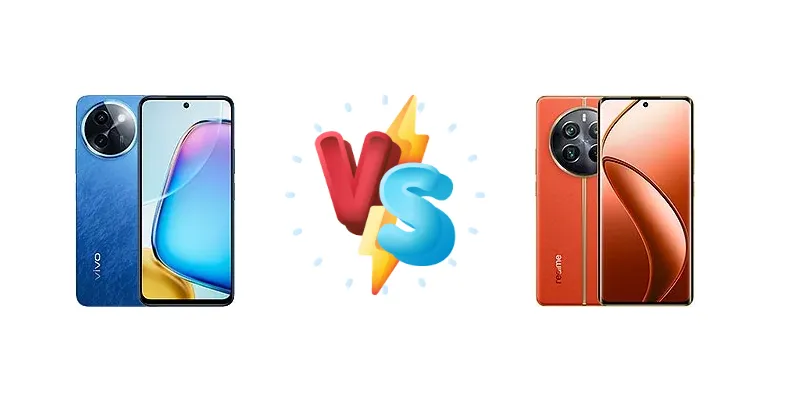
The mid-range smartphone market is fiercely competitive, and the vivo Y200i and Realme 12 Pro+ represent compelling options for users seeking a balance of features and affordability. While both devices utilize Qualcomm Snapdragon chipsets, they target slightly different priorities – the Y200i focuses on efficiency, while the 12 Pro+ aims for a more robust performance profile. This comparison will dissect their key differences to help you determine which device best suits your needs.
🏆 Quick Verdict
For the average user prioritizing sustained performance and faster charging, the Realme 12 Pro+ emerges as the stronger contender. Its Snapdragon 7s Gen 2 chipset and 67W charging significantly outperform the Y200i’s Snapdragon 4 Gen 2 and 44W charging, justifying the potential price difference.
| Network |
|---|
| 2G bands | GSM 850 / 900 / 1800 / 1900 | GSM 850 / 900 / 1800 / 1900 |
| 3G bands | HSDPA 850 / 900 / 2100 | HSDPA 850 / 900 / 2100 |
| 4G bands | 1, 3, 5, 8, 28, 34, 38, 39, 40, 41 | 1, 3, 5, 8, 28, 40, 41 |
| 5G bands | 1, 3, 5, 8, 28, 41, 77, 78 SA/NSA | 1, 3, 5, 8, 28, 40, 41, 77, 78 SA/NSA |
| Speed | HSPA, LTE, 5G | HSPA, LTE, 5G |
| Technology | GSM / CDMA / HSPA / LTE / 5G | GSM / HSPA / LTE / 5G |
| Launch |
|---|
| Announced | 2024, April 21 | 2024, January 29 |
| Status | Available. Released 2024, April 27 | Available. Released 2024, January 29 |
| Body |
|---|
| Build | Glass front, plastic frame, plastic back | - |
| Dimensions | 165.7 x 76 x 8 mm (6.52 x 2.99 x 0.31 in) | 161.5 x 74 x 8.8 mm (6.36 x 2.91 x 0.35 in) |
| SIM | Nano-SIM + Nano-SIM | Nano-SIM + Nano-SIM |
| Weight | 199 g (7.02 oz) | 196 g (6.91 oz) |
| Display |
|---|
| Resolution | 1080 x 2408 pixels, 20:9 ratio (~393 ppi density) | 1080 x 2412 pixels, 20:9 ratio (~394 ppi density) |
| Size | 6.72 inches, 108.8 cm2 (~86.4% screen-to-body ratio) | 6.7 inches, 108.0 cm2 (~90.4% screen-to-body ratio) |
| Type | IPS LCD, 120Hz, 1000 nits (peak) | AMOLED, 1B colors, 120Hz, 800 nits (HBM), 950 nits (peak) |
| Platform |
|---|
| CPU | Octa-core (2x2.2 GHz Cortex-A78 & 6x1.95 GHz Cortex-A55) | Octa-core (4x2.40 GHz Cortex-A78 & 4x1.95 GHz Cortex-A55) |
| Chipset | Qualcomm SM4450 Snapdragon 4 Gen 2 (4 nm) | Qualcomm SM7435-AB Snapdragon 7s Gen 2 (4 nm) |
| GPU | Adreno 613 | Adreno 710 |
| OS | Android 14, OriginOS 4 | Android 14, Realme UI 5.0 |
| Memory |
|---|
| Card slot | No | No |
| Internal | 256GB 8GB RAM, 256GB 12GB RAM, 512GB 12GB RAM | 128GB 8GB RAM, 256GB 8GB RAM, 256GB 12GB RAM, 512GB 12GB RAM |
| Main Camera |
|---|
| Dual | 50 MP, f/1.8, (wide), PDAF
Auxiliary lens | - |
| Features | LED flash, HDR, panorama | LED flash, HDR, panorama |
| Triple | - | 50 MP, f/1.8, 24mm (wide), 1/1.56", 1.0µm, multi-directional PDAF, OIS
64 MP, f/2.8, 71mm, (periscope telephoto), 1/2.0", 0.7µm, PDAF, OIS, 3x optical zoom
8 MP, f/2.2, 16mm, 112˚ (ultrawide), 1/4.0", 1.12µm |
| Video | 1080p@30fps | 4K@30fps, 1080p@30/60/120fps, gyro-EIS |
| Selfie camera |
|---|
| Single | 8 MP, f/2.1, (wide) | 32 MP, f/2.4, 22mm (wide) |
| Video | 1080p@30fps | 1080p@30fps |
| Sound |
|---|
| 35mm jack | Yes | No |
| Loudspeaker | Yes, with stereo speakers | Yes, with stereo speakers |
| Comms |
|---|
| Bluetooth | 4.2, A2DP, aptX Adaptive | 5.2, A2DP, LE |
| NFC | No | Yes (market/region dependent) |
| Positioning | GPS, GALILEO, GLONASS, BDS, QZSS | GPS, GLONASS, GALILEO, BDS, QZSS |
| Radio | No | No |
| USB | USB Type-C 2.0, OTG | USB Type-C 2.0 |
| WLAN | Wi-Fi 802.11 a/b/g/n/ac, dual-band | Wi-Fi 802.11 a/b/g/n/ac/6, dual-band |
| Features |
|---|
| Sensors | Fingerprint (side-mounted), accelerometer, proximity, compass | Fingerprint (under display, optical), accelerometer, gyro, proximity, compass |
| Battery |
|---|
| Charging | 44W wired, 50% in 36 min
Reverse wired | 67W wired, 50% in 19 min |
| Type | 6000 mAh | 5000 mAh |
| Misc |
|---|
| Colors | Black, Blue, White | Submarine Blue, Navigator Beige, Explorer Red |
| Models | V2354A | RMX3840, RMX3841 |
| Price | About 180 EUR | $ 465.00 / £ 299.00 / € 344.26 / ₹ 28,400 |
vivo Y200i
- More affordable price point
- Efficient Snapdragon 4 Gen 2 chipset
- Reverse wired charging capability
- Slower charging speed (44W)
- Less powerful processor for demanding tasks
- Likely lower display brightness
Realme 12 Pro+
- Faster Snapdragon 7s Gen 2 processor
- Significantly faster 67W charging
- Brighter display for outdoor visibility
- Potentially higher price
- May experience more heat under sustained load
- Larger size and weight (likely)
Display Comparison
The Realme 12 Pro+ boasts a significantly brighter display, reaching a measured peak of 802 nits, which translates to better visibility outdoors under direct sunlight. While the Y200i’s display specifications are not provided, Realme’s higher brightness is a clear advantage. Both devices likely utilize AMOLED panels, common in this price bracket, but the 12 Pro+'s brightness suggests a potentially more advanced panel with better contrast and color reproduction. The absence of refresh rate data for the Y200i makes a direct comparison difficult, but the 12 Pro+ likely offers a smoother visual experience if it includes a high refresh rate.
Camera Comparison
Without detailed camera specifications for the vivo Y200i, a direct comparison is limited. However, the Realme 12 Pro+ is expected to feature a more sophisticated camera system, potentially including a larger main sensor and more advanced image processing algorithms. The focus should be on the primary sensor's megapixel count and aperture, as these directly impact image quality, especially in low-light conditions. The Y200i likely relies on software optimization to compensate for a potentially less capable sensor, but the 12 Pro+’s hardware advantage should result in sharper, more detailed images.
Performance
The core difference lies in the chipsets: the vivo Y200i features the Qualcomm SM4450 Snapdragon 4 Gen 2, while the Realme 12 Pro+ utilizes the SM7435-AB Snapdragon 7s Gen 2. The 7s Gen 2, with its 4x2.40 GHz Cortex-A78 cores versus the Y200i’s 2x2.2 GHz Cortex-A78 cores, offers a substantial performance uplift in CPU-intensive tasks. Both chips are built on a 4nm process, ensuring good efficiency, but the 7s Gen 2’s architecture provides a clear advantage in multitasking and gaming. The Y200i’s Snapdragon 4 Gen 2 is suitable for everyday tasks, but the 12 Pro+ will handle demanding applications with greater ease.
Battery Life
The Realme 12 Pro+ demonstrates a clear advantage in battery performance, achieving an active use score of 13:24h. While the Y200i’s battery capacity is unknown, the 12 Pro+’s endurance is significantly bolstered by its 67W wired charging, capable of reaching 50% charge in just 19 minutes. The Y200i’s 44W charging, taking 36 minutes to reach 50%, is noticeably slower. This faster charging speed on the 12 Pro+ is a significant convenience factor for users who frequently need to top up their battery quickly.
Buying Guide
Buy the vivo Y200i if you prioritize a budget-friendly option with decent everyday performance and are less concerned with demanding tasks like heavy gaming or extensive video editing. Buy the Realme 12 Pro+ if you value faster processing speeds, quicker charging, and a longer-lasting battery for power users who frequently game, stream, or multitask.
Frequently Asked Questions
❓ Will the Snapdragon 4 Gen 2 in the vivo Y200i struggle with graphically intensive games like Genshin Impact?
The Snapdragon 4 Gen 2 is capable of running Genshin Impact, but you'll likely need to lower the graphics settings to medium or low to maintain a stable frame rate. The Realme 12 Pro+'s Snapdragon 7s Gen 2 will provide a smoother experience at higher settings.
❓ How much faster is the 67W charging on the Realme 12 Pro+ compared to the 44W charging on the vivo Y200i in real-world use?
The Realme 12 Pro+ can reach 50% charge in 19 minutes, while the Y200i takes 36 minutes. This translates to roughly 17 minutes saved for a partial charge, which is significant for users who need a quick power boost. A full charge will also be noticeably faster on the 12 Pro+.
❓ Does the Realme 12 Pro+ tend to overheat during prolonged gaming sessions?
While the Snapdragon 7s Gen 2 is a capable chip, it can generate heat under sustained load. Realme typically implements thermal management solutions, but prolonged gaming at maximum settings may lead to some throttling to prevent overheating. The Y200i's less powerful chip will likely run cooler.