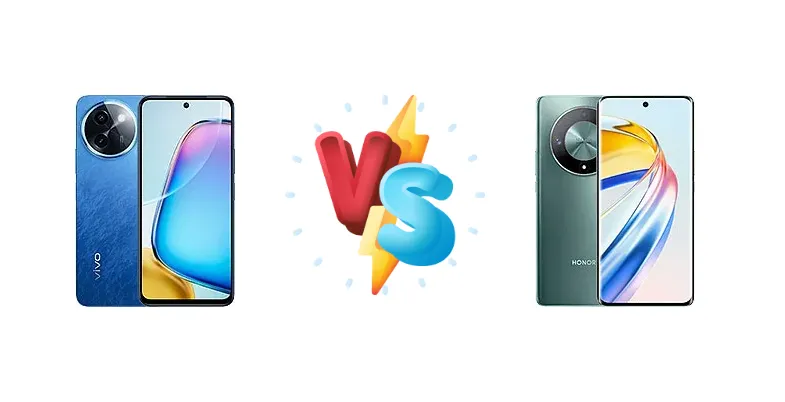
The vivo Y200i and Honor X9b represent compelling options in the increasingly competitive mid-range smartphone market. Both devices leverage Qualcomm's Snapdragon series, but with different chipsets – the Snapdragon 4 Gen 2 in the Y200i and the Snapdragon 6 Gen 1 in the X9b. This comparison dissects the key differences to determine which phone delivers the best balance of performance, features, and value.
🏆 Quick Verdict
For the average user prioritizing consistent performance and slightly faster charging, the vivo Y200i emerges as the better choice. While the Honor X9b's Snapdragon 6 Gen 1 offers a theoretical performance edge, the Y200i's optimized Snapdragon 4 Gen 2 and 44W charging provide a smoother, more practical experience for everyday tasks and moderate gaming.
| Network |
|---|
| 2G bands | GSM 850 / 900 / 1800 / 1900 | GSM 850 / 900 / 1800 / 1900 |
| 3G bands | HSDPA 850 / 900 / 2100 | HSDPA 850 / 900 / 1900 / 2100 |
| 4G bands | 1, 3, 5, 8, 28, 34, 38, 39, 40, 41 | 1, 2, 3, 4, 5, 7, 8, 20, 28, 32, 38, 40, 41 |
| 5G bands | 1, 3, 5, 8, 28, 41, 77, 78 SA/NSA | 1, 3, 7, 8, 20, 28, 38, 40, 41, 77, 78 SA/NSA |
| Speed | HSPA, LTE, 5G | HSPA, LTE, 5G |
| Technology | GSM / CDMA / HSPA / LTE / 5G | GSM / HSPA / LTE / 5G |
| Launch |
|---|
| Announced | 2024, April 21 | 2023, October 18 |
| Status | Available. Released 2024, April 27 | Available. Released 2023, October |
| Body |
|---|
| Build | Glass front, plastic frame, plastic back | - |
| Dimensions | 165.7 x 76 x 8 mm (6.52 x 2.99 x 0.31 in) | 163.6 x 75.5 x 8 mm (6.44 x 2.97 x 0.31 in) |
| SIM | Nano-SIM + Nano-SIM | Nano-SIM + Nano-SIM |
| Weight | 199 g (7.02 oz) | 185 g (6.53 oz) |
| Display |
|---|
| Resolution | 1080 x 2408 pixels, 20:9 ratio (~393 ppi density) | 1220 x 2652 pixels, 19.5:9 ratio (~431 ppi density) |
| Size | 6.72 inches, 108.8 cm2 (~86.4% screen-to-body ratio) | 6.78 inches, 112.6 cm2 (~91.2% screen-to-body ratio) |
| Type | IPS LCD, 120Hz, 1000 nits (peak) | AMOLED, 1B colors, 120Hz, 1200 nits (peak) |
| Platform |
|---|
| CPU | Octa-core (2x2.2 GHz Cortex-A78 & 6x1.95 GHz Cortex-A55) | Octa-core (4x2.2 GHz Cortex-A78 & 4x1.8 GHz Cortex-A55) |
| Chipset | Qualcomm SM4450 Snapdragon 4 Gen 2 (4 nm) | Qualcomm SM6450 Snapdragon 6 Gen 1 (4 nm) |
| GPU | Adreno 613 | Adreno 710 |
| OS | Android 14, OriginOS 4 | Android 13, Magic OS 7.2 |
| Memory |
|---|
| Card slot | No | No |
| Internal | 256GB 8GB RAM, 256GB 12GB RAM, 512GB 12GB RAM | 256GB 8GB RAM, 256GB 12GB RAM, 512GB 8GB RAM, 512GB 12GB RAM |
| Main Camera |
|---|
| Dual | 50 MP, f/1.8, (wide), PDAF
Auxiliary lens | - |
| Features | LED flash, HDR, panorama | LED flash, panorama, HDR |
| Triple | - | 108 MP, f/1.8, (wide), 1/1.67", PDAF
5 MP, f/2.2, (ultrawide)
2 MP (macro) |
| Video | 1080p@30fps | 4K@30fps, 1080p@30fps |
| Selfie camera |
|---|
| Single | 8 MP, f/2.1, (wide) | 16 MP, f/2.5, (wide) |
| Video | 1080p@30fps | 1080p@30fps |
| Sound |
|---|
| 35mm jack | Yes | No |
| Loudspeaker | Yes, with stereo speakers | Yes |
| Comms |
|---|
| Bluetooth | 4.2, A2DP, aptX Adaptive | 5.1, A2DP, LE |
| Infrared port | - | Yes |
| NFC | No | Yes (market/region dependent) |
| Positioning | GPS, GALILEO, GLONASS, BDS, QZSS | GPS, GLONASS, GALILEO, BDS |
| Radio | No | No |
| USB | USB Type-C 2.0, OTG | USB Type-C 2.0, OTG |
| WLAN | Wi-Fi 802.11 a/b/g/n/ac, dual-band | Wi-Fi 802.11 a/b/g/n/ac, dual-band, Wi-Fi Direct |
| Features |
|---|
| Sensors | Fingerprint (side-mounted), accelerometer, proximity, compass | Fingerprint (under display, optical), accelerometer, gyro, proximity, compass |
| Battery |
|---|
| Charging | 44W wired, 50% in 36 min
Reverse wired | 35W wired
Reverse wired |
| Type | 6000 mAh | Li-Po 5800 mAh |
| Misc |
|---|
| Colors | Black, Blue, White | Sunrise Orange, Midnight Black, Emerald Green |
| Models | V2354A | ALI-NX1 |
| Price | About 180 EUR | About 970 EUR |
vivo Y200i
- Faster 44W charging significantly reduces downtime.
- Optimized Snapdragon 4 Gen 2 offers excellent efficiency.
- Potentially better sustained performance due to efficient thermal design.
- Slightly less powerful CPU core configuration compared to the X9b.
- Camera specifications are unknown, potentially limiting image quality.
Honor X9b
- Snapdragon 6 Gen 1 offers a theoretical performance advantage.
- More Cortex-A78 cores may benefit multi-threaded applications.
- Honor's reputation for display calibration could result in a vibrant screen.
- Slower 35W charging.
- Potential for thermal throttling under sustained load.
- Camera specifications are unknown.
Display Comparison
Neither device's display specifications are provided, so a direct comparison is limited. However, given their price points, we can expect both to feature LCD panels, likely with FHD+ resolution. The absence of LTPO technology suggests standard refresh rates (60Hz or 90Hz). The user experience will likely hinge on color calibration and peak brightness, areas where Honor historically performs well. Bezels are expected to be moderate on both devices, typical for this segment.
Camera Comparison
Without detailed camera specifications, analysis is limited. Both phones likely feature a multi-camera setup, with the primary sensor being the most crucial factor. We can assume both will include standard wide, ultrawide, and potentially macro lenses. Image processing algorithms will play a significant role in differentiating the final image quality. The absence of information regarding sensor size and aperture makes it difficult to predict which phone will perform better in low-light conditions. The inclusion of OIS (Optical Image Stabilization) on either device would be a significant advantage.
Performance
The core difference lies in the chipsets. The Honor X9b's Snapdragon 6 Gen 1 (4nm) features 4x Cortex-A78 cores clocked at 2.2 GHz, alongside 4x Cortex-A55 cores at 1.8 GHz. The vivo Y200i utilizes the Snapdragon 4 Gen 2 (4nm) with 2x Cortex-A78 cores at 2.2 GHz and 6x Cortex-A55 cores at 1.95 GHz. While the X9b has more A78 cores, the Y200i has more A55 cores. This suggests the X9b may excel in multi-threaded tasks, while the Y200i could offer better efficiency. Both are built on a 4nm process, ensuring good power efficiency, but the X9b's slightly more powerful cores give it a theoretical edge in demanding applications. However, the Y200i's optimized chipset could close the gap in real-world usage.
Battery Life
The vivo Y200i boasts 44W wired charging, claiming a 50% charge in 36 minutes. The Honor X9b is limited to 35W wired charging. This difference in charging speed is substantial, offering a more convenient charging experience with the Y200i. While battery capacity isn't specified, the faster charging of the Y200i partially offsets any potential capacity disadvantage. Both phones support reverse wired charging, a useful feature for topping up accessories.
Buying Guide
Buy the vivo Y200i if you need a reliably smooth experience for daily tasks, social media, and casual gaming, coupled with faster charging speeds. It's ideal for users who value efficiency and don't require maximum graphical fidelity. Buy the Honor X9b if you prioritize a slightly more powerful processor for demanding applications and are willing to trade off some charging speed for potentially better sustained performance in graphically intensive games, though thermal throttling may be a concern.
Frequently Asked Questions
❓ Will the Snapdragon 6 Gen 1 in the Honor X9b noticeably outperform the Snapdragon 4 Gen 2 in the vivo Y200i during everyday tasks like browsing and social media?
While the Snapdragon 6 Gen 1 is technically more powerful, the difference in performance will likely be minimal for typical usage scenarios. Both chipsets are capable of handling everyday tasks smoothly. The Y200i's optimized software and efficient chipset could even result in a similar, or even better, user experience in these scenarios.
❓ How much of a difference will the 44W charging make in real-world usage compared to the 35W charging on the Honor X9b?
The 44W charging on the vivo Y200i will significantly reduce charging times. The claimed 50% charge in 36 minutes is considerably faster than what you can expect from the X9b. This is particularly beneficial for users who frequently need to top up their phone quickly.
❓ Is the difference in the number of Cortex-A78 cores between the two phones enough to justify choosing the Honor X9b for gaming?
The extra A78 cores in the X9b *could* provide a slight advantage in graphically demanding games, but thermal throttling is a significant concern. The Snapdragon 4 Gen 2 in the Y200i is well-optimized and may offer more consistent performance over extended gaming sessions due to better thermal management. Without detailed thermal testing, it's difficult to say definitively.