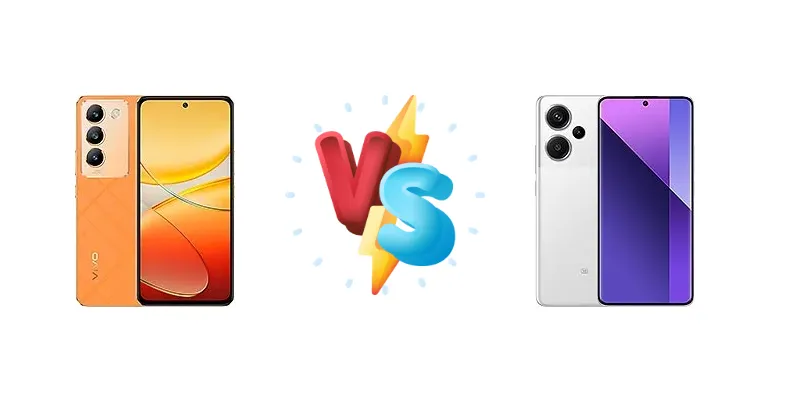
The mid-range smartphone market is fiercely competitive, and the vivo Y200e and Xiaomi Redmi Note 13 Pro+ represent compelling options for budget-conscious buyers. The Y200e leverages Qualcomm's efficient Snapdragon 4 Gen 2, while the Redmi Note 13 Pro+ boasts the more powerful Mediatek Dimensity 7200 Ultra and a blazing-fast 120W charging solution. This comparison dissects these key differences to determine which device offers the best overall experience.
🏆 Quick Verdict
For the average user prioritizing speed and convenience, the Xiaomi Redmi Note 13 Pro+ is the clear winner. Its Dimensity 7200 Ultra chipset delivers significantly better performance, and the 120W charging is a game-changer, fully charging the device in just 19 minutes. While the Y200e offers respectable efficiency, it can't match the Pro+'s raw power.
| Network |
|---|
| 2G bands | GSM 850 / 900 / 1800 / 1900 | GSM 850 / 900 / 1800 / 1900 |
| 3G bands | HSDPA 850 / 900 / 2100 | HSDPA 800 / 850 / 900 / 1700(AWS) / 1900 / 2100 - International |
| 4G bands | 1, 3, 5, 8, 28, 38, 40, 41 | 1, 2, 3, 4, 5, 7, 8, 12, 13, 17, 18, 19, 20, 26, 28, 32, 38, 40, 41, 66 - International |
| 5G bands | 1, 3, 5, 8, 28, 40, 77, 78 SA/NSA | 1, 3, 5, 7, 8, 20, 28, 38, 40, 41, 66, 77, 78 SA/NSA- International |
| Speed | HSPA, LTE, 5G | HSPA, LTE, 5G |
| Technology | GSM / HSPA / LTE / 5G | GSM / CDMA / HSPA / EVDO / LTE / 5G |
| Launch |
|---|
| Announced | 2024, February 22 | 2023, September 21 |
| Status | Available. Released 2024, February 22 | Available. Released 2023, September 21 |
| Body |
|---|
| Build | Glass front, plastic or silicone polymer (eco leather) back | Glass front (Gorilla Glass Victus), glass back or silicone polymer back (eco leather) |
| Dimensions | 163.2 x 75.8 x 7.8 mm (6.43 x 2.98 x 0.31 in) | 161.4 x 74.2 x 8.9 mm (6.35 x 2.92 x 0.35 in) |
| SIM | Nano-SIM + Nano-SIM | · Nano-SIM + eSIM· Nano-SIM + Nano-SIM |
| Weight | 185.5 g or 191 g (6.56 oz) | 199 g or 204.5 g (7.02 oz) |
| Display |
|---|
| Protection | - | Corning Gorilla Glass Victus |
| Resolution | 1080 x 2400 pixels, 20:9 ratio (~395 ppi density) | 1220 x 2712 pixels, 20:9 ratio (~446 ppi density) |
| Size | 6.67 inches, 107.4 cm2 (~86.8% screen-to-body ratio) | 6.67 inches, 107.4 cm2 (~89.7% screen-to-body ratio) |
| Type | AMOLED, 120Hz, 1800 nits (peak) | AMOLED, 68B colors, 120Hz, 1920Hz PWM, Dolby Vision, HDR10+, 1800 nits (peak) |
| Platform |
|---|
| CPU | Octa-core (2x2.2 GHz Cortex-A78 & 6x1.95 GHz Cortex-A55) | Octa-core (2x2.8 GHz Cortex-A715 & 6x2.0 GHz Cortex-A510) |
| Chipset | Qualcomm SM4450 Snapdragon 4 Gen 2 (4 nm) | Mediatek Dimensity 7200 Ultra (4 nm) |
| GPU | Adreno 613 | Mali-G610 MC4 |
| OS | Android 14, Funtouch 14 | Android 13, up to 3 major Android upgrades, HyperOS |
| Memory |
|---|
| Card slot | microSDXC (uses shared SIM slot) | No |
| Internal | 128GB 6GB RAM, 128GB 8GB RAM | 256GB 8GB RAM, 256GB 12GB RAM, 512GB 8GB RAM, 512GB 12GB RAM, 512GB 16GB RAM |
| Main Camera |
|---|
| Dual | 50 MP, f/1.8, (wide), PDAF
Auxiliary lens | - |
| Features | LED flash, panorama, HDR | Dual-LED dual-tone flash, HDR, panorama |
| Triple | - | 200 MP, f/1.7, 23mm (wide), 1/1.4", 0.56µm, multi-directional PDAF, OIS
8 MP, f/2.2, 16mm, 120˚ (ultrawide), 1/4.0", 1.12µm
2 MP (macro) |
| Video | 1080p@30fps | 4K@24/30fps, 1080p@30/60/120fps, gyro-EIS |
| Selfie camera |
|---|
| Features | - | HDR, panorama |
| Single | 16 MP, f/2.0, (wide) | 16 MP, f/2.4, (wide) |
| Video | 1080p@30fps | 1080p@30/60fps |
| Sound |
|---|
| 35mm jack | No | No |
| Loudspeaker | Yes, with stereo speakers | Yes, with stereo speakers |
| Comms |
|---|
| Bluetooth | 5.0, A2DP, LE | 5.3, A2DP, LE |
| Infrared port | - | Yes |
| NFC | No | Yes (market/region dependent) |
| Positioning | GPS, GLONASS, GALILEO, BDS, QZSS | GPS, GLONASS, BDS, GALILEO, QZSS |
| Radio | No | No |
| USB | USB Type-C 2.0, OTG | USB Type-C 2.0, OTG |
| WLAN | Wi-Fi 802.11 a/b/g/n/ac, dual-band | Wi-Fi 802.11 a/b/g/n/ac/6, dual-band, Wi-Fi Direct |
| Features |
|---|
| Sensors | Fingerprint (under display, optical), accelerometer, gyro, proximity, compass, flicker | Fingerprint (under display, optical), accelerometer, gyro, proximity, compass |
| Battery |
|---|
| Charging | 44W wired, 32% in 15 min | 120W wired, PD3.0, 100% in 19 min |
| Type | Li-Ion 5000 mAh | Li-Po 5000 mAh |
| Misc |
|---|
| Colors | Black Diamond, Saffron Delight | Midnight Black (Fushion Black), Moonlight White (Fushion White), Aurora Purple, Fushion Purple, Camo Green |
| Models | V2336 | 23090RA98C, 23090RA98G, 23090RA98I |
| Price | ₹ 19,999 | $ 299.98 / £ 299.00 / € 208.98 / ₹ 24,999 |
| SAR | - | 1.09 W/kg (head) 0.85 W/kg (body) |
| SAR EU | - | 0.98 W/kg (head) 1.00 W/kg (body) |
vivo Y200e
- Potentially more affordable price point
- Efficient Snapdragon 4 Gen 2 chipset
- Decent charging speed for the price
- Significantly lower performance than the Redmi Note 13 Pro+
- Likely inferior display quality
- Limited camera capabilities compared to the competition
Xiaomi Redmi Note 13 Pro+
- Powerful Mediatek Dimensity 7200 Ultra chipset
- Blazing-fast 120W charging
- High peak display brightness (1283 nits)
- Higher price tag
- Potentially more heat generation under heavy load
- Software bloat (typical of Xiaomi)
Display Comparison
The Redmi Note 13 Pro+ immediately stands out with its measured peak brightness of 1283 nits, offering superior visibility in direct sunlight compared to the Y200e (brightness data unavailable, but likely lower given the chipset tier). While both utilize 4nm chipsets, the display technology isn't specified for the Y200e, suggesting it likely lacks features like LTPO for adaptive refresh rates found in higher-end devices. This means the Redmi Note 13 Pro+ will likely offer a smoother and more power-efficient viewing experience, especially during prolonged use.
Camera Comparison
Without detailed camera specifications for either device, a direct comparison is limited. However, the Redmi Note 13 Pro+’s positioning suggests a more sophisticated camera system. The focus should be on the main sensor resolution and aperture. The Redmi Note 13 Pro+ likely features a larger sensor and wider aperture, enabling better low-light performance and more detailed images. The Y200e, targeting a lower price point, will likely compromise on sensor size and image processing capabilities. The presence of a 2MP macro camera on either device is largely irrelevant; image quality will be limited by the sensor size and lens quality.
Performance
The core difference lies in the chipsets. The Redmi Note 13 Pro+'s Mediatek Dimensity 7200 Ultra, with its 2x2.8 GHz Cortex-A715 cores, provides a substantial performance advantage over the vivo Y200e’s Qualcomm Snapdragon 4 Gen 2 (2x2.2 GHz Cortex-A78). The Dimensity 7200 Ultra’s newer architecture and higher clock speeds translate to faster app loading times, smoother multitasking, and a more responsive gaming experience. While both are built on a 4nm process for efficiency, the Dimensity 7200 Ultra is designed for a higher performance ceiling. The Y200e will handle daily tasks adequately, but the Redmi Note 13 Pro+ is the better choice for demanding users.
Battery Life
The Redmi Note 13 Pro+ excels in charging speed, achieving a full charge in just 19 minutes with its 120W wired charging. The vivo Y200e’s 44W charging, while respectable, takes considerably longer, reaching 32% in 15 minutes. The Redmi Note 13 Pro+ also boasts a strong active use battery score of 10:38h, indicating excellent endurance. While the Y200e’s battery capacity isn’t specified, the faster charging and longer runtime of the Redmi Note 13 Pro+ make it the more convenient option for users who frequently need to top up their battery.
Buying Guide
Buy the vivo Y200e if you prioritize long-term efficiency and a lower initial cost, and your usage primarily revolves around everyday tasks like social media, calls, and light browsing. Buy the Xiaomi Redmi Note 13 Pro+ if you demand faster performance for gaming and multitasking, and value the convenience of incredibly rapid charging – even if it comes at a slightly higher price point.
Frequently Asked Questions
❓ Will the Dimensity 7200 Ultra in the Redmi Note 13 Pro+ overheat during extended gaming sessions?
While the Dimensity 7200 Ultra is a powerful chip, Mediatek has made strides in thermal management. The 4nm process helps, and Xiaomi typically employs effective cooling solutions in their Pro+ models. However, sustained peak performance will inevitably generate heat. Expect some throttling after prolonged gaming, but it shouldn't be severe enough to ruin the experience.
❓ Is the 44W charging on the vivo Y200e slow compared to the 120W on the Redmi Note 13 Pro+?
Yes, the difference is substantial. 44W charging is adequate for overnight charging, but the Redmi Note 13 Pro+'s 120W charging is a game-changer. It allows you to quickly top up your battery during short breaks, making it ideal for users who are always on the go. The Redmi Note 13 Pro+ can go from 0-100% in 19 minutes, while the Y200e will take significantly longer.
❓ Does the Redmi Note 13 Pro+ support high refresh rate gaming?
The Redmi Note 13 Pro+ likely supports high refresh rate gaming, but the actual frame rates achievable will depend on the game and graphics settings. The Dimensity 7200 Ultra has the horsepower to handle many popular titles at 60fps or higher, but demanding games may require lowering the settings to maintain smooth performance. The display's refresh rate is a key factor, and the Redmi Note 13 Pro+ likely features a 120Hz panel.