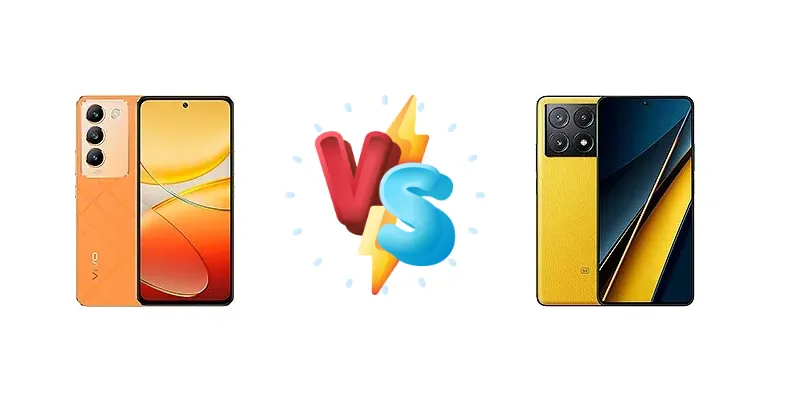
The mid-range smartphone market is fiercely competitive, and the Xiaomi Poco X6 Pro and vivo Y200e represent compelling options for budget-conscious buyers. The Poco X6 Pro aims for performance dominance with the Mediatek Dimensity 8300 Ultra, while the vivo Y200e focuses on a balance of efficiency and everyday usability with the Snapdragon 4 Gen 2. This comparison dissects their key differences to help you choose the right device.
🏆 Quick Verdict
For users prioritizing gaming and demanding tasks, the Xiaomi Poco X6 Pro is the clear winner. Its Dimensity 8300 Ultra chipset delivers significantly higher performance. However, the vivo Y200e offers a more efficient processor and faster charging for those focused on daily use and battery longevity.
| Network |
|---|
| 2G bands | GSM 850 / 900 / 1800 / 1900 | GSM 850 / 900 / 1800 / 1900 |
| 3G bands | HSDPA 850 / 900 / 2100 | HSDPA 850 / 900 / 1700(AWS) / 1900 / 2100 |
| 4G bands | 1, 3, 5, 8, 28, 38, 40, 41 | 1, 2, 3, 4, 5, 7, 8, 18, 19, 20, 28, 38, 40, 41, 48, 66 |
| 5G bands | 1, 3, 5, 8, 28, 40, 77, 78 SA/NSA | 1, 2, 3, 5, 7, 8, 20, 28, 38, 40, 41, 48, 77, 78 SA/NSA/Sub6 |
| Speed | HSPA, LTE, 5G | HSPA, LTE, 5G |
| Technology | GSM / HSPA / LTE / 5G | GSM / HSPA / LTE / 5G |
| Launch |
|---|
| Announced | 2024, February 22 | 2024, January 11 |
| Status | Available. Released 2024, February 22 | Available. Released 2024, January 12 |
| Body |
|---|
| Build | Glass front, plastic or silicone polymer (eco leather) back | Glass front (Gorilla Glass 5), plastic frame, plastic back or silicone polymer back (eco leather) |
| Dimensions | 163.2 x 75.8 x 7.8 mm (6.43 x 2.98 x 0.31 in) | 160.5 x 74.3 x 8.3 mm (6.32 x 2.93 x 0.33 in) |
| SIM | Nano-SIM + Nano-SIM | Nano-SIM + Nano-SIM |
| Weight | 185.5 g or 191 g (6.56 oz) | 186 g or 190 g (6.56 oz) |
| Display |
|---|
| Protection | - | Corning Gorilla Glass 5 |
| Resolution | 1080 x 2400 pixels, 20:9 ratio (~395 ppi density) | 1220 x 2712 pixels, 20:9 ratio (~446 ppi density) |
| Size | 6.67 inches, 107.4 cm2 (~86.8% screen-to-body ratio) | 6.67 inches, 107.4 cm2 (~90.1% screen-to-body ratio) |
| Type | AMOLED, 120Hz, 1800 nits (peak) | AMOLED, 68B colors, 120Hz, 1920Hz PWM, HDR10+, Dolby Vision, 500 nits (typ), 1200 nits (HBM), 1800 nits (peak) |
| Platform |
|---|
| CPU | Octa-core (2x2.2 GHz Cortex-A78 & 6x1.95 GHz Cortex-A55) | Octa-core (1x3.35 GHz Cortex-A715 & 3x3.20 GHz Cortex-A715 & 4x2.20 GHz Cortex-A510) |
| Chipset | Qualcomm SM4450 Snapdragon 4 Gen 2 (4 nm) | Mediatek Dimensity 8300 Ultra (4 nm) |
| GPU | Adreno 613 | Mali G615-MC6 |
| OS | Android 14, Funtouch 14 | Android 14, up to 3 major Android upgrades, HyperOS |
| Memory |
|---|
| Card slot | microSDXC (uses shared SIM slot) | No |
| Internal | 128GB 6GB RAM, 128GB 8GB RAM | 256GB 8GB RAM, 256GB 12GB RAM, 512GB 12GB RAM |
| Main Camera |
|---|
| Dual | 50 MP, f/1.8, (wide), PDAF
Auxiliary lens | - |
| Features | LED flash, panorama, HDR | LED flash, HDR, panorama |
| Triple | - | 64 MP, f/1.7, 25mm (wide), 1/2.0", 0.7µm, PDAF, OIS
8 MP, f/2.2, 120˚ (ultrawide), 1/4.0", 1.12µm
2 MP (macro) |
| Video | 1080p@30fps | 4K@24/30fps, 1080p@30/60fps, gyro-EIS |
| Selfie camera |
|---|
| Features | - | HDR, panorama |
| Single | 16 MP, f/2.0, (wide) | 16 MP, f/2.4, (wide), 1/3.06", 1.0µm |
| Video | 1080p@30fps | 1080p@30/60fps |
| Sound |
|---|
| 35mm jack | No | No |
| Loudspeaker | Yes, with stereo speakers | Yes, with dual speakers |
| Comms |
|---|
| Bluetooth | 5.0, A2DP, LE | 5.4, A2DP, LE, aptX HD |
| Infrared port | - | Yes |
| NFC | No | Yes (market/region dependent) |
| Positioning | GPS, GLONASS, GALILEO, BDS, QZSS | GPS, GALILEO, GLONASS, QZSS, BDS (B1I+B1c) |
| Radio | No | No |
| USB | USB Type-C 2.0, OTG | USB Type-C 2.0, OTG |
| WLAN | Wi-Fi 802.11 a/b/g/n/ac, dual-band | Wi-Fi 802.11 a/b/g/n/ac/6, dual-band, Wi-Fi Direct |
| Features |
|---|
| Sensors | Fingerprint (under display, optical), accelerometer, gyro, proximity, compass, flicker | Fingerprint (under display, optical), accelerometer, gyro, compass |
| Battery |
|---|
| Charging | 44W wired, 32% in 15 min | 67W wired, QC2.0, PD3.0, 100% in 45 min |
| Type | Li-Ion 5000 mAh | 5000 mAh |
| Misc |
|---|
| Colors | Black Diamond, Saffron Delight | Black, Yellow, Gray |
| Models | V2336 | 2311DRK48G, 2311DRK48I |
| Price | ₹ 19,999 | € 195.30 / $ 209.79 / £ 274.99 / ₹ 21,999 |
| SAR EU | - | 0.99 W/kg (head) 1.00 W/kg (body) |
vivo Y200e
- More efficient Snapdragon 4 Gen 2 processor
- Faster 44W charging (initial boost)
- Potentially longer standby time
- Significantly lower processing power
- Likely dimmer display
- Limited camera details suggest a less capable system
Xiaomi Poco X6 Pro
- Powerful Mediatek Dimensity 8300 Ultra chipset
- Brighter 1148 nit display
- Faster 67W charging with QC/PD support
- Long active use battery life (11:46h)
- Less power-efficient processor
- Potentially shorter standby time
- May run warmer under heavy load
Display Comparison
The Poco X6 Pro boasts a significantly brighter display, reaching a measured 1148 nits, making it far more usable outdoors under direct sunlight. While the vivo Y200e’s display specifications are not provided, it’s likely to be considerably dimmer. The X6 Pro’s brightness advantage is crucial for media consumption and gaming. We expect the X6 Pro to have a higher refresh rate as well, contributing to smoother visuals, though this is not explicitly stated. The lack of detailed display specs for the Y200e makes a precise comparison difficult, but the X6 Pro clearly leads in brightness.
Camera Comparison
Camera details for both phones are limited. The Poco X6 Pro is advertised as having photo/video capabilities, suggesting a more versatile camera system. Without sensor size or aperture information, it’s difficult to make a definitive judgment. However, given Xiaomi’s history, the X6 Pro likely features a higher-resolution main sensor and more advanced image processing algorithms. The Y200e’s camera is likely geared towards casual photography. The absence of details on the Y200e’s camera suggests it won’t compete with the X6 Pro in image quality or features.
Performance
The performance gap between these devices is substantial. The Poco X6 Pro’s Mediatek Dimensity 8300 Ultra, with its octa-core configuration (1x3.35 GHz Cortex-A715 & 3x3.20 GHz Cortex-A715 & 4x2.20 GHz Cortex-A510), is in a different league than the vivo Y200e’s Qualcomm SM4450 Snapdragon 4 Gen 2 (2x2.2 GHz Cortex-A78 & 6x1.95 GHz Cortex-A55). The Dimensity 8300 Ultra utilizes newer CPU core designs (A715) and a more aggressive core configuration, resulting in significantly faster processing speeds and improved multitasking capabilities. The 4nm fabrication process is shared, but the architectural differences favor the Poco. The X6 Pro is the obvious choice for gamers and power users.
Battery Life
The Poco X6 Pro delivers an impressive 11:46h of active use, demonstrating strong battery optimization despite its powerful processor. The vivo Y200e’s battery capacity is not specified, but its Snapdragon 4 Gen 2 chipset is inherently more power-efficient. However, the X6 Pro’s 67W charging with QC2.0 and PD3.0 support, achieving 100% charge in 45 minutes, significantly outperforms the Y200e’s 44W charging (32% in 15 minutes). While the Y200e may offer longer standby time, the X6 Pro’s faster charging is more convenient for active users.
Buying Guide
Buy the vivo Y200e if you need a reliable daily driver with efficient power consumption and quick 44W charging, prioritizing battery life and smooth performance for standard tasks. Buy the Xiaomi Poco X6 Pro if you prefer a phone capable of handling demanding games and applications, valuing raw processing power and a brighter display, even at the cost of slightly reduced battery efficiency.
Frequently Asked Questions
❓ Does the Poco X6 Pro's Dimensity 8300 Ultra chipset get hot during extended gaming sessions?
While the Dimensity 8300 Ultra is a powerful chip, the Poco X6 Pro's thermal management system is crucial. Expect some heat during prolonged gaming, but the chipset's 4nm process and Xiaomi's cooling solutions should prevent significant throttling. Performance will likely dip slightly after extended use, but remain higher than the Y200e.
❓ How does the 44W charging on the vivo Y200e compare to the 67W charging on the Poco X6 Pro in real-world use?
The Poco X6 Pro's 67W charging is significantly faster. While the Y200e gets 32% charge in 15 minutes, the X6 Pro will reach a much higher percentage in the same timeframe. The X6 Pro can achieve a full charge in 45 minutes, offering greater convenience for users who need to quickly top up their battery.
❓ Is the Snapdragon 4 Gen 2 in the vivo Y200e sufficient for playing popular mobile games like PUBG Mobile or Call of Duty Mobile?
The Snapdragon 4 Gen 2 can run PUBG Mobile and Call of Duty Mobile, but you'll likely need to lower graphics settings to achieve a smooth frame rate. It's suitable for casual gaming, but the Poco X6 Pro's Dimensity 8300 Ultra will provide a far superior gaming experience with higher frame rates and graphical fidelity.