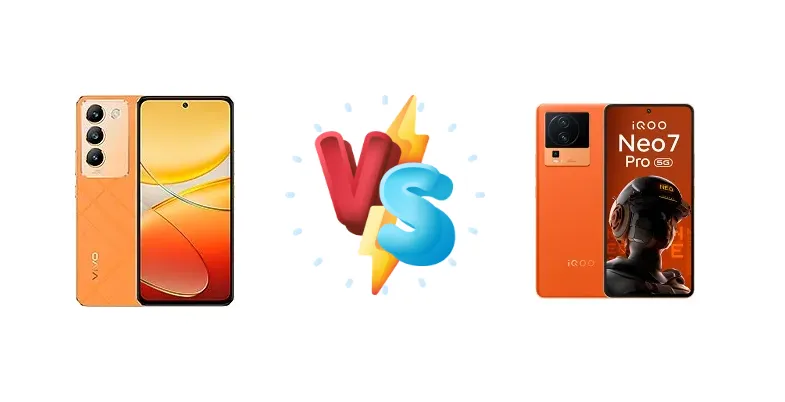
The vivo Y200e and iQOO Neo 7 Pro represent distinct approaches within vivo’s smartphone lineup. The Y200e aims for affordability with a focus on everyday usability, while the iQOO Neo 7 Pro targets performance-minded users seeking a more robust experience. This comparison dissects their core differences, focusing on the impact of their contrasting chipsets and charging capabilities.
🏆 Quick Verdict
For the average user prioritizing battery life and affordability, the vivo Y200e offers a solid experience. However, the iQOO Neo 7 Pro is the clear winner for gamers and power users, thanks to its significantly more powerful Snapdragon 8+ Gen 1 chipset and blazing-fast 120W charging. The performance difference justifies the price premium for demanding tasks.
| Network |
|---|
| 2G bands | GSM 850 / 900 / 1800 / 1900 | GSM 850 / 900 / 1800 / 1900 |
| 3G bands | HSDPA 850 / 900 / 2100 | HSDPA 800 / 850 / 900 / 1700(AWS) / 1900 / 2100 |
| 4G bands | 1, 3, 5, 8, 28, 38, 40, 41 | 1, 2, 3, 4, 5, 8, 28, 34, 38, 39, 40, 41 |
| 5G bands | 1, 3, 5, 8, 28, 40, 77, 78 SA/NSA | 1, 3, 5, 8, 28, 40, 77, 78 SA/NSA |
| Speed | HSPA, LTE, 5G | HSPA, LTE, 5G |
| Technology | GSM / HSPA / LTE / 5G | GSM / HSPA / LTE / 5G |
| Launch |
|---|
| Announced | 2024, February 22 | 2023, July 04 |
| Status | Available. Released 2024, February 22 | Available. Released 2023, July 15 |
| Body |
|---|
| Build | Glass front, plastic or silicone polymer (eco leather) back | Glass front, plastic frame, glass or leather back |
| Dimensions | 163.2 x 75.8 x 7.8 mm (6.43 x 2.98 x 0.31 in) | 164.8 x 76.9 x 8.5 mm or 8.9 mm |
| SIM | Nano-SIM + Nano-SIM | Nano-SIM + Nano-SIM |
| Weight | 185.5 g or 191 g (6.56 oz) | 197 g or 202 g (6.95 oz) |
| Display |
|---|
| Resolution | 1080 x 2400 pixels, 20:9 ratio (~395 ppi density) | 1080 x 2400 pixels, 20:9 ratio (~388 ppi density) |
| Size | 6.67 inches, 107.4 cm2 (~86.8% screen-to-body ratio) | 6.78 inches, 111.0 cm2 (~87.6% screen-to-body ratio) |
| Type | AMOLED, 120Hz, 1800 nits (peak) | AMOLED, 1B colors, 120Hz, HDR10+, 1300 nits (peak) |
| Platform |
|---|
| CPU | Octa-core (2x2.2 GHz Cortex-A78 & 6x1.95 GHz Cortex-A55) | Octa-core (1x3.19 GHz Cortex-X2 & 3x2.75 GHz Cortex-A710 & 4x2.0 GHz Cortex-A510) |
| Chipset | Qualcomm SM4450 Snapdragon 4 Gen 2 (4 nm) | Qualcomm SM8475 Snapdragon 8+ Gen 1 (4 nm) |
| GPU | Adreno 613 | Adreno 730 |
| OS | Android 14, Funtouch 14 | Android 13, Funtouch 13 |
| Memory |
|---|
| Card slot | microSDXC (uses shared SIM slot) | No |
| Internal | 128GB 6GB RAM, 128GB 8GB RAM | 128GB 8GB RAM, 256GB 12GB RAM |
| Main Camera |
|---|
| Dual | 50 MP, f/1.8, (wide), PDAF
Auxiliary lens | - |
| Features | LED flash, panorama, HDR | LED flash, HDR, panorama |
| Triple | - | 50 MP, f/1.9, 24mm (wide), 1/1.57", 1.0µm, PDAF, OIS
8 MP, f/2.2, 16mm (ultrawide), 1/4.0", 1.12µm
2 MP (macro) |
| Video | 1080p@30fps | 4K@30fps, 1080p@30fps |
| Selfie camera |
|---|
| Features | - | HDR |
| Single | 16 MP, f/2.0, (wide) | 16 MP, f/2.5, (wide), 1/3.1", 1.0µm |
| Video | 1080p@30fps | 1080p@30fps |
| Sound |
|---|
| 35mm jack | No | No |
| Loudspeaker | Yes, with stereo speakers | Yes, with stereo speakers |
| Comms |
|---|
| Bluetooth | 5.0, A2DP, LE | 5.3, A2DP, LE, aptX HD, aptX Adaptive |
| Infrared port | - | Yes |
| NFC | No | No |
| Positioning | GPS, GLONASS, GALILEO, BDS, QZSS | GPS, GLONASS, GALILEO, BDS, QZSS, NavIC |
| Radio | No | No |
| USB | USB Type-C 2.0, OTG | USB Type-C 2.0, OTG |
| WLAN | Wi-Fi 802.11 a/b/g/n/ac, dual-band | Wi-Fi 802.11 a/b/g/n/ac/6, dual-band, Wi-Fi Direct |
| Features |
|---|
| Sensors | Fingerprint (under display, optical), accelerometer, gyro, proximity, compass, flicker | Fingerprint (under display, optical), accelerometer, gyro, proximity, compass |
| Battery |
|---|
| Charging | 44W wired, 32% in 15 min | 120W wired, 50% in 8 min |
| Type | Li-Ion 5000 mAh | 5000 mAh |
| Misc |
|---|
| Colors | Black Diamond, Saffron Delight | Fearless Flame, Dark Storm |
| Models | V2336 | I2217 |
| Price | ₹ 19,999 | About 380 EUR |
vivo Y200e
- More affordable price point
- Good battery efficiency due to the Snapdragon 4 Gen 2
- Sufficient for everyday tasks
- Significantly slower charging speed
- Lower performance compared to the iQOO Neo 7 Pro
- Less capable for demanding games
vivo iQOO Neo 7 Pro
- Blazing-fast 120W charging
- Flagship-level performance with Snapdragon 8+ Gen 1
- Superior gaming capabilities
- Higher price tag
- Potentially higher power consumption
- May run warmer under heavy load
Display Comparison
While both devices likely feature LCD panels (data not provided), the core difference lies beneath the surface. The iQOO Neo 7 Pro, positioned as a higher-tier device, is expected to have a higher peak brightness and potentially a higher refresh rate for smoother scrolling and gaming. The Y200e will likely prioritize power efficiency over display fidelity. Without specific display specs, it's reasonable to assume the iQOO Neo 7 Pro offers a more visually immersive experience.
Camera Comparison
Without detailed camera specifications, it’s difficult to make a definitive comparison. However, the iQOO Neo 7 Pro, being a more premium device, is likely to feature a larger main sensor and more advanced image processing algorithms. While both phones may offer similar features like night mode, the iQOO Neo 7 Pro’s superior processing power will enable faster image processing and potentially better low-light performance. The Y200e will likely focus on providing adequate image quality for social media sharing, while the iQOO Neo 7 Pro aims for a more refined photographic experience.
Performance
The performance gap is substantial. The iQOO Neo 7 Pro’s Snapdragon 8+ Gen 1 (4nm) is a flagship-level chipset featuring a Cortex-X2 prime core clocked at 3.19 GHz, designed for peak performance. This contrasts sharply with the Y200e’s Snapdragon 4 Gen 2 (4nm), which utilizes a Cortex-A78-based core configuration peaking at 2.2 GHz. The 8+ Gen 1’s superior architecture and higher clock speeds translate to significantly faster app loading, smoother multitasking, and a far more capable gaming experience. The iQOO Neo 7 Pro will handle graphically intensive games at higher settings with less throttling. The Y200e is sufficient for casual gaming and everyday tasks, but will struggle with demanding titles.
Battery Life
The iQOO Neo 7 Pro’s 120W charging is a game-changer, capable of reaching 50% charge in just 8 minutes. This is a massive advantage over the Y200e’s 44W charging, which takes 15 minutes to reach 32%. While battery capacity isn’t specified, the faster charging of the iQOO Neo 7 Pro effectively mitigates any potential capacity difference. Users who frequently find themselves needing a quick top-up will greatly benefit from the iQOO Neo 7 Pro’s charging speed.
Buying Guide
Buy the vivo Y200e if you need a reliable daily driver for social media, browsing, and light tasks, and value long battery life over raw processing power. It’s ideal for users on a tighter budget. Buy the vivo iQOO Neo 7 Pro if you prioritize gaming, demanding apps, and quick charging. This phone is for those who want a smooth, responsive experience and don't want to wait for their phone to power up.
Frequently Asked Questions
❓ Will the Snapdragon 4 Gen 2 in the Y200e struggle with graphically intensive games like Genshin Impact?
Yes, the Snapdragon 4 Gen 2 is a mid-range chipset and will likely struggle to run Genshin Impact at high settings. You'll likely need to lower the graphics settings significantly to achieve playable frame rates, and even then, expect some stuttering. The iQOO Neo 7 Pro’s Snapdragon 8+ Gen 1 is far better suited for demanding games.
❓ How much faster is the 120W charging on the iQOO Neo 7 Pro compared to the 44W charging on the Y200e in real-world use?
The difference is substantial. The iQOO Neo 7 Pro can gain 50% charge in just 8 minutes, while the Y200e takes 15 minutes to reach 32%. This means you can add a significant amount of battery life to the iQOO Neo 7 Pro in the time it takes the Y200e to reach a relatively low charge level. This is a huge benefit for users who are always on the go.
❓ Does the iQOO Neo 7 Pro have any features to help manage heat during long gaming sessions?
While specific thermal solutions aren't detailed in the provided data, iQOO phones generally incorporate advanced cooling systems, such as vapor chamber cooling, to mitigate thermal throttling during prolonged gaming. The Snapdragon 8+ Gen 1 is also more efficient than previous generation flagships, contributing to better thermal management.