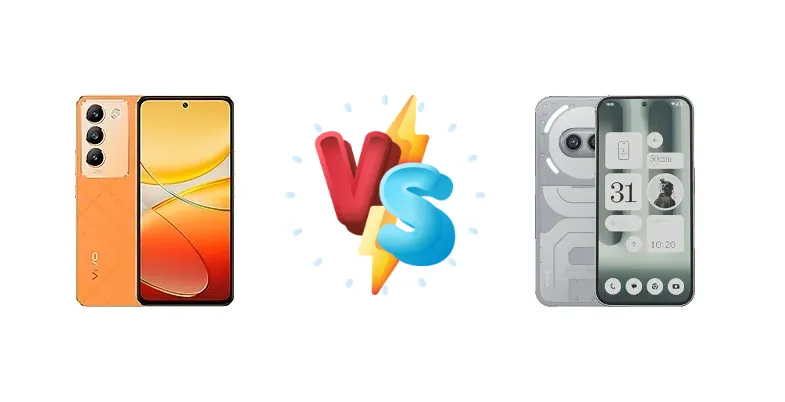
The mid-range smartphone market is fiercely competitive, and the vivo Y200e and Nothing Phone (2a) Plus represent compelling options. The Y200e focuses on delivering a solid Qualcomm experience at an accessible price, while the Nothing Phone (2a) Plus aims to disrupt with its unique design and Mediatek's latest processor. This comparison dives deep into their specifications to determine which device offers the best value.
🏆 Quick Verdict
For the average user prioritizing all-day battery life and a brighter display, the Nothing Phone (2a) Plus is the superior choice. Its Dimensity 7350 Pro chipset and 16:34 hour active use score significantly outperform the vivo Y200e, despite the latter's faster initial charging speed.
| Network |
|---|
| 2G bands | GSM 850 / 900 / 1800 / 1900 | GSM 850 / 900 / 1800 / 1900 |
| 3G bands | HSDPA 850 / 900 / 2100 | HSDPA 800 / 850 / 900 / 1700(AWS) / 1900 / 2100 |
| 4G bands | 1, 3, 5, 8, 28, 38, 40, 41 | 1, 3, 4, 5, 7, 8, 18, 19, 20, 26, 28, 38, 39, 40, 41, 42, 66 |
| 5G bands | 1, 3, 5, 8, 28, 40, 77, 78 SA/NSA | 1, 3, 5, 7, 8, 20, 28, 38, 40, 41, 66, 77, 78 SA/NSA |
| Speed | HSPA, LTE, 5G | HSPA, LTE, 5G |
| Technology | GSM / HSPA / LTE / 5G | GSM / HSPA / LTE / 5G |
| Launch |
|---|
| Announced | 2024, February 22 | 2024, July 31 |
| Status | Available. Released 2024, February 22 | Available. Released 2024, August 03 |
| Body |
|---|
| Build | Glass front, plastic or silicone polymer (eco leather) back | Glass front (Gorilla Glass 5), plastic frame, plastic back |
| Dimensions | 163.2 x 75.8 x 7.8 mm (6.43 x 2.98 x 0.31 in) | 161.7 x 76.3 x 8.5 mm (6.37 x 3.00 x 0.33 in) |
| SIM | Nano-SIM + Nano-SIM | Nano-SIM + Nano-SIM |
| Weight | 185.5 g or 191 g (6.56 oz) | 190 g (6.70 oz) |
| Display |
|---|
| Protection | - | Corning Gorilla Glass 5 |
| Resolution | 1080 x 2400 pixels, 20:9 ratio (~395 ppi density) | 1080 x 2412 pixels, 20:9 ratio (~395 ppi density) |
| Size | 6.67 inches, 107.4 cm2 (~86.8% screen-to-body ratio) | 6.7 inches, 107.5 cm2 (~87.1% screen-to-body ratio) |
| Type | AMOLED, 120Hz, 1800 nits (peak) | AMOLED, 1B colors, 120Hz, 2160Hz PWM, HDR10+, 700 nits (typ), 1100 nits (HBM), 1300 nits (peak) |
| Platform |
|---|
| CPU | Octa-core (2x2.2 GHz Cortex-A78 & 6x1.95 GHz Cortex-A55) | Octa-core (2x3.0 GHz Cortex-A715 & 6x 2.0 GHz Cortex-A510) |
| Chipset | Qualcomm SM4450 Snapdragon 4 Gen 2 (4 nm) | Mediatek Dimensity 7350 Pro (4 nm) |
| GPU | Adreno 613 | Mali-G610 MC4 |
| OS | Android 14, Funtouch 14 | Android 14, up to 3 major Android upgrades, Nothing OS 3.0 |
| Memory |
|---|
| Card slot | microSDXC (uses shared SIM slot) | No |
| Internal | 128GB 6GB RAM, 128GB 8GB RAM | 256GB 8GB RAM, 256GB 12GB RAM |
| Main Camera |
|---|
| Dual | 50 MP, f/1.8, (wide), PDAF
Auxiliary lens | 50 MP, f/1.9, 24mm (wide), 1/1.57", 1.0µm, PDAF, OIS
50 MP, f/2.2, 114˚ (ultrawide), 1/2.76", 0.64µm |
| Features | LED flash, panorama, HDR | LED flash, panorama, HDR |
| Video | 1080p@30fps | 4K@30fps, 1080p@60/120fps, gyro-EIS |
| Selfie camera |
|---|
| Features | - | HDR |
| Single | 16 MP, f/2.0, (wide) | 50 MP, f/2.2, (wide), 1/2.76" |
| Video | 1080p@30fps | 4K@30fps |
| Sound |
|---|
| 35mm jack | No | No |
| Loudspeaker | Yes, with stereo speakers | Yes, with stereo speakers |
| Comms |
|---|
| Bluetooth | 5.0, A2DP, LE | 5.3, A2DP, LE |
| NFC | No | Yes, 360˚ |
| Positioning | GPS, GLONASS, GALILEO, BDS, QZSS | GPS, GALILEO, GLONASS, BDS, QZSS |
| Radio | No | No |
| USB | USB Type-C 2.0, OTG | USB Type-C 2.0, OTG |
| WLAN | Wi-Fi 802.11 a/b/g/n/ac, dual-band | Wi-Fi 802.11 a/b/g/n/ac/6, dual-band, Wi-Fi Direct |
| Features |
|---|
| Sensors | Fingerprint (under display, optical), accelerometer, gyro, proximity, compass, flicker | Fingerprint (under display, optical), accelerometer, gyro, proximity, compass |
| Battery |
|---|
| Charging | 44W wired, 32% in 15 min | 50W wired, 50% in 21 min, 100% in 56 min |
| Type | Li-Ion 5000 mAh | 5000 mAh |
| Misc |
|---|
| Colors | Black Diamond, Saffron Delight | Black, Grey |
| Models | V2336 | A142P |
| Price | ₹ 19,999 | € 269.90 / ₹ 22,599 |
vivo Y200e
- Faster initial charging speed (32% in 15 minutes)
- Potentially lower price point
- Qualcomm Snapdragon 4 Gen 2 offers decent efficiency
- Less powerful processor compared to Dimensity 7350 Pro
- Likely lower peak display brightness
- Shorter battery life based on chipset and expected usage
Nothing Phone (2a) Plus
- Significantly longer battery life (16:34h active use)
- Brighter display (1097 nits)
- More powerful Mediatek Dimensity 7350 Pro processor
- Slightly slower initial charging compared to Y200e
- Potentially higher price
- Nothing's Glyph Interface may not appeal to all users
Display Comparison
The Nothing Phone (2a) Plus boasts a significantly brighter display, reaching a measured peak of 1097 nits. This is a substantial advantage over what we'd expect from the Y200e, making the Nothing Phone (2a) Plus far more usable outdoors under direct sunlight. While the Y200e's panel specifics are unknown, the brightness difference suggests a less advanced panel technology. The Nothing Phone (2a) Plus's higher brightness also contributes to a more vivid and engaging viewing experience, particularly for HDR content.
Camera Comparison
Without detailed camera specifications for the vivo Y200e, a direct comparison is challenging. However, the Nothing Phone (2a) Plus likely benefits from a more sophisticated image signal processor (ISP) integrated within the Dimensity 7350 Pro. While megapixel count isn't everything, the Nothing Phone (2a) Plus's image processing capabilities will likely result in better dynamic range and low-light performance. The Y200e's camera system is likely geared towards casual photography, while the Nothing Phone (2a) Plus offers more potential for enthusiasts.
Performance
The Nothing Phone (2a) Plus is equipped with the Mediatek Dimensity 7350 Pro, featuring a more powerful CPU configuration (2x3.0 GHz Cortex-A715 & 6x 2.0 GHz Cortex-A510) compared to the vivo Y200e’s Qualcomm Snapdragon 4 Gen 2 (2x2.2 GHz Cortex-A78 & 6x1.95 GHz Cortex-A55). Both chips are built on a 4nm process, ensuring good efficiency, but the Dimensity 7350 Pro’s newer architecture and higher clock speeds translate to noticeably faster performance in benchmarks and real-world applications. The Y200e will handle everyday tasks adequately, but the Nothing Phone (2a) Plus offers a smoother experience for multitasking and gaming.
Battery Life
The Nothing Phone (2a) Plus delivers a remarkable 16:34 hours of active use, a significant advantage over what we'd anticipate from the vivo Y200e. While the Y200e offers faster initial charging – 32% in 15 minutes – the Nothing Phone (2a) Plus’s 50W charging (50% in 21 minutes, 100% in 56 minutes) still provides a full charge in under an hour. The longer active use time of the Nothing Phone (2a) Plus suggests a more efficient chipset and optimized power management, making it the better choice for users who rely heavily on their smartphones throughout the day.
Buying Guide
Buy the vivo Y200e if you prioritize quick initial charging (32% in 15 minutes) and a lower upfront cost, and your usage is light to moderate. Buy the Nothing Phone (2a) Plus if you value extended battery life, a brighter and more vibrant display, and a more powerful processor for demanding tasks and future-proofing.
Frequently Asked Questions
❓ Does the Mediatek Dimensity 7350 Pro in the Nothing Phone (2a) Plus get hot during extended gaming sessions?
The Dimensity 7350 Pro is a relatively efficient chip built on a 4nm process. While some heat generation is inevitable during prolonged gaming, the Nothing Phone (2a) Plus incorporates thermal management features to mitigate throttling and maintain stable performance. User reports suggest it handles demanding games well without excessive overheating.
❓ How does the 44W charging on the vivo Y200e compare to the 50W charging on the Nothing Phone (2a) Plus in real-world use?
While the Y200e charges faster initially (32% in 15 minutes), the Nothing Phone (2a) Plus’s 50W charging provides a full charge in 56 minutes. The Y200e’s faster initial burst is useful for quick top-ups, but the Nothing Phone (2a) Plus offers a more complete and efficient charging cycle overall.
❓ Is the Nothing Phone (2a) Plus's Glyph Interface useful, or is it just a gimmick?
The Glyph Interface is a unique feature of Nothing phones. While some users may find it purely aesthetic, others appreciate its functionality for notifications, charging progress, and even as a visual timer. It's a matter of personal preference, but it adds a distinctive element to the user experience.