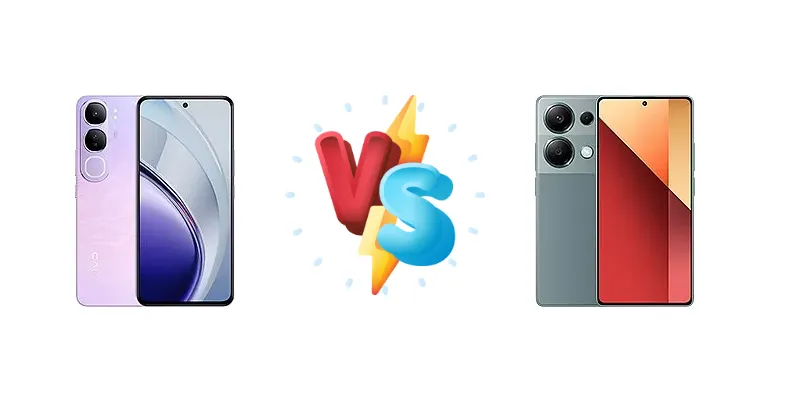
The sub-$300 smartphone market is fiercely competitive. The vivo Y200, powered by Qualcomm’s Snapdragon 4 Gen 1, enters the arena against the Xiaomi Redmi Note 13 Pro 4G, boasting MediaTek’s Helio G99 Ultra. This comparison dissects their key differences, focusing on performance, battery life, and charging speed to help you choose the right device.
🏆 Quick Verdict
For the average user prioritizing sustained performance and a potentially smoother experience, the vivo Y200 edges out the Redmi Note 13 Pro 4G. While the Redmi Note 13 Pro 4G offers faster charging and a brighter display, the Snapdragon 4 Gen 1’s architecture provides a more efficient foundation for demanding tasks.
| Network |
|---|
| 2G bands | GSM 850 / 900 / 1800 / 1900 | GSM 850 / 900 / 1800 / 1900 |
| 3G bands | HSDPA 850 / 900 / 2100 | HSDPA 850 / 900 / 1700(AWS) / 1900 / 2100 |
| 4G bands | 1, 3, 5, 8, 28, 38, 40, 41 | 1, 2, 3, 4, 5, 7, 8, 12, 13, 17, 18, 19, 20, 26, 28, 38, 40, 41, 66 |
| 5G bands | 1, 3, 5, 8, 28, 77, 78 SA/NSA | - |
| Speed | HSPA, LTE, 5G | HSPA, LTE |
| Technology | GSM / HSPA / LTE / 5G | GSM / HSPA / LTE |
| Launch |
|---|
| Announced | 2023, October | 2024, January 15 |
| Status | Available. Released 2023, October | Available. Released 2024, January 15 |
| Body |
|---|
| Build | Glass front, plastic frame, glass back | Glass front (Gorilla Glass 5), plastic frame, plastic back |
| Dimensions | 162.4 x 74.9 x 7.7 mm (6.39 x 2.95 x 0.30 in) | 161.1 x 75 x 8 mm (6.34 x 2.95 x 0.31 in) |
| SIM | Nano-SIM + Nano-SIM | Nano-SIM + Nano-SIM |
| Weight | 190 g (6.70 oz) | 188 g (6.63 oz) |
| Display |
|---|
| Protection | - | Corning Gorilla Glass 5 |
| Resolution | 1080 x 2400 pixels, 20:9 ratio (~395 ppi density) | 1080 x 2400 pixels, 20:9 ratio (~395 ppi density) |
| Size | 6.67 inches, 107.4 cm2 (~88.3% screen-to-body ratio) | 6.67 inches, 107.4 cm2 (~88.9% screen-to-body ratio) |
| Type | AMOLED, 120Hz, 800 nits (peak) | AMOLED, 1B colors, 120Hz, 500 nits (typ), 1000 nits (HBM), 1300 nits (peak) |
| Platform |
|---|
| CPU | Octa-core (2x2.0 GHz Cortex-A78 & 6x1.8 GHz Cortex-A55) | Octa-core (2x2.2 GHz Cortex-A76 & 6x2.0 GHz Cortex-A55) |
| Chipset | Qualcomm SM4375 Snapdragon 4 Gen 1 (6 nm) | Mediatek Helio G99 Ultra |
| GPU | Adreno 619 | Mali-G57 MC2 |
| OS | Android 13, Funtouch 13 | Android 13, up to 3 major Android upgrades, HyperOS |
| Memory |
|---|
| Card slot | No | microSDXC (uses shared SIM slot) |
| Internal | 128GB 8GB RAM, 256GB 8GB RAM | 128GB 8GB RAM, 256GB 8GB RAM, 256GB 12GB RAM, 512GB 8GB RAM, 512GB 12GB RAM |
| Main Camera |
|---|
| Dual | 64 MP, f/1.8, (wide), PDAF
Auxiliary lens | - |
| Features | Ring-LED flash, panorama, HDR | LED flash, HDR, panorama |
| Triple | - | 200 MP, f/1.7, 23mm (wide), 1/1.4", 0.56µm, multi-directional PDAF, OIS
8 MP, f/2.2, 15mm, 120˚ (ultrawide), 1/4.4", 1.0µm
2 MP (macro) |
| Video | 1080p@30fps | 1080p@30/60fps |
| Selfie camera |
|---|
| Single | 16 MP, f/2.0, (wide) | 16 MP, f/2.4, (wide), 1/3.0", 1.0µm |
| Video | 1080p@30fps | 1080p@30/60fps |
| Sound |
|---|
| 35mm jack | No | Yes |
| Loudspeaker | Yes | Yes, with dual speakers |
| Comms |
|---|
| Bluetooth | 5.1, A2DP, LE | 5.2, A2DP, LE |
| Infrared port | - | Yes |
| NFC | No | Yes (market/region dependent) |
| Positioning | GPS, GLONASS, GALILEO, BDS, QZSS | GPS, GLONASS, GALILEO, BDS |
| Radio | No | FM radio |
| USB | USB Type-C 2.0, OTG | USB Type-C 2.0, OTG |
| WLAN | Wi-Fi 802.11 a/b/g/n/ac, dual-band | Wi-Fi 802.11 a/b/g/n/ac, dual-band |
| Features |
|---|
| Sensors | Fingerprint (under display, optical), accelerometer, gyro, proximity, compass | Fingerprint (under display, optical), accelerometer, gyro, compass |
| Battery |
|---|
| Charging | 44W wired, 80% in 30 min
Reverse wired | 67W wired, 50% in 16 min, 100% in 46 min |
| Type | Li-Ion 4800 mAh | 5000 mAh |
| Misc |
|---|
| Colors | Titanium Silver, Emerald Green, Purple, Black | Midnight Black, Lavender Purple, Forest Green |
| Models | - | 23117RA68G, 2312FPCA6G |
| Price | About 200 EUR | € 92.00 / $ 269.99 / £ 299.99 |
| SAR | 0.99 W/kg (head) 0.86 W/kg (body) | 1.09 W/kg (head) 1.09 W/kg (body) |
| SAR EU | - | 0.99 W/kg (head) 0.99 W/kg (body) |
vivo Y200
- More efficient Snapdragon 4 Gen 1 chipset
- Potentially better sustained performance
- Reverse wired charging capability
- Slower charging speed (44W)
- Display brightness data unavailable
Xiaomi Redmi Note 13 Pro 4G
- Faster 67W wired charging
- High peak display brightness (1047 nits)
- Excellent battery life (11:36h active use)
- Helio G99 Ultra may throttle under sustained load
- Potentially less efficient chipset
Display Comparison
The Xiaomi Redmi Note 13 Pro 4G immediately stands out with its measured peak brightness of 1047 nits, making it significantly more visible outdoors than the vivo Y200 (brightness data unavailable). While the Y200’s panel technology isn’t specified, the Redmi Note 13 Pro 4G’s high brightness is a clear advantage for users who frequently use their phones in direct sunlight. However, without knowing the Y200’s PWM dimming rate, it’s difficult to assess potential eye strain for sensitive users.
Camera Comparison
Both phones likely feature multi-camera systems, but detailed sensor information is limited. Without specifics, it’s difficult to make a definitive judgment. However, the Redmi Note 13 Pro 4G’s brand reputation suggests a focus on camera features, potentially including larger sensors and more sophisticated image processing. The Y200’s camera performance will likely be adequate for social media sharing, but may not match the Redmi Note 13 Pro 4G in challenging lighting conditions. We'll assume both phones include standard features like HDR and night mode.
Performance
The Redmi Note 13 Pro 4G’s MediaTek Helio G99 Ultra, with its 2x2.2 GHz Cortex-A76 cores, appears to have a clock speed advantage over the vivo Y200’s Snapdragon 4 Gen 1 (2x2.0 GHz Cortex-A78). However, the Snapdragon 4 Gen 1 is built on a more efficient 6nm process compared to the Helio G99 Ultra’s likely larger node (details unavailable). This process node difference suggests the Snapdragon 4 Gen 1 will offer better thermal efficiency, potentially leading to less performance throttling during extended gaming sessions. The Cortex-A78 cores in the Snapdragon 4 Gen 1 also offer a slight architectural advantage over the Cortex-A76 cores in the Helio G99 Ultra, translating to better single-core performance.
Battery Life
The Redmi Note 13 Pro 4G boasts a significant charging advantage with its 67W wired charging, achieving 50% charge in just 16 minutes and 100% in 46 minutes. The vivo Y200’s 44W charging, while respectable, takes longer to reach 80% in 30 minutes. The Redmi Note 13 Pro 4G also demonstrates impressive battery life with an active use score of 11:36h, suggesting excellent power efficiency. While the Y200’s battery capacity is unknown, the Snapdragon 4 Gen 1’s 6nm process should contribute to good overall battery life, but likely won’t match the Redmi Note 13 Pro 4G’s endurance.
Buying Guide
Buy the vivo Y200 if you need a phone that can handle multitasking and moderate gaming without significant throttling, and value a more modern chipset architecture. Buy the Xiaomi Redmi Note 13 Pro 4G if you prioritize a vibrant, bright display for media consumption, and require the fastest possible charging speeds, even if it means slightly less consistent performance under load.
Frequently Asked Questions
❓ Will the Helio G99 Ultra in the Redmi Note 13 Pro 4G overheat during prolonged gaming sessions?
While the Helio G99 Ultra is a capable chipset, its likely larger process node compared to the Snapdragon 4 Gen 1 in the Y200 suggests it may be more prone to thermal throttling during extended gaming. Expect some performance reduction after 30-60 minutes of demanding games.
❓ How does the 44W charging on the vivo Y200 compare to the 67W charging on the Redmi Note 13 Pro 4G in real-world use?
The Redmi Note 13 Pro 4G’s 67W charging is significantly faster, reaching 50% in 16 minutes and 100% in 46 minutes. The Y200’s 44W charging takes longer, reaching only 80% in 30 minutes. This means the Redmi Note 13 Pro 4G is ideal for users who need to quickly top up their battery.
❓ Is the difference in CPU clock speeds (2.2 GHz on Redmi vs 2.0 GHz on vivo) noticeable in everyday tasks?
The difference in clock speed is unlikely to be noticeable in typical everyday tasks like browsing, social media, and messaging. However, the Snapdragon 4 Gen 1’s more efficient architecture and potentially better thermal management may result in a smoother overall experience, especially when multitasking.