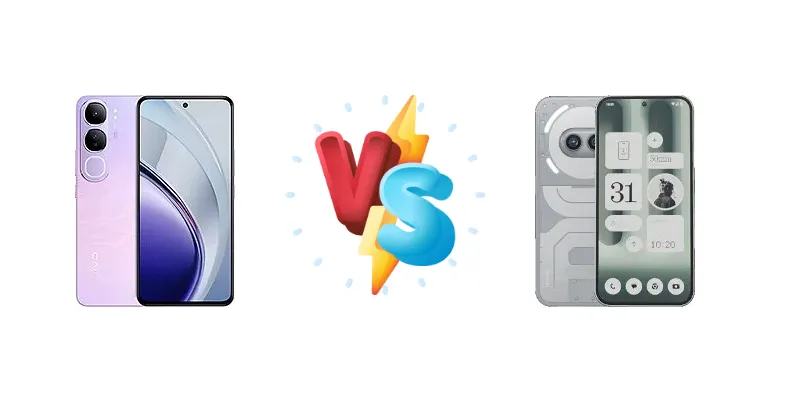
The mid-range smartphone market is fiercely competitive, and the vivo Y200 and Nothing Phone (2a) Plus represent compelling options for budget-conscious buyers. The Y200 focuses on a balance of features, while the Nothing Phone (2a) Plus aims to deliver a refined experience with a focus on battery life and a unique design. This comparison dives deep into their specifications to determine which device offers the best value.
🏆 Quick Verdict
For the average user prioritizing all-day battery life and a smoother software experience, the Nothing Phone (2a) Plus is the better choice. Its Mediatek Dimensity 7350 Pro chipset and optimized software deliver superior performance and endurance, despite the vivo Y200's faster 44W charging.
| Network |
|---|
| 2G bands | GSM 850 / 900 / 1800 / 1900 | GSM 850 / 900 / 1800 / 1900 |
| 3G bands | HSDPA 850 / 900 / 2100 | HSDPA 800 / 850 / 900 / 1700(AWS) / 1900 / 2100 |
| 4G bands | 1, 3, 5, 8, 28, 38, 40, 41 | 1, 3, 4, 5, 7, 8, 18, 19, 20, 26, 28, 38, 39, 40, 41, 42, 66 |
| 5G bands | 1, 3, 5, 8, 28, 77, 78 SA/NSA | 1, 3, 5, 7, 8, 20, 28, 38, 40, 41, 66, 77, 78 SA/NSA |
| Speed | HSPA, LTE, 5G | HSPA, LTE, 5G |
| Technology | GSM / HSPA / LTE / 5G | GSM / HSPA / LTE / 5G |
| Launch |
|---|
| Announced | 2023, October | 2024, July 31 |
| Status | Available. Released 2023, October | Available. Released 2024, August 03 |
| Body |
|---|
| Build | Glass front, plastic frame, glass back | Glass front (Gorilla Glass 5), plastic frame, plastic back |
| Dimensions | 162.4 x 74.9 x 7.7 mm (6.39 x 2.95 x 0.30 in) | 161.7 x 76.3 x 8.5 mm (6.37 x 3.00 x 0.33 in) |
| SIM | Nano-SIM + Nano-SIM | Nano-SIM + Nano-SIM |
| Weight | 190 g (6.70 oz) | 190 g (6.70 oz) |
| Display |
|---|
| Protection | - | Corning Gorilla Glass 5 |
| Resolution | 1080 x 2400 pixels, 20:9 ratio (~395 ppi density) | 1080 x 2412 pixels, 20:9 ratio (~395 ppi density) |
| Size | 6.67 inches, 107.4 cm2 (~88.3% screen-to-body ratio) | 6.7 inches, 107.5 cm2 (~87.1% screen-to-body ratio) |
| Type | AMOLED, 120Hz, 800 nits (peak) | AMOLED, 1B colors, 120Hz, 2160Hz PWM, HDR10+, 700 nits (typ), 1100 nits (HBM), 1300 nits (peak) |
| Platform |
|---|
| CPU | Octa-core (2x2.0 GHz Cortex-A78 & 6x1.8 GHz Cortex-A55) | Octa-core (2x3.0 GHz Cortex-A715 & 6x 2.0 GHz Cortex-A510) |
| Chipset | Qualcomm SM4375 Snapdragon 4 Gen 1 (6 nm) | Mediatek Dimensity 7350 Pro (4 nm) |
| GPU | Adreno 619 | Mali-G610 MC4 |
| OS | Android 13, Funtouch 13 | Android 14, up to 3 major Android upgrades, Nothing OS 3.0 |
| Memory |
|---|
| Card slot | No | No |
| Internal | 128GB 8GB RAM, 256GB 8GB RAM | 256GB 8GB RAM, 256GB 12GB RAM |
| Main Camera |
|---|
| Dual | 64 MP, f/1.8, (wide), PDAF
Auxiliary lens | 50 MP, f/1.9, 24mm (wide), 1/1.57", 1.0µm, PDAF, OIS
50 MP, f/2.2, 114˚ (ultrawide), 1/2.76", 0.64µm |
| Features | Ring-LED flash, panorama, HDR | LED flash, panorama, HDR |
| Video | 1080p@30fps | 4K@30fps, 1080p@60/120fps, gyro-EIS |
| Selfie camera |
|---|
| Features | - | HDR |
| Single | 16 MP, f/2.0, (wide) | 50 MP, f/2.2, (wide), 1/2.76" |
| Video | 1080p@30fps | 4K@30fps |
| Sound |
|---|
| 35mm jack | No | No |
| Loudspeaker | Yes | Yes, with stereo speakers |
| Comms |
|---|
| Bluetooth | 5.1, A2DP, LE | 5.3, A2DP, LE |
| NFC | No | Yes, 360˚ |
| Positioning | GPS, GLONASS, GALILEO, BDS, QZSS | GPS, GALILEO, GLONASS, BDS, QZSS |
| Radio | No | No |
| USB | USB Type-C 2.0, OTG | USB Type-C 2.0, OTG |
| WLAN | Wi-Fi 802.11 a/b/g/n/ac, dual-band | Wi-Fi 802.11 a/b/g/n/ac/6, dual-band, Wi-Fi Direct |
| Features |
|---|
| Sensors | Fingerprint (under display, optical), accelerometer, gyro, proximity, compass | Fingerprint (under display, optical), accelerometer, gyro, proximity, compass |
| Battery |
|---|
| Charging | 44W wired, 80% in 30 min
Reverse wired | 50W wired, 50% in 21 min, 100% in 56 min |
| Type | Li-Ion 4800 mAh | 5000 mAh |
| Misc |
|---|
| Colors | Titanium Silver, Emerald Green, Purple, Black | Black, Grey |
| Models | - | A142P |
| Price | About 200 EUR | € 269.90 / ₹ 22,599 |
| SAR | 0.99 W/kg (head) 0.86 W/kg (body) | - |
vivo Y200
- Faster 44W wired charging
- Potentially lower price point
- Traditional smartphone design
- Less powerful chipset (Snapdragon 4 Gen 1)
- Likely shorter battery life
- Display brightness likely lower
Nothing Phone (2a) Plus
- Superior performance (Dimensity 7350 Pro)
- Longer battery life (16:34h active use)
- Brighter display (1097 nits)
- Slower charging speed (56 minutes to 100%)
- Potentially higher price
- Unique design may not appeal to everyone
Display Comparison
The Nothing Phone (2a) Plus boasts a significantly brighter display, reaching a measured peak of 1097 nits, compared to an unspecified brightness for the vivo Y200. This higher brightness translates to better visibility outdoors under direct sunlight. While the Y200’s panel technology isn’t specified, the Nothing Phone (2a) Plus likely utilizes an AMOLED panel, offering superior contrast and color accuracy. Bezels are expected to be similar on both devices, catering to the mid-range segment. The Nothing Phone (2a) Plus’s brightness advantage is a key differentiator for users who frequently use their phones outdoors.
Camera Comparison
Without detailed camera specifications for the vivo Y200, a direct comparison is challenging. However, both phones likely feature a primary camera as their main selling point. The Nothing Phone (2a) Plus is expected to prioritize image processing and software optimization for natural-looking photos. The aperture and sensor size of the main camera on the Nothing Phone (2a) Plus will be crucial for low-light performance. The presence of Optical Image Stabilization (OIS) on either device would be a significant advantage. It's reasonable to assume both phones will include standard auxiliary lenses, but their quality is unlikely to be a major differentiating factor.
Performance
The Nothing Phone (2a) Plus is equipped with the Mediatek Dimensity 7350 Pro (4nm), featuring a more powerful CPU configuration – 2x3.0 GHz Cortex-A715 cores and 6x2.0 GHz Cortex-A510 cores – compared to the vivo Y200’s Qualcomm Snapdragon 4 Gen 1 (6nm) with 2x2.0 GHz Cortex-A78 and 6x1.8 GHz Cortex-A55 cores. The 4nm process node of the Dimensity 7350 Pro offers improved power efficiency and thermal performance, potentially leading to less throttling during sustained workloads. While the Snapdragon 4 Gen 1 is a capable chip for everyday tasks, the Dimensity 7350 Pro provides a noticeable performance uplift for gaming and demanding applications. The Nothing Phone (2a) Plus benefits from a more modern CPU architecture.
Battery Life
The Nothing Phone (2a) Plus demonstrates a clear advantage in battery life, achieving an active use score of 16 hours and 34 minutes. While the vivo Y200’s battery capacity is unknown, its 44W wired charging is faster than the Nothing Phone (2a) Plus’s 50W charging, reaching 80% in 30 minutes. However, the Nothing Phone (2a) Plus still manages a full charge in 56 minutes. The superior efficiency of the Dimensity 7350 Pro chipset, combined with software optimizations, allows the Nothing Phone (2a) Plus to deliver significantly longer battery life despite the slightly slower charging speed. Users prioritizing longevity will favor the Nothing Phone (2a) Plus.
Buying Guide
Buy the vivo Y200 if you prioritize rapid charging speeds and a more traditional smartphone aesthetic. Its 44W charging can top up the battery quickly when you're in a pinch. Buy the Nothing Phone (2a) Plus if you value long-lasting battery life, a clean and minimalist software experience (Nothing OS), and a brighter, more vibrant display for media consumption.
Frequently Asked Questions
❓ Does the Mediatek Dimensity 7350 Pro in the Nothing Phone (2a) Plus get hot during extended gaming sessions?
The Dimensity 7350 Pro is built on a 4nm process, which generally results in better thermal efficiency compared to larger node chipsets. While some heat generation is inevitable during gaming, the Nothing Phone (2a) Plus is expected to manage temperatures effectively, minimizing throttling and maintaining consistent performance for longer periods. The phone's cooling system, though not detailed, is likely optimized for this chipset.
❓ How does the software experience differ between Funtouch OS (vivo Y200) and Nothing OS (Nothing Phone (2a) Plus)?
Funtouch OS is known for its customization options and feature-rich interface, but it can sometimes feel bloated with pre-installed apps. Nothing OS, on the other hand, prioritizes a clean, minimalist, and near-stock Android experience. It focuses on simplicity and efficiency, offering a smoother and more responsive user interface. Users who prefer a less cluttered experience will likely favor Nothing OS.
❓ Is the 44W charging on the vivo Y200 significantly faster in real-world use than the 50W charging on the Nothing Phone (2a) Plus?
While the vivo Y200's 44W charging reaches 80% in 30 minutes, the Nothing Phone (2a) Plus takes 56 minutes for a full charge. However, the difference in practical charging time isn't as dramatic as the wattage suggests. The Nothing Phone (2a) Plus's larger battery capacity and optimized charging algorithms contribute to a competitive charging experience, and the longer battery life reduces the frequency of needing to charge.