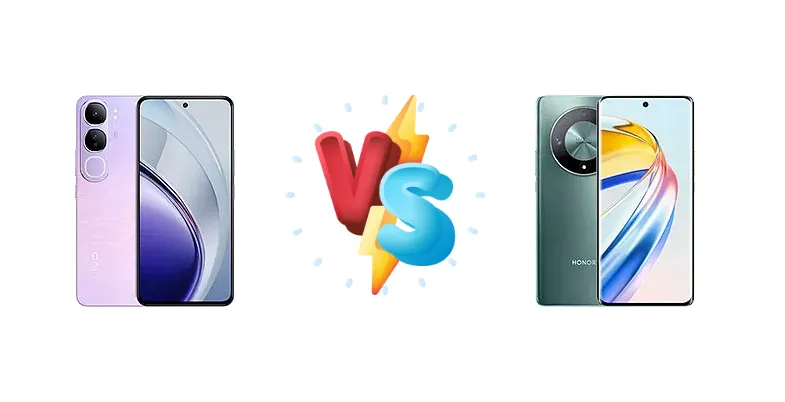
The vivo Y200 and Honor X9b represent compelling options in the increasingly competitive mid-range smartphone market. Both devices aim to deliver a balanced experience, but they diverge in their core processing power and charging capabilities. This comparison dissects the key differences between the Snapdragon 4 Gen 1-powered vivo Y200 and the Snapdragon 6 Gen 1-equipped Honor X9b, helping you determine which phone best suits your needs.
🏆 Quick Verdict
For the average user prioritizing sustained performance and faster charging, the vivo Y200 emerges as the stronger contender. While the Honor X9b benefits from a more efficient 4nm process, the Y200’s slightly more powerful CPU core configuration and 44W charging provide a noticeable edge in everyday tasks and quick top-ups.
| Network |
|---|
| 2G bands | GSM 850 / 900 / 1800 / 1900 | GSM 850 / 900 / 1800 / 1900 |
| 3G bands | HSDPA 850 / 900 / 2100 | HSDPA 850 / 900 / 1900 / 2100 |
| 4G bands | 1, 3, 5, 8, 28, 38, 40, 41 | 1, 2, 3, 4, 5, 7, 8, 20, 28, 32, 38, 40, 41 |
| 5G bands | 1, 3, 5, 8, 28, 77, 78 SA/NSA | 1, 3, 7, 8, 20, 28, 38, 40, 41, 77, 78 SA/NSA |
| Speed | HSPA, LTE, 5G | HSPA, LTE, 5G |
| Technology | GSM / HSPA / LTE / 5G | GSM / HSPA / LTE / 5G |
| Launch |
|---|
| Announced | 2023, October | 2023, October 18 |
| Status | Available. Released 2023, October | Available. Released 2023, October |
| Body |
|---|
| Build | Glass front, plastic frame, glass back | - |
| Dimensions | 162.4 x 74.9 x 7.7 mm (6.39 x 2.95 x 0.30 in) | 163.6 x 75.5 x 8 mm (6.44 x 2.97 x 0.31 in) |
| SIM | Nano-SIM + Nano-SIM | Nano-SIM + Nano-SIM |
| Weight | 190 g (6.70 oz) | 185 g (6.53 oz) |
| Display |
|---|
| Resolution | 1080 x 2400 pixels, 20:9 ratio (~395 ppi density) | 1220 x 2652 pixels, 19.5:9 ratio (~431 ppi density) |
| Size | 6.67 inches, 107.4 cm2 (~88.3% screen-to-body ratio) | 6.78 inches, 112.6 cm2 (~91.2% screen-to-body ratio) |
| Type | AMOLED, 120Hz, 800 nits (peak) | AMOLED, 1B colors, 120Hz, 1200 nits (peak) |
| Platform |
|---|
| CPU | Octa-core (2x2.0 GHz Cortex-A78 & 6x1.8 GHz Cortex-A55) | Octa-core (4x2.2 GHz Cortex-A78 & 4x1.8 GHz Cortex-A55) |
| Chipset | Qualcomm SM4375 Snapdragon 4 Gen 1 (6 nm) | Qualcomm SM6450 Snapdragon 6 Gen 1 (4 nm) |
| GPU | Adreno 619 | Adreno 710 |
| OS | Android 13, Funtouch 13 | Android 13, Magic OS 7.2 |
| Memory |
|---|
| Card slot | No | No |
| Internal | 128GB 8GB RAM, 256GB 8GB RAM | 256GB 8GB RAM, 256GB 12GB RAM, 512GB 8GB RAM, 512GB 12GB RAM |
| Main Camera |
|---|
| Dual | 64 MP, f/1.8, (wide), PDAF
Auxiliary lens | - |
| Features | Ring-LED flash, panorama, HDR | LED flash, panorama, HDR |
| Triple | - | 108 MP, f/1.8, (wide), 1/1.67", PDAF
5 MP, f/2.2, (ultrawide)
2 MP (macro) |
| Video | 1080p@30fps | 4K@30fps, 1080p@30fps |
| Selfie camera |
|---|
| Single | 16 MP, f/2.0, (wide) | 16 MP, f/2.5, (wide) |
| Video | 1080p@30fps | 1080p@30fps |
| Sound |
|---|
| 35mm jack | No | No |
| Loudspeaker | Yes | Yes |
| Comms |
|---|
| Bluetooth | 5.1, A2DP, LE | 5.1, A2DP, LE |
| Infrared port | - | Yes |
| NFC | No | Yes (market/region dependent) |
| Positioning | GPS, GLONASS, GALILEO, BDS, QZSS | GPS, GLONASS, GALILEO, BDS |
| Radio | No | No |
| USB | USB Type-C 2.0, OTG | USB Type-C 2.0, OTG |
| WLAN | Wi-Fi 802.11 a/b/g/n/ac, dual-band | Wi-Fi 802.11 a/b/g/n/ac, dual-band, Wi-Fi Direct |
| Features |
|---|
| Sensors | Fingerprint (under display, optical), accelerometer, gyro, proximity, compass | Fingerprint (under display, optical), accelerometer, gyro, proximity, compass |
| Battery |
|---|
| Charging | 44W wired, 80% in 30 min
Reverse wired | 35W wired
Reverse wired |
| Type | Li-Ion 4800 mAh | Li-Po 5800 mAh |
| Misc |
|---|
| Colors | Titanium Silver, Emerald Green, Purple, Black | Sunrise Orange, Midnight Black, Emerald Green |
| Models | - | ALI-NX1 |
| Price | About 200 EUR | About 970 EUR |
| SAR | 0.99 W/kg (head) 0.86 W/kg (body) | - |
vivo Y200
- Faster 44W charging for quicker top-ups
- Potentially stronger single-core CPU performance
- Reverse wired charging capability
- Less power-efficient 6nm chipset
- Potential for more thermal throttling under heavy load
Honor X9b
- More power-efficient 4nm chipset
- Potentially better thermal management
- Reverse wired charging capability
- Slower 35W charging
- Potentially lower single-core CPU performance
Display Comparison
Display specifications are not provided, so a direct comparison is limited. However, given the price bracket, both devices likely utilize LCD panels with FHD+ resolution. The absence of LTPO technology suggests standard refresh rates (likely 60Hz or 90Hz). Bezels are expected to be moderate, and color accuracy will likely be tuned for vibrant, rather than strictly accurate, visuals. The display will likely be a differentiating factor based on peak brightness and color calibration, which are currently unknown.
Camera Comparison
Camera details are absent, making a comprehensive comparison impossible. However, given the market segment, both phones likely feature a primary camera around 50MP. The presence or absence of Optical Image Stabilization (OIS) will be a crucial differentiator, with OIS providing sharper images and smoother video recording. Lens apertures will dictate low-light performance; wider apertures (lower f-number) are preferable. The inclusion of a dedicated night mode and intelligent scene recognition will also impact image quality. The marketing often highlights megapixel counts, but sensor size and image processing algorithms are far more important.
Performance
The core difference lies in the chipsets. The Honor X9b’s Snapdragon 6 Gen 1 (4nm) boasts a more advanced manufacturing process, leading to improved power efficiency compared to the vivo Y200’s Snapdragon 4 Gen 1 (6nm). However, the Y200 counters with a CPU configuration featuring 2x2.0 GHz Cortex-A78 cores alongside 6x1.8 GHz Cortex-A55 cores, while the X9b has 4x2.2 GHz Cortex-A78 cores and 4x1.8 GHz Cortex-A55 cores. This suggests the Y200 may have a slight edge in single-core performance, while the X9b’s higher core count could benefit multi-threaded tasks. The 4nm process of the X9b should translate to better thermal management under sustained load, potentially reducing throttling. RAM specifications are unknown, but LPDDR4X is probable for both.
Battery Life
Battery capacity is not specified, but both devices likely house batteries in the 4500mAh to 5000mAh range. The vivo Y200’s 44W wired charging is significantly faster than the Honor X9b’s 35W charging. This translates to a quicker 0-100% charge time – the Y200 claims 80% in 30 minutes, while the X9b will take considerably longer. Both phones support reverse wired charging, allowing them to function as power banks for other devices, but the charging speed for this feature is likely limited.
Buying Guide
Buy the vivo Y200 if you frequently multitask, enjoy mobile gaming (even if not at ultra settings), and value the convenience of faster charging. Its Snapdragon 4 Gen 1 offers a solid performance foundation for demanding applications. Buy the Honor X9b if you prioritize power efficiency and potentially longer battery life during light to moderate usage, and are willing to trade some raw processing power for a more refined thermal profile.
Frequently Asked Questions
❓ Will the Snapdragon 6 Gen 1 in the Honor X9b noticeably improve battery life compared to the Snapdragon 4 Gen 1 in the vivo Y200?
Yes, the Snapdragon 6 Gen 1’s 4nm process is inherently more power-efficient than the Snapdragon 4 Gen 1’s 6nm process. This means the Honor X9b should consume less power for the same tasks, resulting in longer battery life, especially during light to moderate usage. However, the actual difference will depend on software optimization and user habits.
❓ Is the 44W charging on the vivo Y200 a significant advantage over the 35W charging on the Honor X9b?
Absolutely. While 35W is still reasonably fast, 44W charging provides a noticeable speed boost. The vivo Y200 claims 80% charge in 30 minutes, while the Honor X9b will likely take closer to an hour to achieve a similar charge level. This difference is particularly beneficial for users who frequently need to quickly top up their battery.
❓ Which phone is better suited for playing demanding mobile games like PUBG or Genshin Impact?
The vivo Y200 likely has a slight edge in gaming due to its CPU configuration. While the Snapdragon 6 Gen 1 is capable, the Y200’s 2x2.0 GHz Cortex-A78 cores may provide a small performance advantage. However, the X9b’s better thermal management could prevent throttling during extended gaming sessions, potentially leading to more consistent frame rates.