
vivo Y200 (India) vs Xiaomi 13T Pro: Which Mid-Range Phone Reigns Supreme?
| Phones Images | |||||
|---|---|---|---|---|---|
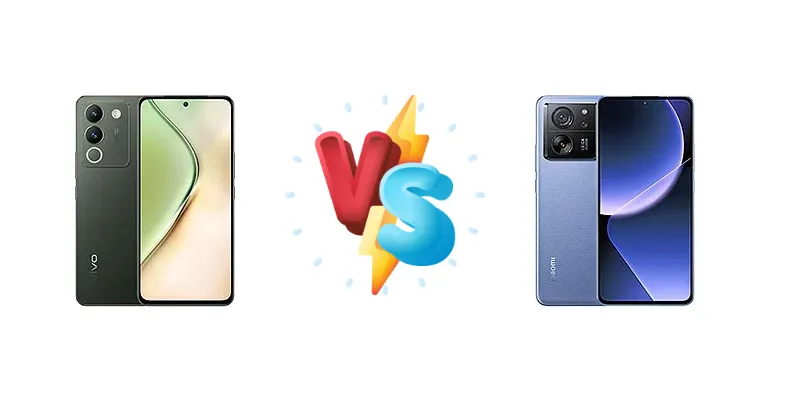
|
🏆 Quick Verdict
For the average user prioritizing raw performance and rapid charging, the Xiaomi 13T Pro is the clear winner. Its Dimensity 9200+ chipset offers a substantial leap in processing power compared to the Snapdragon 4 Gen 1 in the vivo Y200, and the 120W charging is significantly faster. However, the Y200 remains a compelling option for budget-conscious buyers.
| PHONES | ||
|---|---|---|
| Phone Names | vivo Y200 (India) | Xiaomi 13T Pro |
| Network | ||
|---|---|---|
| 2G bands | GSM 850 / 900 / 1800 / 1900 | GSM 850 / 900 / 1800 / 1900 |
| 3G bands | HSDPA 850 / 900 / 2100 | HSDPA 800 / 850 / 900 / 1700(AWS) / 1900 / 2100 |
| 4G bands | 1, 3, 5, 8, 28, 38, 40, 41 | 1, 2, 3, 4, 5, 7, 8, 12, 13, 17, 18, 19, 20, 25, 26, 28, 32, 38, 39, 40, 41, 42, 48, 66 |
| 5G bands | 1, 3, 5, 8, 28, 77, 78 SA/NSA | 1, 3, 5, 7, 8, 20, 28, 38, 40, 41, 66, 75, 77, 78 SA/NSA |
| Speed | HSPA, LTE, 5G | HSPA, LTE, 5G |
| Technology | GSM / HSPA / LTE / 5G | GSM / HSPA / LTE / 5G |
| Launch | ||
|---|---|---|
| Announced | 2023, October 23 | 2023, September 26 |
| Status | Available. Released 2023, October 23 | Available. Released 2023, September 26 |
| Body | ||
|---|---|---|
| Build | Glass front, plastic frame, glass back | Glass front (Gorilla Glass 5), glass back or silicone polymer back, plastic frame |
| Dimensions | 162.4 x 74.9 x 7.7 mm (6.39 x 2.95 x 0.30 in) | 162.2 x 75.7 x 8.5 mm (6.39 x 2.98 x 0.33 in) |
| SIM | Nano-SIM + Nano-SIM | · Nano-SIM + eSIM· Nano-SIM + Nano-SIM |
| Weight | 190 g (6.70 oz) | 200 g or 206 g (7.05 oz) |
| Display | ||
|---|---|---|
| Protection | - | Corning Gorilla Glass 5 |
| Resolution | 1080 x 2400 pixels, 20:9 ratio (~395 ppi density) | 1220 x 2712 pixels, 20:9 ratio (~446 ppi density) |
| Size | 6.67 inches, 107.4 cm2 (~88.3% screen-to-body ratio) | 6.67 inches, 107.4 cm2 (~87.5% screen-to-body ratio) |
| Type | AMOLED, 120Hz, 800 nits (peak) | AMOLED, 68B colors, 144Hz, Dolby Vision, HDR10+, 1200 nits (HBM), 2600 nits (peak) |
| Platform | ||
|---|---|---|
| CPU | Octa-core (2x2.0 GHz Cortex-A78 & 6x1.8 GHz Cortex-A55) | Octa-core (1x3.35 GHz Cortex-X3 & 3x3.0 GHz Cortex-A715 & 4x2.0 GHz Cortex-A510) |
| Chipset | Qualcomm SM4375 Snapdragon 4 Gen 1 (6 nm) | Mediatek Dimensity 9200+ (4 nm) |
| GPU | Adreno 619 | Immortalis-G715 MC11 |
| OS | Android 13, Funtouch 13 | Android 13, up to 4 major Android upgrades, HyperOS |
| Memory | ||
|---|---|---|
| Card slot | No | No |
| Internal | 128GB 8GB RAM, 256GB 8GB RAM | 256GB 12GB RAM, 512GB 12GB RAM, 1TB 16GB RAM |
| Main Camera | ||
|---|---|---|
| Dual | 64 MP, f/1.8, (wide), PDAF, OIS Auxiliary lens | - |
| Features | Ring-LED flash, panorama, HDR | Leica lens, color spectrum sensor, LED flash, HDR, panorama |
| Triple | - | 50 MP, f/1.9, 24mm (wide), 1/1.28", 1.22µm, PDAF, OIS 50 MP, f/1.9, 50mm (telephoto), 1/2.88", 0.61µm, PDAF, 2x optical zoom 12 MP, f/2.2, 15mm (ultrawide), 1/3.06", 1.12µm |
| Video | 1080p@30fps | 8K@24fps, 4K@24/30/60fps, 4K/1080p@30fps HDR10+, 1080p@30/60/120/240fps; 10-bit LOG, gyro-EIS |
| Selfie camera | ||
|---|---|---|
| Features | - | HDR |
| Single | 16 MP, f/2.0, (wide) | 20 MP, f/2.2, (wide), 0.8µm |
| Video | 1080p@30fps | 1080p@30fps, HDR10+ |
| Sound | ||
|---|---|---|
| 35mm jack | No | No |
| Loudspeaker | Yes | Yes, with stereo speakers |
| Comms | ||
|---|---|---|
| Bluetooth | 5.1, A2DP, LE | 5.4, A2DP, LE |
| Infrared port | - | Yes |
| NFC | No | Yes |
| Positioning | GPS, GLONASS, GALILEO, BDS, QZSS | GPS (L1+L5), GLONASS (G1), GALILEO (E1+E5a), NavIC (L5), BDS |
| Radio | No | No |
| USB | USB Type-C 2.0, OTG | USB Type-C 2.0, OTG |
| WLAN | Wi-Fi 802.11 a/b/g/n/ac, dual-band | Wi-Fi 802.11 a/b/g/n/ac/6e/7, dual/tri-band (market/region dependent), Wi-Fi Direct |
| Features | ||
|---|---|---|
| Sensors | Fingerprint (under display, optical), accelerometer, gyro, proximity, compass | Fingerprint (under display, optical), accelerometer, gyro, proximity, compass |
| Battery | ||
|---|---|---|
| Charging | 44W wired, 50% in 28 min Reverse wired | 120W wired, PD3.0, QC4, 100% in 19 min |
| Type | Li-Ion 4800 mAh | Li-Po 5000 mAh |
| Misc | ||
|---|---|---|
| Colors | Jungle Green, Desert Gold | Alpine Blue, Meadow Green, Black |
| Models | V2307 | 23078PND5G |
| Price | About 250 EUR | $ 370.00 / £ 482.55 / € 301.99 |
| SAR | 0.99 W/kg (head) 0.86 W/kg (body) | - |
| SAR EU | - | 1.00 W/kg (head) 0.99 W/kg (body) |
vivo Y200 (India)
- More affordable price point
- Decent performance for everyday tasks
- Reverse wired charging capability
- Significantly slower charging speed
- Less powerful processor compared to the 13T Pro
- Likely lower display brightness
Xiaomi 13T Pro
- Flagship-level Dimensity 9200+ processor
- Ultra-fast 120W charging
- Brighter and potentially higher-quality display
- Higher price tag
- May run hotter under sustained load (though the 4nm node mitigates this)
- No reverse wireless charging
Display Comparison
The Xiaomi 13T Pro boasts a significantly brighter display, reaching a measured peak of 1094 nits. This is crucial for outdoor visibility, a clear advantage over the Y200, which lacks specified brightness data but is likely lower given its chipset and price bracket. While both likely utilize AMOLED panels, the 13T Pro’s higher brightness and potential for higher refresh rates (not specified for either) contribute to a more vibrant and responsive visual experience. The absence of LTPO technology in either device suggests both will rely on adaptive refresh rates to conserve battery, but the 13T Pro’s superior panel quality will likely deliver a more refined experience.
Camera Comparison
Detailed camera specifications are limited for both devices. However, the Xiaomi 13T Pro is expected to feature a more sophisticated camera system, leveraging the processing power of the Dimensity 9200+ for advanced image processing. While the Y200 likely offers a capable camera for everyday photography, the 13T Pro’s potential for features like improved low-light performance and higher-resolution video recording is significantly greater. The absence of information regarding sensor sizes and OIS makes a definitive comparison difficult, but the 13T Pro’s positioning suggests a more premium camera experience.
Performance
The performance gap between these two devices is substantial. The Xiaomi 13T Pro’s Mediatek Dimensity 9200+ (4nm) is a flagship-level chipset featuring a Cortex-X3 prime core clocked at 3.35 GHz, designed for peak performance. In contrast, the vivo Y200’s Qualcomm Snapdragon 4 Gen 1 (6nm) utilizes a Cortex-A78 based core configuration, geared towards efficiency rather than outright speed. The Dimensity 9200+’s 4nm process node also provides better thermal efficiency, minimizing throttling during sustained workloads. This translates to smoother multitasking, faster app loading times, and a significantly better gaming experience on the 13T Pro.
Battery Life
The Xiaomi 13T Pro’s 120W wired charging is a game-changer, achieving a full charge in just 19 minutes. This is a massive advantage over the vivo Y200’s 44W charging, which takes 28 minutes to reach 50%. While the 13T Pro’s battery capacity isn’t specified, its active use score of 11:50h and endurance rating of 102h indicate excellent battery life. The Y200’s battery capacity is also unknown, but the slower charging speed suggests a focus on efficiency rather than rapid replenishment. The 13T Pro’s charging speed is particularly beneficial for users who frequently need to top up their battery quickly.
Buying Guide
Buy the vivo Y200 (India) if you need a reliable daily driver with decent performance for everyday tasks and prioritize a lower price point. Buy the Xiaomi 13T Pro if you prefer a smoother experience with demanding apps and games, value incredibly fast charging, and are willing to spend more for a more powerful processor and brighter display.