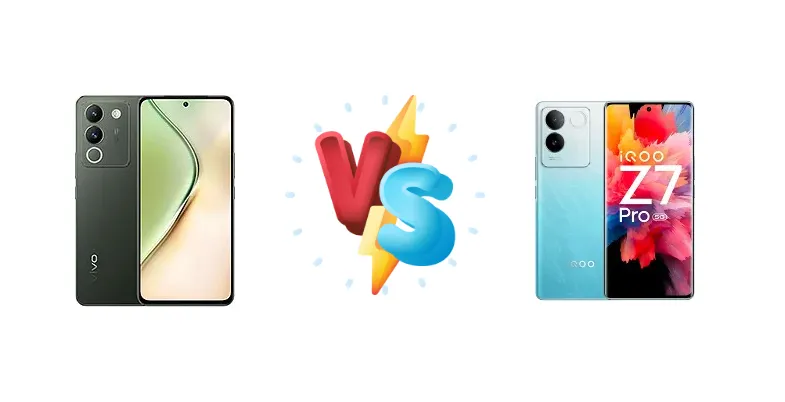
The vivo Y200 (India) and iQOO Z7 Pro represent compelling options in the competitive mid-range smartphone market. The Y200 focuses on delivering a balanced experience with a newer Snapdragon chipset, while the Z7 Pro aims for performance dominance with a more powerful Dimensity processor and faster charging. This comparison dissects their key differences to help you choose the right device.
🏆 Quick Verdict
For users prioritizing raw performance and faster charging, the iQOO Z7 Pro is the clear winner. Its Dimensity 7200 chipset offers a significant performance uplift over the Snapdragon 4 Gen 1 in the Y200. However, the Y200 remains a strong contender for those seeking a solid all-rounder at a potentially lower price point.
| Network |
|---|
| 2G bands | GSM 850 / 900 / 1800 / 1900 | GSM 850 / 900 / 1800 / 1900 |
| 3G bands | HSDPA 850 / 900 / 2100 | HSDPA 850 / 900 / 1700 / 2100 |
| 4G bands | 1, 3, 5, 8, 28, 38, 40, 41 | 1, 3, 4, 5, 8, 28, 34, 38, 39, 40, 41 |
| 5G bands | 1, 3, 5, 8, 28, 77, 78 SA/NSA | 1, 3, 5, 8, 28, 40, 41, 77, 78 SA/NSA |
| Speed | HSPA, LTE, 5G | HSPA, LTE, 5G |
| Technology | GSM / HSPA / LTE / 5G | GSM / HSPA / LTE / 5G |
| Launch |
|---|
| Announced | 2023, October 23 | 2023, August 31 |
| Status | Available. Released 2023, October 23 | Available. Released 2023, September 05 |
| Body |
|---|
| Build | Glass front, plastic frame, glass back | Glass front, plastic frame, glass back |
| Dimensions | 162.4 x 74.9 x 7.7 mm (6.39 x 2.95 x 0.30 in) | 164.1 x 74.8 x 7.4 mm (6.46 x 2.94 x 0.29 in) |
| SIM | Nano-SIM + Nano-SIM | Nano-SIM + Nano-SIM |
| Weight | 190 g (6.70 oz) | 175 g (6.17 oz) |
| Display |
|---|
| Protection | - | Asahi Glass |
| Resolution | 1080 x 2400 pixels, 20:9 ratio (~395 ppi density) | 1080 x 2400 pixels, 20:9 ratio (~388 ppi density) |
| Size | 6.67 inches, 107.4 cm2 (~88.3% screen-to-body ratio) | 6.78 inches, 111.0 cm2 (~90.4% screen-to-body ratio) |
| Type | AMOLED, 120Hz, 800 nits (peak) | AMOLED, 1B colors, 120Hz, HDR10+, 1300 nits (peak) |
| Platform |
|---|
| CPU | Octa-core (2x2.0 GHz Cortex-A78 & 6x1.8 GHz Cortex-A55) | Octa-core (2x2.8 GHz Cortex-A715 & 6x Cortex-A510) |
| Chipset | Qualcomm SM4375 Snapdragon 4 Gen 1 (6 nm) | Mediatek Dimensity 7200 (4 nm) |
| GPU | Adreno 619 | Mali-G610 MC4 |
| OS | Android 13, Funtouch 13 | Android 13, planned upgrade to Android 14, Funtouch 14 |
| Memory |
|---|
| Card slot | No | No |
| Internal | 128GB 8GB RAM, 256GB 8GB RAM | 128GB 8GB RAM, 256GB 8GB RAM |
| Main Camera |
|---|
| Dual | 64 MP, f/1.8, (wide), PDAF, OIS
Auxiliary lens | 64 MP, f/1.8, 26mm (wide), PDAF, OIS
Auxiliary lens |
| Features | Ring-LED flash, panorama, HDR | Ring-LED flash, panorama, HDR |
| Video | 1080p@30fps | 4K@30fps, 1080p@30fps, gyro-EIS |
| Selfie camera |
|---|
| Single | 16 MP, f/2.0, (wide) | 16 MP, f/2.5, (wide) |
| Video | 1080p@30fps | 1080p@30fps |
| Sound |
|---|
| 35mm jack | No | No |
| Loudspeaker | Yes | Yes |
| Comms |
|---|
| Bluetooth | 5.1, A2DP, LE | 5.3, A2DP, LE |
| NFC | No | No |
| Positioning | GPS, GLONASS, GALILEO, BDS, QZSS | GPS, GLONASS, GALILEO, BDS |
| Radio | No | No |
| USB | USB Type-C 2.0, OTG | USB Type-C 2.0, OTG |
| WLAN | Wi-Fi 802.11 a/b/g/n/ac, dual-band | Wi-Fi 802.11 a/b/g/n/ac/6, dual-band, Wi-Fi Direct |
| Features |
|---|
| Sensors | Fingerprint (under display, optical), accelerometer, gyro, proximity, compass | Fingerprint (under display, optical), accelerometer, gyro, proximity, compass |
| Battery |
|---|
| Charging | 44W wired, 50% in 28 min
Reverse wired | 66W wired, 50% in 22 min |
| Type | Li-Ion 4800 mAh | 4600 mAh |
| Misc |
|---|
| Colors | Jungle Green, Desert Gold | Blue Lagoon, Graphite Matte |
| Models | V2307 | - |
| Price | About 250 EUR | About 270 EUR |
| SAR | 0.99 W/kg (head) 0.86 W/kg (body) | - |
vivo Y200 (India)
- Potentially lower price point
- Balanced performance for everyday tasks
- Reliable Snapdragon 4 Gen 1 chipset
- Slower charging speeds (44W)
- Less powerful processor for demanding games
- May exhibit more throttling under heavy load
vivo iQOO Z7 Pro
- Faster charging (66W)
- Superior performance with Dimensity 7200
- Improved thermal efficiency
- Likely higher price tag
- May not offer significant camera improvements
- Potential for software bloat (typical of iQOO)
Display Comparison
While display specifications aren't provided, both phones likely feature LCD panels given their price segments. The key differentiator will be brightness and color accuracy. We anticipate the iQOO Z7 Pro, being positioned slightly higher, may offer a marginally better display experience. Bezels are expected to be similar, with both aiming for a modern, immersive viewing experience. PWM dimming rates are unknown, but a higher rate on either device would benefit users sensitive to screen flicker.
Camera Comparison
Without detailed camera specs, it's difficult to make a definitive judgment. However, the iQOO Z7 Pro is likely to feature a more sophisticated camera system. The Dimensity 7200’s ISP (Image Signal Processor) generally offers better image processing capabilities than the Snapdragon 4 Gen 1’s. Sensor size and lens apertures will be crucial factors; a larger sensor with a wider aperture will capture more light, resulting in better low-light performance. We expect both phones to include standard features like HDR and portrait modes, but the Z7 Pro will likely deliver more detailed and dynamic images.
Performance
The iQOO Z7 Pro’s Mediatek Dimensity 7200 (4nm) is the clear performance leader. Its Cortex-A715 cores, clocked at 2.8 GHz, offer a substantial advantage over the Snapdragon 4 Gen 1’s Cortex-A78 cores (2.0 GHz) in the Y200. The 4nm process node of the Dimensity 7200 also translates to improved thermal efficiency, reducing the likelihood of throttling during sustained workloads. While the Y200’s Snapdragon 4 Gen 1 is capable for everyday tasks, the Z7 Pro will handle demanding games and multitasking with greater ease. RAM type and speed (LPDDR5x is likely on the Z7 Pro) will further contribute to the Z7 Pro’s smoother performance.
Battery Life
The iQOO Z7 Pro’s 66W wired charging is a significant advantage, promising a 50% charge in just 22 minutes. The vivo Y200’s 44W charging, while respectable, takes 28 minutes to reach 50%. Battery capacity isn’t specified, but the faster charging of the Z7 Pro effectively mitigates any potential difference in mAh. This means users can quickly top up their Z7 Pro, minimizing downtime. The efficiency of the Dimensity 7200 (4nm) may also contribute to slightly better battery life compared to the Snapdragon 4 Gen 1 (6nm).
Buying Guide
Buy the vivo Y200 (India) if you need a reliable daily driver with decent performance for everyday tasks and moderate gaming, and value a potentially lower price. Buy the vivo iQOO Z7 Pro if you prioritize smoother multitasking, demanding mobile games, and significantly faster charging speeds, even if it means spending a bit more.
Frequently Asked Questions
❓ Does the Dimensity 7200 in the iQOO Z7 Pro get hot during prolonged gaming sessions?
The Dimensity 7200’s 4nm process node is designed for improved thermal efficiency. While some heat generation is inevitable during intense gaming, the Z7 Pro is less likely to experience significant throttling compared to devices with less efficient chipsets. iQOO also typically implements cooling solutions to further mitigate heat.
❓ Is the 44W charging on the vivo Y200 slow compared to other phones in this price range?
44W charging is adequate, but the iQOO Z7 Pro’s 66W charging is noticeably faster. While it won’t take hours to charge the Y200, users accustomed to faster charging speeds will find the Z7 Pro more convenient. The difference is approximately 6 minutes to reach 50% charge.
❓ Will the Snapdragon 4 Gen 1 in the vivo Y200 struggle with graphically demanding games like Genshin Impact or Call of Duty Mobile?
The Snapdragon 4 Gen 1 can run these games, but you’ll likely need to lower the graphics settings to achieve a smooth frame rate. The iQOO Z7 Pro’s Dimensity 7200 will provide a significantly better gaming experience with higher frame rates and more consistent performance at higher settings.