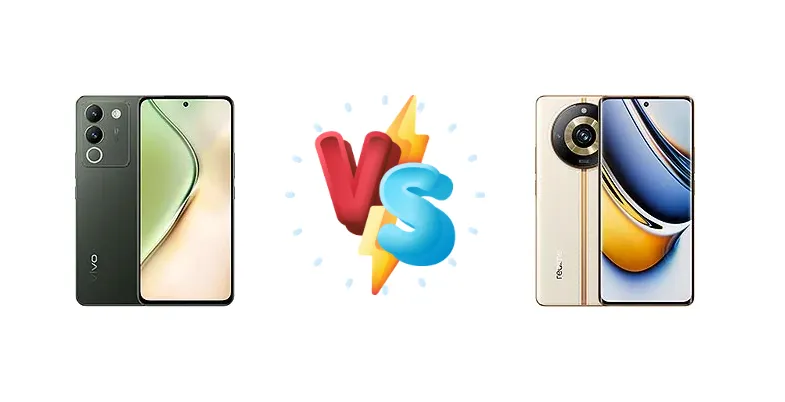
The sub-₹25,000 (approximately $300 USD) segment is fiercely competitive, and the vivo Y200 (India) and Realme 11 Pro+ are two strong contenders. The Y200 focuses on a balanced experience with Qualcomm’s Snapdragon 4 Gen 1, while the 11 Pro+ aims for faster charging and a more powerful Dimensity chipset. This comparison dives deep into the specifics to determine which phone delivers the best value.
🏆 Quick Verdict
For the average user prioritizing rapid charging and slightly more potent CPU performance, the Realme 11 Pro+ is the better choice. Its 100W charging significantly reduces downtime. However, the vivo Y200 offers a different CPU architecture that may appeal to those seeking a specific performance profile.
| Network |
|---|
| 2G bands | GSM 850 / 900 / 1800 / 1900 | GSM 850 / 900 / 1800 / 1900 |
| 3G bands | HSDPA 850 / 900 / 2100 | HSDPA 850 / 900 / 2100 |
| 4G bands | 1, 3, 5, 8, 28, 38, 40, 41 | 1, 3, 5, 8, 28, 38, 40, 41 - India |
| 5G bands | 1, 3, 5, 8, 28, 77, 78 SA/NSA | 1, 3, 5, 8, 28, 40, 41, 77, 78 SA/NSA - International |
| Speed | HSPA, LTE, 5G | HSPA, LTE, 5G |
| Technology | GSM / HSPA / LTE / 5G | GSM / CDMA / HSPA / CDMA2000 / LTE / 5G |
| | - | CDMA2000 1x |
| Launch |
|---|
| Announced | 2023, October 23 | 2023, May 10 |
| Status | Available. Released 2023, October 23 | Available. Released 2023, May 15 |
| Body |
|---|
| Build | Glass front, plastic frame, glass back | Glass front, leather or plastic back, plastic frame |
| Dimensions | 162.4 x 74.9 x 7.7 mm (6.39 x 2.95 x 0.30 in) | 161.6 x 73.9 x 8.2 mm or 8.7 mm |
| SIM | Nano-SIM + Nano-SIM | Nano-SIM + Nano-SIM |
| Weight | 190 g (6.70 oz) | 183 g or 189 g (6.46 oz) |
| Display |
|---|
| Resolution | 1080 x 2400 pixels, 20:9 ratio (~395 ppi density) | 1080 x 2412 pixels, 20:9 ratio (~394 ppi density) |
| Size | 6.67 inches, 107.4 cm2 (~88.3% screen-to-body ratio) | 6.7 inches, 108.0 cm2 (~90.5% screen-to-body ratio) |
| Type | AMOLED, 120Hz, 800 nits (peak) | AMOLED, 1B colors, HDR10+, 120Hz, 950 nits (peak) |
| Platform |
|---|
| CPU | Octa-core (2x2.0 GHz Cortex-A78 & 6x1.8 GHz Cortex-A55) | Octa-core (2x2.6 GHz Cortex-A78 & 6x2.0 GHz Cortex-A55) |
| Chipset | Qualcomm SM4375 Snapdragon 4 Gen 1 (6 nm) | Mediatek Dimensity 7050 (6 nm) |
| GPU | Adreno 619 | Mali-G68 MC4 |
| OS | Android 13, Funtouch 13 | Android 13, up to 2 major Android upgrades, Realme UI 5.0 |
| Memory |
|---|
| Card slot | No | No |
| Internal | 128GB 8GB RAM, 256GB 8GB RAM | 256GB 8GB RAM, 256GB 12GB RAM, 512GB 12GB RAM, 1TB 12GB RAM |
| Main Camera |
|---|
| Dual | 64 MP, f/1.8, (wide), PDAF, OIS
Auxiliary lens | - |
| Features | Ring-LED flash, panorama, HDR | LED flash, HDR, panorama |
| Triple | - | 200 MP, f/1.7, 23mm (wide), 1/1.4", 0.56µm, PDAF, OIS
8 MP, f/2.2, 16mm, 112˚ (ultrawide)
2 MP (macro) |
| Video | 1080p@30fps | 4K@30fps, 1080p@30/60/120/480fps, 720p@960fps, gyro-EIS |
| Selfie camera |
|---|
| Features | - | Panorama |
| Single | 16 MP, f/2.0, (wide) | 32 MP, f/2.5, 22mm (wide) |
| Video | 1080p@30fps | 1080p@30fps |
| Sound |
|---|
| 3.5mm jack | - | No |
| 35mm jack | No | No |
| Loudspeaker | Yes | Yes, with stereo speakers |
| | - | 24-bit/192kHz audio |
| Comms |
|---|
| Bluetooth | 5.1, A2DP, LE | 5.2, A2DP, LE, aptX HD |
| NFC | No | Yes |
| Positioning | GPS, GLONASS, GALILEO, BDS, QZSS | GPS, GLONASS, GALILEO, BDS, QZSS, NavIC |
| Radio | No | No |
| USB | USB Type-C 2.0, OTG | USB Type-C 2.0 |
| WLAN | Wi-Fi 802.11 a/b/g/n/ac, dual-band | Wi-Fi 802.11 a/b/g/n/ac/6, dual-band |
| Features |
|---|
| Sensors | Fingerprint (under display, optical), accelerometer, gyro, proximity, compass | Fingerprint (under display, optical), accelerometer, gyro, proximity, compass |
| Battery |
|---|
| Charging | 44W wired, 50% in 28 min
Reverse wired | 100W wired |
| Type | Li-Ion 4800 mAh | 5000 mAh |
| Misc |
|---|
| Colors | Jungle Green, Desert Gold | Astral Black, Sunrise Beige, Oasis Green |
| Models | V2307 | RMX3740, RMX3741 |
| Price | About 250 EUR | € 399.90 / ₹ 27,990 |
| SAR | 0.99 W/kg (head) 0.86 W/kg (body) | - |
vivo Y200 (India)
- Efficient Snapdragon 4 Gen 1 chipset
- Balanced performance for everyday tasks
- Potentially better thermal management due to lower peak performance
- Slower 44W charging
- Missing display specifications (brightness, panel type)
Realme 11 Pro+
- Ultra-fast 100W charging
- Brighter 793 nit display
- More powerful Dimensity 7050 CPU
- Potential for higher thermal throttling under sustained load
- Camera details are currently unknown
Display Comparison
The Realme 11 Pro+ boasts a significantly brighter display, reaching a measured 793 nits. While the vivo Y200’s display specifications are not provided, the Realme’s higher peak brightness translates to better visibility under direct sunlight. Both devices utilize 6nm chipsets, suggesting similar power efficiency in display operation, but the Realme’s brightness advantage is a clear win for outdoor users. We expect both to be FHD+ AMOLED panels, common in this price bracket, but the Realme’s brightness is a key differentiator.
Camera Comparison
Detailed camera specifications beyond 'Photo/Video' are missing for the Realme 11 Pro+. However, Realme often emphasizes camera capabilities in its Pro+ line. The vivo Y200’s camera details are also absent. Without sensor size, aperture, or OIS information, a direct comparison is difficult. We can assume both phones will feature multi-camera setups, but the Realme’s brand positioning suggests a potentially more advanced imaging system. The absence of details on both sides makes this a tie, pending further information.
Performance
The Realme 11 Pro+ leverages the Mediatek Dimensity 7050, featuring a 2x2.6 GHz Cortex-A78 core configuration, while the vivo Y200 utilizes the Qualcomm Snapdragon 4 Gen 1 with 2x2.0 GHz Cortex-A78 cores. The higher clock speeds of the Dimensity 7050 suggest a performance edge in CPU-intensive tasks. Both chipsets are built on a 6nm process, indicating comparable efficiency. However, the Snapdragon 4 Gen 1’s architecture may offer different strengths in specific workloads. The Realme’s chipset is likely to provide a smoother experience in graphically demanding games and multitasking.
Battery Life
The Realme 11 Pro+’s 100W wired charging is a game-changer, promising significantly faster top-ups compared to the vivo Y200’s 44W charging. Realme claims a 50% charge in just 28 minutes for the Y200, while the 11 Pro+ can likely achieve a full charge in under 30 minutes. While the Realme 11 Pro+ had an endurance rating of 112h, this is an older metric and doesn't account for software or usage patterns. The faster charging speed of the Realme is a substantial advantage for users who frequently need to quickly replenish their battery.
Buying Guide
Buy the vivo Y200 (India) if you need a reliable daily driver with a focus on efficient power consumption and a balanced Snapdragon chipset. Buy the Realme 11 Pro+ if you prioritize blazing-fast 100W charging, a slightly more powerful CPU for demanding tasks, and a brighter display for outdoor visibility.
Frequently Asked Questions
❓ Does the Dimensity 7050 in the Realme 11 Pro+ tend to overheat during prolonged gaming sessions?
While the Dimensity 7050 is a capable chipset, its higher clock speeds can lead to increased heat generation. Realme likely employs thermal management solutions, but sustained gaming at maximum settings may result in some throttling. The Snapdragon 4 Gen 1 in the vivo Y200, with its lower peak performance, is less prone to overheating.
❓ How much faster is the 100W charging on the Realme 11 Pro+ compared to the 44W charging on the vivo Y200 in real-world usage?
The 100W charging on the Realme 11 Pro+ can fully charge the device in approximately 30-40 minutes, while the 44W charging on the vivo Y200 will take closer to 60-75 minutes. This difference is significant for users who need a quick power boost throughout the day.
❓ Is the difference in CPU performance between the Snapdragon 4 Gen 1 and Dimensity 7050 noticeable for everyday tasks like browsing and social media?
For basic tasks like browsing, social media, and messaging, the difference in CPU performance between the two chipsets will be minimal. Both phones will provide a smooth and responsive experience. The Dimensity 7050’s advantage becomes more apparent in demanding applications and games.