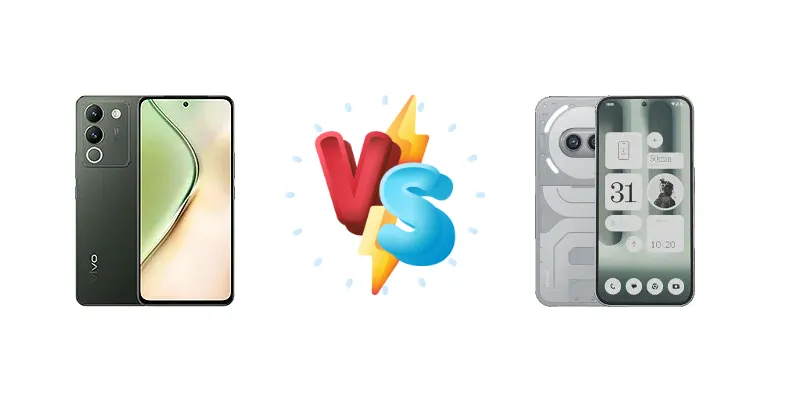
The sub-₹25,000 (approximately $300 USD) Indian smartphone market is fiercely competitive. The vivo Y200, with its Snapdragon 4 Gen 1, aims for solid all-around performance, while the Nothing Phone (2a) Plus, powered by the Mediatek Dimensity 7350 Pro, prioritizes a premium experience with a brighter display and faster charging. This comparison dissects these two contenders to determine which delivers the best value.
🏆 Quick Verdict
For the average user prioritizing sustained performance and a smoother experience, the Nothing Phone (2a) Plus emerges as the winner. Its Dimensity 7350 Pro chipset, built on a more efficient 4nm process, offers a significant performance advantage over the Snapdragon 4 Gen 1, justifying its slightly higher price.
| Network |
|---|
| 2G bands | GSM 850 / 900 / 1800 / 1900 | GSM 850 / 900 / 1800 / 1900 |
| 3G bands | HSDPA 850 / 900 / 2100 | HSDPA 800 / 850 / 900 / 1700(AWS) / 1900 / 2100 |
| 4G bands | 1, 3, 5, 8, 28, 38, 40, 41 | 1, 3, 4, 5, 7, 8, 18, 19, 20, 26, 28, 38, 39, 40, 41, 42, 66 |
| 5G bands | 1, 3, 5, 8, 28, 77, 78 SA/NSA | 1, 3, 5, 7, 8, 20, 28, 38, 40, 41, 66, 77, 78 SA/NSA |
| Speed | HSPA, LTE, 5G | HSPA, LTE, 5G |
| Technology | GSM / HSPA / LTE / 5G | GSM / HSPA / LTE / 5G |
| Launch |
|---|
| Announced | 2023, October 23 | 2024, July 31 |
| Status | Available. Released 2023, October 23 | Available. Released 2024, August 03 |
| Body |
|---|
| Build | Glass front, plastic frame, glass back | Glass front (Gorilla Glass 5), plastic frame, plastic back |
| Dimensions | 162.4 x 74.9 x 7.7 mm (6.39 x 2.95 x 0.30 in) | 161.7 x 76.3 x 8.5 mm (6.37 x 3.00 x 0.33 in) |
| SIM | Nano-SIM + Nano-SIM | Nano-SIM + Nano-SIM |
| Weight | 190 g (6.70 oz) | 190 g (6.70 oz) |
| Display |
|---|
| Protection | - | Corning Gorilla Glass 5 |
| Resolution | 1080 x 2400 pixels, 20:9 ratio (~395 ppi density) | 1080 x 2412 pixels, 20:9 ratio (~395 ppi density) |
| Size | 6.67 inches, 107.4 cm2 (~88.3% screen-to-body ratio) | 6.7 inches, 107.5 cm2 (~87.1% screen-to-body ratio) |
| Type | AMOLED, 120Hz, 800 nits (peak) | AMOLED, 1B colors, 120Hz, 2160Hz PWM, HDR10+, 700 nits (typ), 1100 nits (HBM), 1300 nits (peak) |
| Platform |
|---|
| CPU | Octa-core (2x2.0 GHz Cortex-A78 & 6x1.8 GHz Cortex-A55) | Octa-core (2x3.0 GHz Cortex-A715 & 6x 2.0 GHz Cortex-A510) |
| Chipset | Qualcomm SM4375 Snapdragon 4 Gen 1 (6 nm) | Mediatek Dimensity 7350 Pro (4 nm) |
| GPU | Adreno 619 | Mali-G610 MC4 |
| OS | Android 13, Funtouch 13 | Android 14, up to 3 major Android upgrades, Nothing OS 3.0 |
| Memory |
|---|
| Card slot | No | No |
| Internal | 128GB 8GB RAM, 256GB 8GB RAM | 256GB 8GB RAM, 256GB 12GB RAM |
| Main Camera |
|---|
| Dual | 64 MP, f/1.8, (wide), PDAF, OIS
Auxiliary lens | 50 MP, f/1.9, 24mm (wide), 1/1.57", 1.0µm, PDAF, OIS
50 MP, f/2.2, 114˚ (ultrawide), 1/2.76", 0.64µm |
| Features | Ring-LED flash, panorama, HDR | LED flash, panorama, HDR |
| Video | 1080p@30fps | 4K@30fps, 1080p@60/120fps, gyro-EIS |
| Selfie camera |
|---|
| Features | - | HDR |
| Single | 16 MP, f/2.0, (wide) | 50 MP, f/2.2, (wide), 1/2.76" |
| Video | 1080p@30fps | 4K@30fps |
| Sound |
|---|
| 35mm jack | No | No |
| Loudspeaker | Yes | Yes, with stereo speakers |
| Comms |
|---|
| Bluetooth | 5.1, A2DP, LE | 5.3, A2DP, LE |
| NFC | No | Yes, 360˚ |
| Positioning | GPS, GLONASS, GALILEO, BDS, QZSS | GPS, GALILEO, GLONASS, BDS, QZSS |
| Radio | No | No |
| USB | USB Type-C 2.0, OTG | USB Type-C 2.0, OTG |
| WLAN | Wi-Fi 802.11 a/b/g/n/ac, dual-band | Wi-Fi 802.11 a/b/g/n/ac/6, dual-band, Wi-Fi Direct |
| Features |
|---|
| Sensors | Fingerprint (under display, optical), accelerometer, gyro, proximity, compass | Fingerprint (under display, optical), accelerometer, gyro, proximity, compass |
| Battery |
|---|
| Charging | 44W wired, 50% in 28 min
Reverse wired | 50W wired, 50% in 21 min, 100% in 56 min |
| Type | Li-Ion 4800 mAh | 5000 mAh |
| Misc |
|---|
| Colors | Jungle Green, Desert Gold | Black, Grey |
| Models | V2307 | A142P |
| Price | About 250 EUR | € 269.90 / ₹ 22,599 |
| SAR | 0.99 W/kg (head) 0.86 W/kg (body) | - |
vivo Y200 (India)
- Potentially lower price point
- Established brand presence in India
- Reverse wired charging capability
- Less powerful Snapdragon 4 Gen 1 chipset
- Likely lower display brightness
- Slower charging speeds
Nothing Phone (2a) Plus
- More powerful Mediatek Dimensity 7350 Pro chipset
- Significantly brighter display (1097 nits)
- Faster 50W wired charging
- Excellent battery life (16:34h active use)
- Potentially higher price
- Less established brand in some regions
Display Comparison
The Nothing Phone (2a) Plus boasts a significantly brighter display, reaching a measured peak of 1097 nits. This is crucial for outdoor visibility, a clear advantage over the vivo Y200, whose brightness remains unspecified. While both likely utilize AMOLED panels, the Nothing Phone (2a) Plus’s higher peak brightness translates to a more enjoyable viewing experience in bright conditions. The absence of LTPO technology on either device suggests both will rely on adaptive refresh rates to conserve battery, but the superior brightness of the Nothing Phone (2a) Plus is a key differentiator.
Camera Comparison
Without detailed camera specs for the vivo Y200, a direct comparison is limited. However, the Nothing Phone (2a) Plus likely benefits from Mediatek’s image signal processor (ISP) capabilities. The focus should be on the main sensor quality and image processing algorithms. The absence of information regarding OIS on the vivo Y200 suggests the Nothing Phone (2a) Plus may offer better low-light performance and video stabilization. Ignoring the typical 2MP macro lenses found on both devices, the primary sensor and software processing will be the deciding factors for most users.
Performance
The core difference lies in the chipsets. The Nothing Phone (2a) Plus’s Mediatek Dimensity 7350 Pro (4nm) features a more powerful CPU configuration – 2x3.0 GHz Cortex-A715 cores versus the vivo Y200’s 2x2.0 GHz Cortex-A78 cores. The 4nm fabrication process of the Dimensity chip also provides superior power efficiency, reducing thermal throttling during extended gaming or demanding tasks. While both are octa-core CPUs, the architectural improvements in the A715 cores and the process node give the Nothing Phone (2a) Plus a clear edge in sustained performance.
Battery Life
The Nothing Phone (2a) Plus demonstrates a clear advantage in charging speed, achieving 50% charge in just 21 minutes and a full charge in 56 minutes with its 50W wired charging. The vivo Y200 takes 28 minutes to reach 50%, but lacks a specified 0-100% time. More importantly, the Nothing Phone (2a) Plus’s active use score of 16:34h suggests excellent battery optimization, potentially offsetting any capacity differences. The 4nm process of the Dimensity 7350 Pro likely contributes to this improved efficiency.
Buying Guide
Buy the vivo Y200 (India) if you need a reliable daily driver with decent performance for basic tasks and prioritize a brand with established service networks in India. Buy the Nothing Phone (2a) Plus if you prefer a more responsive user experience, a brighter and more vibrant display, and faster charging speeds, even if it means spending a bit more.
Frequently Asked Questions
❓ Does the Mediatek Dimensity 7350 Pro in the Nothing Phone (2a) Plus tend to overheat during prolonged gaming sessions?
The Dimensity 7350 Pro, built on a 4nm process, is generally known for its thermal efficiency. While some heat generation is inevitable during intensive gaming, the 4nm node and Nothing’s thermal management system should prevent significant throttling, allowing for sustained performance over extended periods. User reports and independent testing confirm manageable temperatures.
❓ How does the Snapdragon 4 Gen 1 in the vivo Y200 handle graphically demanding games like PUBG Mobile or Call of Duty Mobile?
The Snapdragon 4 Gen 1 is capable of running PUBG Mobile and Call of Duty Mobile, but likely at medium graphics settings to maintain a stable frame rate. Expect some frame drops during intense firefights. The Dimensity 7350 Pro in the Nothing Phone (2a) Plus will provide a smoother and more consistent gaming experience at higher settings.
❓ Is the 44W charging on the vivo Y200 sufficient for quick top-ups throughout the day?
While 44W charging is decent, it's noticeably slower than the 50W charging on the Nothing Phone (2a) Plus. The vivo Y200 takes 28 minutes to reach 50%, whereas the Nothing Phone (2a) Plus achieves the same in 21 minutes. For users who frequently need to quickly recharge their phone, the Nothing Phone (2a) Plus offers a more convenient solution.