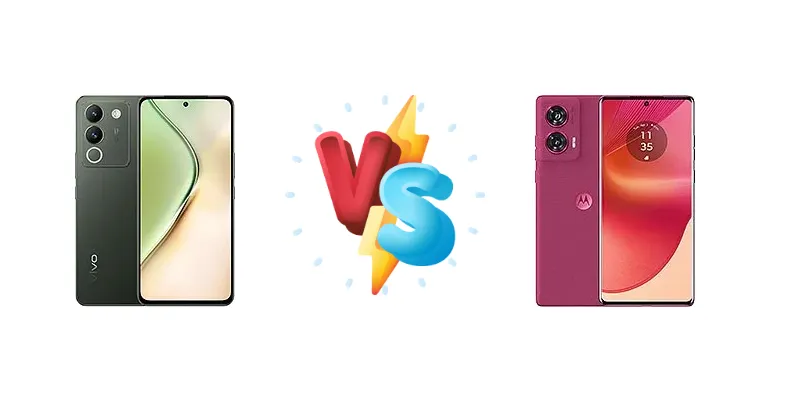
The mid-range smartphone market is fiercely competitive, and the vivo Y200 (India) and Motorola Edge 50 Fusion represent compelling options. The Y200 focuses on a balance of features at an accessible price point, while the Edge 50 Fusion aims for a more premium experience with a more powerful chipset – though regional variations exist. This comparison dives deep into the specifications to determine which device delivers the best value.
🏆 Quick Verdict
For the average user prioritizing sustained performance and faster charging, the Motorola Edge 50 Fusion (International variant with Snapdragon 7s Gen 2) is the stronger choice. Its more efficient 4nm process and superior CPU performance outweigh the Y200’s slightly faster charging in most real-world scenarios. However, the LATAM variant with Snapdragon 6 Gen 1 significantly alters this recommendation.
| Network |
|---|
| 2G bands | GSM 850 / 900 / 1800 / 1900 | GSM 850 / 900 / 1800 / 1900 |
| 3G bands | HSDPA 850 / 900 / 2100 | HSDPA 850 / 900 / 1900 / 2100 |
| 4G bands | 1, 3, 5, 8, 28, 38, 40, 41 | 1, 2, 3, 5, 7, 8, 18, 19, 20, 26, 28, 32, 38, 40, 41, 42, 71 - International |
| 5G bands | 1, 3, 5, 8, 28, 77, 78 SA/NSA | 1, 3, 5, 7, 8, 20, 26, 28, 38, 40, 41, 77, 78 SA/NSA |
| Speed | HSPA, LTE, 5G | HSPA, LTE, 5G |
| Technology | GSM / HSPA / LTE / 5G | GSM / HSPA / LTE / 5G |
| Launch |
|---|
| Announced | 2023, October 23 | 2024, April 16 |
| Status | Available. Released 2023, October 23 | Available. Released 2024, May 15 |
| Body |
|---|
| Build | Glass front, plastic frame, glass back | Glass front, silicone polymer back (eco leather), plastic frame |
| Dimensions | 162.4 x 74.9 x 7.7 mm (6.39 x 2.95 x 0.30 in) | 161.9 x 73.1 x 7.9 mm (6.37 x 2.88 x 0.31 in) |
| SIM | Nano-SIM + Nano-SIM | · Nano-SIM + eSIM· Nano-SIM + Nano-SIM |
| Weight | 190 g (6.70 oz) | 174.9 g (6.17 oz) |
| Display |
|---|
| Protection | - | Corning Gorilla Glass 5 |
| Resolution | 1080 x 2400 pixels, 20:9 ratio (~395 ppi density) | 1080 x 2400 pixels, 20:9 ratio (~393 ppi density) |
| Size | 6.67 inches, 107.4 cm2 (~88.3% screen-to-body ratio) | 6.7 inches, 108.4 cm2 (~91.6% screen-to-body ratio) |
| Type | AMOLED, 120Hz, 800 nits (peak) | P-OLED, 1B colors, 120Hz (LATAM), 144Hz (INT), 1600 nits (peak) |
| Platform |
|---|
| CPU | Octa-core (2x2.0 GHz Cortex-A78 & 6x1.8 GHz Cortex-A55) | Octa-core (4x2.40 GHz Cortex-A78 & 4x1.95 GHz Cortex-A55) - InternationalOcta-core (4x2.2 GHz Cortex-A78 & 4x1.8 GHz Cortex-A55) - LATAM |
| Chipset | Qualcomm SM4375 Snapdragon 4 Gen 1 (6 nm) | Qualcomm SM7435-AB Snapdragon 7s Gen 2 (4 nm) - InternationalQualcomm SM6450 Snapdragon 6 Gen 1 (4 nm) - LATAM |
| GPU | Adreno 619 | Adreno 710 |
| OS | Android 13, Funtouch 13 | Android 14, upgradable to Android 15, up to 3 major Android upgrades |
| Memory |
|---|
| Card slot | No | No |
| Internal | 128GB 8GB RAM, 256GB 8GB RAM | 128GB 8GB RAM, 256GB 8GB RAM, 256GB 12GB RAM, 512GB 8GB RAM, 512GB 12GB RAM |
| Main Camera |
|---|
| Dual | 64 MP, f/1.8, (wide), PDAF, OIS
Auxiliary lens | 50 MP, f/1.9, (wide), 1/1.56", 1.0µm, multi-directional PDAF, OIS
13 MP, f/2.2, 120˚ (ultrawide), 1/3.0", 1.12µm, AF |
| Features | Ring-LED flash, panorama, HDR | LED flash, HDR, panorama |
| Video | 1080p@30fps | 4K@30fps, 1080p@30/60/120fps, gyro-EIS |
| Selfie camera |
|---|
| Features | - | HDR |
| Single | 16 MP, f/2.0, (wide) | 32 MP, f/2.5, (wide), 1/3.14", 0.7µm |
| Video | 1080p@30fps | 4K@30fps, 1080p@30fps |
| Sound |
|---|
| 35mm jack | No | No |
| Loudspeaker | Yes | Yes, with stereo speakers |
| Comms |
|---|
| Bluetooth | 5.1, A2DP, LE | 5.2, A2DP, LE |
| NFC | No | Yes |
| Positioning | GPS, GLONASS, GALILEO, BDS, QZSS | GPS, GLONASS, GALILEO |
| Radio | No | No |
| USB | USB Type-C 2.0, OTG | USB Type-C 2.0, OTG |
| WLAN | Wi-Fi 802.11 a/b/g/n/ac, dual-band | Wi-Fi 802.11 a/b/g/n/ac, dual-band |
| Features |
|---|
| Sensors | Fingerprint (under display, optical), accelerometer, gyro, proximity, compass | Fingerprint (under display, optical), accelerometer, gyro, proximity, compass |
| Battery |
|---|
| Charging | 44W wired, 50% in 28 min
Reverse wired | 68W wired, 50% in 15 min |
| Type | Li-Ion 4800 mAh | 5000 mAh |
| Misc |
|---|
| Colors | Jungle Green, Desert Gold | Forest Blue, Marshmallow Blue, Hot Pink |
| Models | V2307 | XT2429-1 |
| Price | About 250 EUR | € 208.99 / $ 245.00 / ₹ 18,667 |
| SAR | 0.99 W/kg (head) 0.86 W/kg (body) | - |
vivo Y200 (India)
- More affordable price point
- Decent performance for everyday tasks
- 44W fast charging with reverse wired charging
- Less powerful chipset compared to the Fusion (International)
- Likely lower display brightness
- Limited information on camera capabilities
Motorola Edge 50 Fusion
- Faster and more efficient Snapdragon 7s Gen 2 (International)
- Significantly brighter display (1322 nits)
- 68W fast charging
- Higher price tag
- Snapdragon 6 Gen 1 variant (LATAM) reduces performance advantage
- Potential for software bloat (Motorola's history)
Display Comparison
The Motorola Edge 50 Fusion boasts a significantly brighter display, reaching a measured 1322 nits. This is a substantial advantage over what we’d expect from the Y200, making the Fusion far more usable outdoors under direct sunlight. While the Y200’s panel specifications are not provided, the Fusion’s brightness alone is a major differentiator. The Fusion’s panel likely benefits from its higher price point, potentially including features like higher PWM dimming rates for reduced flicker, benefiting users sensitive to screen flicker.
Camera Comparison
Without detailed camera specifications for the vivo Y200, a direct comparison is difficult. However, both phones likely target similar image processing philosophies – aiming for vibrant, social media-ready photos. The Motorola Edge 50 Fusion’s camera system is expected to benefit from Qualcomm’s ISP capabilities within the Snapdragon 7s Gen 2. While megapixel counts aren’t everything, a larger sensor size (if present in the Fusion) would contribute to better low-light performance. We can assume both phones will include standard features like portrait modes and night modes, but the Fusion’s more powerful processor will likely enable faster image processing and potentially more advanced computational photography features.
Performance
The core difference lies in the chipsets. The Motorola Edge 50 Fusion (International) utilizes the Qualcomm SM7435-AB Snapdragon 7s Gen 2 (4nm), featuring an octa-core CPU with 4x2.40 GHz Cortex-A78 cores and 4x1.95 GHz Cortex-A55 cores. This is a clear step up from the vivo Y200’s Snapdragon 4 Gen 1 (6nm) with its 2x2.0 GHz Cortex-A78 and 6x1.8 GHz Cortex-A55 configuration. The 4nm process of the 7s Gen 2 offers superior power efficiency, translating to less thermal throttling during extended use. However, the LATAM version of the Edge 50 Fusion uses the Snapdragon 6 Gen 1, which narrows the performance gap considerably. The Y200’s Snapdragon 4 Gen 1 is adequate for basic tasks, but the Fusion’s 7s Gen 2 provides a noticeably smoother experience with multitasking and graphically intensive applications.
Battery Life
The Motorola Edge 50 Fusion’s 68W wired charging is significantly faster than the vivo Y200’s 44W charging, achieving 50% charge in just 15 minutes compared to the Y200’s 28 minutes. The Edge 50 Fusion also demonstrates impressive battery life, achieving an active use score of 12:40h. While the Y200’s battery capacity isn’t specified, the Fusion’s combination of efficient chipset and fast charging provides a clear advantage. The 4nm process of the Snapdragon 7s Gen 2 contributes to better power management, offsetting any potential capacity difference.
Buying Guide
Buy the vivo Y200 (India) if you need a reliable daily driver with decent performance for everyday tasks and prioritize a lower upfront cost. Buy the Motorola Edge 50 Fusion (International) if you prefer a smoother experience with demanding apps, enjoy longer gaming sessions, and value a brighter, more vibrant display. Be aware of the chipset difference in the LATAM version.
Frequently Asked Questions
❓ Does the Snapdragon 6 Gen 1 (LATAM Edge 50 Fusion) significantly impact gaming performance?
Yes, the Snapdragon 6 Gen 1 is noticeably less powerful than the Snapdragon 7s Gen 2. While still capable of running most games, you'll likely experience lower frame rates and more frequent frame drops in demanding titles. The 7s Gen 2 offers a much smoother and more consistent gaming experience.
❓ How does the charging speed difference translate to real-world usage?
The 68W charging on the Motorola Edge 50 Fusion is a game-changer. Getting from 0% to 50% in just 15 minutes is significantly faster than the Y200’s 28 minutes. This is particularly useful for users who frequently find themselves needing a quick power boost throughout the day.
❓ Is the difference in chipset noticeable for everyday tasks like browsing and social media?
For basic tasks, the difference might not be immediately apparent. However, the Snapdragon 7s Gen 2 in the Edge 50 Fusion will provide a smoother and more responsive experience when multitasking, switching between apps, and loading web pages. The Y200’s Snapdragon 4 Gen 1 may exhibit slight lag in these scenarios.
❓ What kind of display technology is used in the Motorola Edge 50 Fusion, and does it support high refresh rates?
While the exact display technology isn't specified, the 1322 nits peak brightness suggests a high-quality panel, likely AMOLED. The Edge 50 Fusion supports a 144Hz refresh rate, providing exceptionally smooth scrolling and animations, a feature not typically found in the Y200's segment.