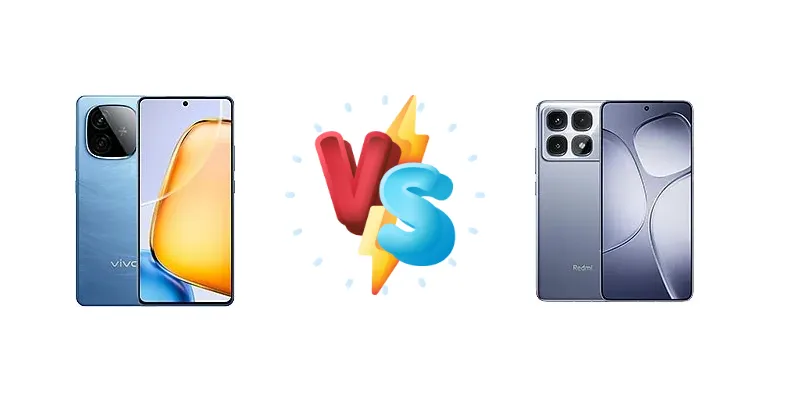
The vivo Y200 GT and Xiaomi Redmi K70 Ultra represent compelling options in the increasingly competitive mid-range smartphone market. While both devices aim to deliver a premium experience without the flagship price tag, they take distinctly different approaches to achieving this goal, primarily through their chipset choices and charging capabilities. This comparison will dissect those differences to help you determine which phone best suits your needs.
🏆 Quick Verdict
For the average user prioritizing raw performance and faster charging, the Xiaomi Redmi K70 Ultra is the clear winner. Its Dimensity 9300+ chipset offers a significant performance leap over the Snapdragon 7 Gen 3, and the 120W charging is substantially quicker. However, the Y200 GT remains a strong contender for those seeking a more balanced package.
| Network |
|---|
| 2G bands | GSM 850 / 900 / 1800 / 1900 | GSM 850 / 900 / 1800 / 1900 |
| 3G bands | HSDPA 850 / 900 / 2100 | HSDPA 800 / 850 / 900 / 1700(AWS) / 2100 |
| 4G bands | 1, 3, 5, 8, 28, 34, 38, 39, 40, 41 | 1, 3, 4, 5, 7, 8, 18, 19, 26, 28, 34, 38, 39, 40, 41, 42, 48, 66 |
| 5G bands | 1, 5, 8, 28, 38, 41, 77, 78 SA/NSA | 1, 3, 5, 7, 8, 28, 66, 38, 40, 41, 48, 77, 78 SA/NSA |
| Speed | HSPA, LTE, 5G | HSPA, LTE, 5G |
| Technology | GSM / CDMA / HSPA / LTE / 5G | GSM / CDMA / HSPA / CDMA2000 / LTE / 5G |
| Launch |
|---|
| Announced | 2024, May 20 | 2024, July 19 |
| Status | Available. Released 2024, May 20 | Available. Released 2024, July 19 |
| Body |
|---|
| Build | - | Glass front, aluminum frame |
| Dimensions | 163.7 x 75.9 x 8 mm (6.44 x 2.99 x 0.31 in) | 160.4 x 75.1 x 8.4 mm (6.31 x 2.96 x 0.33 in) |
| SIM | Nano-SIM + Nano-SIM | Nano-SIM + Nano-SIM |
| Weight | 194.6 g (6.88 oz) | 211 g (7.44 oz) |
| Display |
|---|
| Protection | - | Scratch/drop-resistant glass |
| Resolution | 1260 x 2800 pixels, 20:9 ratio (~453 ppi density) | 1220 x 2712 pixels, 20:9 ratio (~446 ppi density) |
| Size | 6.78 inches, 111.0 cm2 (~89.3% screen-to-body ratio) | 6.67 inches, 107.4 cm2 (~89.1% screen-to-body ratio) |
| Type | AMOLED, 1B colors, 144Hz, HDR, 4500 nits (peak) | OLED, 68B colors, 144Hz, Dolby Vision, HDR10+, 1600 nits (HBM), 4000 nits (peak) |
| Platform |
|---|
| CPU | Octa-core (1x2.63 GHz Cortex-A715 & 4x2.4 GHz Cortex-A715 & 3x1.8 GHz Cortex-A510) | Octa-core (1x3.25 GHz Cortex-X4 & 3x2.85 GHz Cortex-X4 & 4x2.0 GHz Cortex-A720) |
| Chipset | Qualcomm SM7550-AB Snapdragon 7 Gen 3 (4 nm) | Mediatek Dimensity 9300+ (4 nm) |
| GPU | Adreno 720 | Immortalis-G720 MC12 |
| OS | Android 14, OriginOS 4 | Android 14, HyperOS |
| Memory |
|---|
| Card slot | No | No |
| Internal | 128GB 8GB RAM, 256GB 8GB RAM, 256GB 12GB RAM, 512GB 12GB RAM | 256GB 12GB RAM, 512GB 12GB RAM, 512GB 16GB RAM, 1TB 16GB RAM, 1TB 24GB RAM |
| Main Camera |
|---|
| Dual | 50 MP, f/1.8, (wide), 1/1.95", 0.8µm, PDAF
Auxiliary lens | - |
| Features | LED flash, panorama, HDR | Color spectrum sensor, Dual-LED dual-tone flash, HDR, panorama |
| Triple | - | 50 MP, f/1.7, 23mm (wide), 1/1.56", 1.0µm, PDAF, OIS
8 MP, 119˚ (ultrawide), 1/4.0", 1.12µm
2 MP (macro) |
| Video | 4K@30fps, 1080p, gyro-EIS | 8K@24/30fps, 4K@24/30/60fps, 1080p@30/60/120/240/960fps, gyro-EIS |
| Selfie camera |
|---|
| Features | - | HDR |
| Single | 16 MP, f/2.5, (wide), 1/3.0", 1.0µm | 20 MP, (wide), 1/2.0", 0.8µm |
| Video | 1080p@30fps | 1080p@30fps |
| Sound |
|---|
| 35mm jack | No | No |
| Loudspeaker | Yes, with stereo speakers | Yes, with stereo speakers |
| Comms |
|---|
| Bluetooth | 5.4, A2DP, LE, aptX HD, aptX Adaptive, aptX Lossless | 5.4, A2DP, LE, LHDC 5 |
| Infrared port | Yes | Yes |
| NFC | Yes | Yes |
| Positioning | GPS, GALILEO, GLONASS, QZSS, BDS (B1I+B1c) | GPS (L1+L5), BDS (B1I+B1C+B2a+B2b), GALILEO (E1+E5a+E5b), QZSS (L1+L5), NavIC (L5), GLONASS |
| Radio | No | Unspecified |
| USB | USB Type-C 2.0, OTG | USB Type-C |
| WLAN | Wi-Fi 802.11 a/b/g/n/ac/6, dual-band | Wi-Fi 802.11 a/b/g/n/ac/6/7, dual-band, Wi-Fi Direct |
| Features |
|---|
| Sensors | Fingerprint (under display, optical), accelerometer, gyro, proximity, compass | Fingerprint (under display, optical), accelerometer, gyro, proximity, compass |
| Battery |
|---|
| Charging | 80W wired, 50% in 26 min
7.5W reverse wired | 120W wired, PD3.0, 100% in 24 min |
| Type | 6000 mAh | Li-Po 5500 mAh |
| Misc |
|---|
| Colors | Black, Blue | Black, White, Violet, Green Championship Edition, Orange Championship Edition |
| Models | V2361GA | 2407FRK8EC |
| Price | About 230 EUR | About 330 EUR |
vivo Y200 GT
- Potentially more efficient Snapdragon 7 Gen 3 chipset
- 80W fast charging is still very quick
- Likely a more refined software experience (based on vivo's history)
- Significantly less powerful CPU and GPU than the K70 Ultra
- Slower charging speed compared to the K70 Ultra
- May lag behind in demanding games and multitasking
Xiaomi Redmi K70 Ultra
- Massively powerful Dimensity 9300+ chipset
- Ultra-fast 120W charging
- Superior gaming performance
- Potentially higher power consumption
- Xiaomi’s MIUI can be resource-intensive
- May run warmer under sustained load
Display Comparison
Context data lacks display specifics, but given the market positioning, both likely feature AMOLED panels. The Redmi K70 Ultra, based on Xiaomi’s history, is expected to have a higher peak brightness and potentially a higher refresh rate (144Hz vs 120Hz). The Dimensity 9300+'s ISP is also better equipped to handle display processing, potentially leading to more accurate colors. Bezels are likely comparable, but the K70 Ultra may benefit from slightly more advanced display calibration.
Camera Comparison
Without detailed camera specs, it’s difficult to make a definitive judgment. However, Xiaomi typically prioritizes camera hardware in its 'K' series. We can anticipate the K70 Ultra having a larger main sensor and potentially a more sophisticated image processing pipeline, leveraging the Dimensity 9300+'s superior ISP. The Y200 GT will likely focus on software optimization to deliver good image quality, but may struggle to match the K70 Ultra in low-light scenarios or dynamic range. The presence of OIS on the main sensor will be a key differentiator, and the K70 Ultra is more likely to include it.
Performance
The core difference lies in the chipsets. The Xiaomi Redmi K70 Ultra’s Mediatek Dimensity 9300+ boasts a Cortex-X4 prime core clocked at 3.25 GHz, alongside three more Cortex-X4 cores, offering a substantial advantage in CPU-intensive tasks compared to the vivo Y200 GT’s Snapdragon 7 Gen 3. The Snapdragon 7 Gen 3 utilizes a Cortex-A715 prime core at 2.63 GHz. While both are 4nm chips, the Dimensity 9300+'s architecture is significantly more powerful. This translates to faster app loading, smoother multitasking, and higher frame rates in demanding games. The K70 Ultra’s GPU will also outperform the Snapdragon’s Adreno GPU. The K70 Ultra likely utilizes faster LPDDR5x RAM, further enhancing performance.
Battery Life
The Redmi K70 Ultra’s 120W charging is a game-changer, achieving a full charge in just 24 minutes. The vivo Y200 GT’s 80W charging, while respectable, takes 26 minutes to reach 50% and significantly longer for a full charge. While battery capacity isn’t specified, the faster charging of the K70 Ultra effectively mitigates any potential capacity disadvantage. The Dimensity 9300+'s efficiency also contributes to better battery life under heavy load, despite potentially having a smaller battery.
Buying Guide
Buy the vivo Y200 GT if you prioritize a balanced experience with a focus on efficient power consumption and a potentially more refined software experience. It's ideal for everyday users who enjoy social media, streaming, and casual gaming. Buy the Xiaomi Redmi K70 Ultra if you demand maximum performance for gaming, multitasking, and content creation, and if minimizing charging time is a top priority. This phone is geared towards power users and mobile gamers.
Frequently Asked Questions
❓ Will the Dimensity 9300+ in the Redmi K70 Ultra overheat during prolonged gaming sessions?
While the Dimensity 9300+ is a powerful chip, Xiaomi typically employs effective thermal management solutions in its 'K' series. Expect some heat, but the K70 Ultra should sustain peak performance for extended periods without significant throttling, especially compared to older chipsets. The larger surface area of the phone also aids in heat dissipation.
❓ Does the vivo Y200 GT's Snapdragon 7 Gen 3 offer a playable experience in graphically demanding games like Genshin Impact?
Yes, the Snapdragon 7 Gen 3 is capable of running Genshin Impact, but you'll likely need to lower the graphics settings to medium or low to maintain a stable frame rate. Don't expect the same level of performance as the Redmi K70 Ultra, which can handle higher settings with ease.
❓ How does the 80W charging on the vivo Y200 GT compare to other phones in its price range?
80W charging is still considered fast charging and is competitive within the mid-range segment. However, the Redmi K70 Ultra's 120W charging is significantly faster, offering a substantial time saving for users who frequently need to top up their battery.