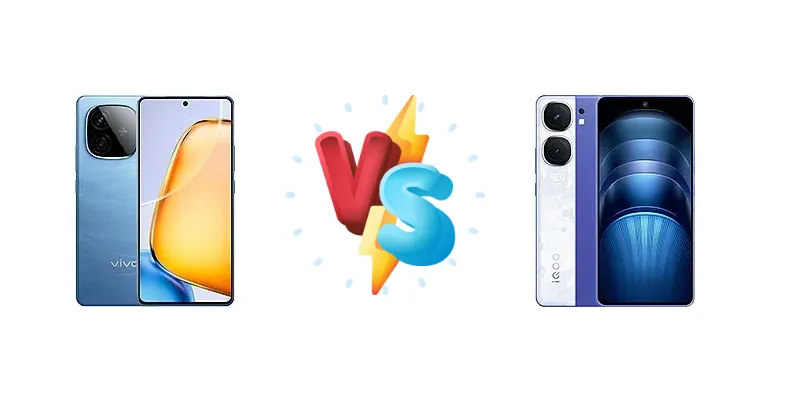
vivo's strategy is bifurcated: the Y-series focuses on value, while iQOO targets performance enthusiasts. The Y200 GT and Neo9S Pro+ represent this split, offering distinct experiences despite both running Qualcomm silicon. This comparison dissects the core differences, focusing on how the chipset and charging capabilities impact daily use and gaming.
🏆 Quick Verdict
For most users, the iQOO Neo9S Pro+ is the superior choice. Its Snapdragon 8 Gen 3 delivers significantly higher performance, justifying the price premium. However, the vivo Y200 GT provides excellent value for budget-conscious users who prioritize efficiency and don't need top-tier gaming capabilities.
| Network |
|---|
| 2G bands | GSM 850 / 900 / 1800 / 1900 | GSM 850 / 900 / 1800 / 1900 |
| 3G bands | HSDPA 850 / 900 / 2100 | HSDPA 850 / 900 / 1700(AWS) / 1900 / 2100 |
| 4G bands | 1, 3, 5, 8, 28, 34, 38, 39, 40, 41 | 1, 3, 4, 5, 7, 8, 18, 19, 26, 28, 34, 38, 39, 40, 41 |
| 5G bands | 1, 5, 8, 28, 38, 41, 77, 78 SA/NSA | 1, 3, 5, 8, 28, 38, 40, 41, 77, 78 SA/NSA |
| Speed | HSPA, LTE, 5G | HSPA, LTE, 5G |
| Technology | GSM / CDMA / HSPA / LTE / 5G | GSM / CDMA / HSPA / CDMA2000 / LTE / 5G |
| Launch |
|---|
| Announced | 2024, May 20 | 2024, July 11 |
| Status | Available. Released 2024, May 20 | Available. Released 2024, July 16 |
| Body |
|---|
| Dimensions | 163.7 x 75.9 x 8 mm (6.44 x 2.99 x 0.31 in) | 163.5 x 75.7 x 8 mm or 8.3 mm |
| SIM | Nano-SIM + Nano-SIM | Nano-SIM + Nano-SIM |
| Weight | 194.6 g (6.88 oz) | 193 g or 198 g (6.81 oz) |
| Display |
|---|
| Resolution | 1260 x 2800 pixels, 20:9 ratio (~453 ppi density) | 1260 x 2800 pixels, 20:9 ratio (~453 ppi density) |
| Size | 6.78 inches, 111.0 cm2 (~89.3% screen-to-body ratio) | 6.78 inches, 111.0 cm2 (~89.7% screen-to-body ratio) |
| Type | AMOLED, 1B colors, 144Hz, HDR, 4500 nits (peak) | LTPO AMOLED, 1B colors, 144Hz, HDR10+, 1400 nits (HBM) |
| Platform |
|---|
| CPU | Octa-core (1x2.63 GHz Cortex-A715 & 4x2.4 GHz Cortex-A715 & 3x1.8 GHz Cortex-A510) | Octa-core (1x3.3 GHz Cortex-X4 & 3x3.2 GHz Cortex-A720 & 2x3.0 GHz Cortex-A720 & 2x2.3 GHz Cortex-A520) |
| Chipset | Qualcomm SM7550-AB Snapdragon 7 Gen 3 (4 nm) | Qualcomm SM8650-AB Snapdragon 8 Gen 3 (4 nm) |
| GPU | Adreno 720 | Adreno 750 |
| OS | Android 14, OriginOS 4 | Android 14, upgradable to Android 15, OriginOS 5 |
| Memory |
|---|
| Card slot | No | No |
| Internal | 128GB 8GB RAM, 256GB 8GB RAM, 256GB 12GB RAM, 512GB 12GB RAM | 256GB 12GB RAM, 256GB 16GB RAM, 512GB 12GB RAM, 512GB 16GB RAM, 1TB 16GB RAM |
| Main Camera |
|---|
| Dual | 50 MP, f/1.8, (wide), 1/1.95", 0.8µm, PDAF
Auxiliary lens | 50 MP, f/1.9, (wide), 1/1.56", PDAF, OIS
50 MP, f/2.0, 119˚ (ultrawide), 1/2.76", 0.64µm, AF |
| Features | LED flash, panorama, HDR | LED flash, panorama, HDR |
| Video | 4K@30fps, 1080p, gyro-EIS | 8K, 4K, 1080p, gyro-EIS |
| Selfie camera |
|---|
| Single | 16 MP, f/2.5, (wide), 1/3.0", 1.0µm | 16 MP, f/2.5, (wide) |
| Video | 1080p@30fps | 1080p@30fps |
| Sound |
|---|
| 35mm jack | No | No |
| Loudspeaker | Yes, with stereo speakers | Yes, with stereo speakers |
| Comms |
|---|
| Bluetooth | 5.4, A2DP, LE, aptX HD, aptX Adaptive, aptX Lossless | 5.4, A2DP, LE, aptX HD, aptX Adaptive, aptX Lossless, LHDC |
| Infrared port | Yes | Yes |
| NFC | Yes | Yes |
| Positioning | GPS, GALILEO, GLONASS, QZSS, BDS (B1I+B1c) | GPS (L1+L5), BDS (B1I+B1c+B2a), GALILEO (E1+E5a), QZSS (L1+L5), GLONASS |
| Radio | No | No |
| USB | USB Type-C 2.0, OTG | USB Type-C 2.0, OTG |
| WLAN | Wi-Fi 802.11 a/b/g/n/ac/6, dual-band | Wi-Fi 802.11 a/b/g/n/ac/6/7, dual-band |
| Features |
|---|
| Sensors | Fingerprint (under display, optical), accelerometer, gyro, proximity, compass | Fingerprint (under display, ultrasonic), accelerometer, gyro, proximity, compass |
| Battery |
|---|
| Charging | 80W wired, 50% in 26 min
7.5W reverse wired | 120W wired, 70% in 17 min, 100% in 28 min
Reverse wired |
| Type | 6000 mAh | 5500 mAh |
| Misc |
|---|
| Colors | Black, Blue | Blue/White, Black, White |
| Models | V2361GA | V2403A |
| Price | About 230 EUR | About 380 EUR |
vivo Y200 GT
- More affordable price point
- Efficient Snapdragon 7 Gen 3 chipset
- Fast 80W wired charging
- Significantly lower performance than the iQOO Neo9S Pro+
- Likely a less advanced camera system
vivo iQOO Neo9S Pro+
- Flagship-level performance with Snapdragon 8 Gen 3
- Ultra-fast 120W wired charging
- Potentially superior camera capabilities
- Higher price tag
- May generate more heat under sustained load
Display Comparison
While both devices likely feature AMOLED panels (based on brand trends), specific details like resolution and refresh rate are missing. However, the core difference lies in the processing power driving them. The Snapdragon 8 Gen 3 in the iQOO Neo9S Pro+ will handle high refresh rate gaming and complex animations with greater ease, minimizing stuttering. The Y200 GT’s Snapdragon 7 Gen 3, while capable, will show its limitations in graphically intensive scenarios.
Camera Comparison
Without specific camera sensor details, it’s difficult to make a definitive judgment. However, the iQOO Neo9S Pro+, positioned as a flagship, likely incorporates a more advanced camera system with a larger main sensor and potentially better image stabilization (OIS). The Snapdragon 8 Gen 3’s ISP (Image Signal Processor) is also significantly more capable, enabling superior image processing, especially in low-light conditions. The Y200 GT will likely offer a competent camera experience, but won’t match the Neo9S Pro+’s potential for detail and dynamic range.
Performance
The performance gap is substantial. The iQOO Neo9S Pro+ boasts the Snapdragon 8 Gen 3, featuring a 1x3.3 GHz Cortex-X4 prime core, compared to the Y200 GT’s Snapdragon 7 Gen 3 with its 1x2.63 GHz Cortex-A715. This architectural difference translates to a significant uplift in CPU and GPU performance. The Neo9S Pro+’s CPU configuration (3x3.2 GHz Cortex-A720 & 2x3.0 GHz Cortex-A720 & 2x2.3 GHz Cortex-A520) is demonstrably more powerful than the Y200 GT’s (4x2.4 GHz Cortex-A715 & 3x1.8 GHz Cortex-A510). Gamers and power users will immediately notice the difference in loading times and frame rates.
Battery Life
The iQOO Neo9S Pro+’s 120W wired charging is a game-changer, achieving 70% charge in 17 minutes and 100% in 28 minutes. This is significantly faster than the Y200 GT’s 80W charging (50% in 26 minutes). While battery capacity isn’t specified, the faster charging of the Neo9S Pro+ mitigates any potential disadvantage from a slightly smaller battery. The inclusion of reverse wired charging on both devices is a convenient feature for topping up accessories.
Buying Guide
Buy the vivo Y200 GT if you need a reliable daily driver with good battery life and fast 80W charging, prioritizing affordability over raw power. It’s ideal for social media, streaming, and casual gaming. Buy the vivo iQOO Neo9S Pro+ if you demand the fastest possible performance for demanding games, content creation, or heavy multitasking, and are willing to pay extra for the Snapdragon 8 Gen 3 and its associated benefits like faster app loading and smoother frame rates.
Frequently Asked Questions
❓ Will the Snapdragon 7 Gen 3 in the Y200 GT handle demanding games like Genshin Impact?
The Snapdragon 7 Gen 3 can run Genshin Impact, but you’ll likely need to lower graphics settings to achieve a consistently smooth frame rate. Expect some frame drops during intense combat scenarios. The iQOO Neo9S Pro+ with the Snapdragon 8 Gen 3 will provide a much more fluid and visually rich gaming experience.
❓ How much faster is the 120W charging on the iQOO Neo9S Pro+ compared to the 80W on the Y200 GT in real-world use?
The 120W charging on the iQOO Neo9S Pro+ allows for a significantly faster top-up. While the Y200 GT reaches 50% in 26 minutes, the Neo9S Pro+ hits 70% in the same timeframe. This means you can quickly add hours of usage with just a short charging session, ideal for users who are always on the go.
❓ Does the iQOO Neo9S Pro+ get noticeably hotter than the Y200 GT during extended gaming sessions?
The Snapdragon 8 Gen 3 is a more powerful chip and will generate more heat under sustained load than the Snapdragon 7 Gen 3. While iQOO likely incorporates advanced cooling solutions, the Neo9S Pro+ may become warmer during prolonged gaming. However, this increased heat is the trade-off for significantly higher performance.