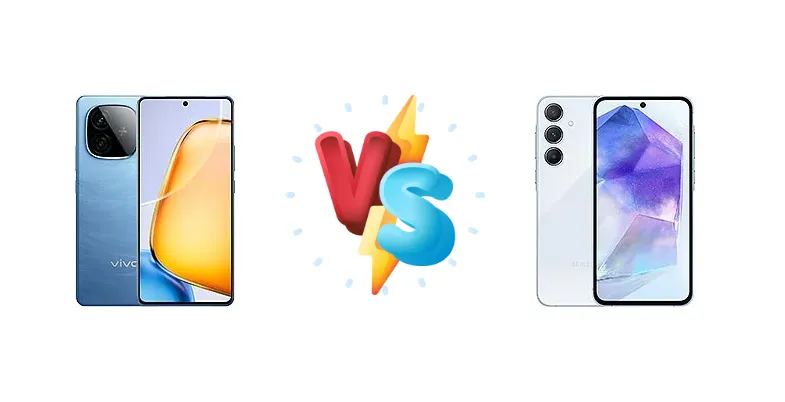
The mid-range smartphone market is fiercely competitive, and the vivo Y200 GT and Samsung Galaxy A55 represent compelling options. The Y200 GT aggressively targets performance with a Snapdragon 7 Gen 3, while the A55 prioritizes a refined user experience and strong battery life powered by Samsung’s Exynos 1480. This comparison dissects their key differences to determine which device delivers the best value.
🏆 Quick Verdict
For users prioritizing raw performance and fast charging, the vivo Y200 GT is the clear winner. Its Snapdragon 7 Gen 3 offers a noticeable edge in demanding tasks. However, the Samsung Galaxy A55 excels in battery endurance and display brightness, making it a better choice for everyday users who value longevity and outdoor visibility.
| Network |
|---|
| 2G bands | GSM 850 / 900 / 1800 / 1900 | GSM 850 / 900 / 1800 / 1900 |
| 3G bands | HSDPA 850 / 900 / 2100 | HSDPA 850 / 900 / 1700(AWS) / 1900 / 2100 |
| 4G bands | 1, 3, 5, 8, 28, 34, 38, 39, 40, 41 | 1, 2, 3, 4, 5, 7, 8, 12, 17, 20, 25, 26, 28, 32, 38, 40, 41, 66 |
| 5G bands | 1, 5, 8, 28, 38, 41, 77, 78 SA/NSA | 1, 3, 5, 7, 8, 20, 28, 38, 40, 41, 66, 77, 78 SA/NSA/Sub6 |
| Speed | HSPA, LTE, 5G | HSPA, LTE, 5G |
| Technology | GSM / CDMA / HSPA / LTE / 5G | GSM / HSPA / LTE / 5G |
| Launch |
|---|
| Announced | 2024, May 20 | 2024, March 11 |
| Status | Available. Released 2024, May 20 | Available. Released 2024, March 15 |
| Body |
|---|
| Build | - | Glass front (Gorilla Glass Victus+), glass back (Gorilla Glass), aluminum frame |
| Dimensions | 163.7 x 75.9 x 8 mm (6.44 x 2.99 x 0.31 in) | 161.1 x 77.4 x 8.2 mm (6.34 x 3.05 x 0.32 in) |
| SIM | Nano-SIM + Nano-SIM | · Nano-SIM· Nano-SIM + eSIM· Nano-SIM + Nano-SIM· Nano-SIM + Nano-SIM + eSIM (max 2 at a time) |
| Weight | 194.6 g (6.88 oz) | 213 g (7.51 oz) |
| Display |
|---|
| Protection | - | Corning Gorilla Glass Victus+ |
| Resolution | 1260 x 2800 pixels, 20:9 ratio (~453 ppi density) | 1080 x 2340 pixels, 19.5:9 ratio (~390 ppi density) |
| Size | 6.78 inches, 111.0 cm2 (~89.3% screen-to-body ratio) | 6.6 inches, 106.9 cm2 (~85.8% screen-to-body ratio) |
| Type | AMOLED, 1B colors, 144Hz, HDR, 4500 nits (peak) | Super AMOLED, 120Hz, HDR10+, 1000 nits (HBM) |
| Platform |
|---|
| CPU | Octa-core (1x2.63 GHz Cortex-A715 & 4x2.4 GHz Cortex-A715 & 3x1.8 GHz Cortex-A510) | Octa-core (4x2.75 GHz Cortex-A78 & 4x2.0 GHz Cortex-A55) |
| Chipset | Qualcomm SM7550-AB Snapdragon 7 Gen 3 (4 nm) | Exynos 1480 (4 nm) |
| GPU | Adreno 720 | Xclipse 530 |
| OS | Android 14, OriginOS 4 | Android 14, up to 4 major Android upgrades, One UI 6.1 |
| Memory |
|---|
| Card slot | No | microSDXC (uses shared SIM slot) |
| Internal | 128GB 8GB RAM, 256GB 8GB RAM, 256GB 12GB RAM, 512GB 12GB RAM | 128GB 6GB RAM, 128GB 8GB RAM, 256GB 6GB RAM, 256GB 8GB RAM, 256GB 12GB RAM |
| Main Camera |
|---|
| Dual | 50 MP, f/1.8, (wide), 1/1.95", 0.8µm, PDAF
Auxiliary lens | - |
| Features | LED flash, panorama, HDR | LED flash, panorama, HDR |
| Triple | - | 50 MP, f/1.8, (wide), 1/1.56", 1.0µm, PDAF, OIS
12 MP, f/2.2, 123˚ (ultrawide), 1/3.06", 1.12µm
5 MP (macro) |
| Video | 4K@30fps, 1080p, gyro-EIS | 4K@30fps, 1080p@30/60fps, gyro-EIS |
| Selfie camera |
|---|
| Single | 16 MP, f/2.5, (wide), 1/3.0", 1.0µm | 32 MP, f/2.2, 26mm (wide), 1/2.74", 0.8µm |
| Video | 1080p@30fps | 4K@30fps, 1080p@30/60fps |
| Sound |
|---|
| 35mm jack | No | No |
| Loudspeaker | Yes, with stereo speakers | Yes, with stereo speakers |
| Comms |
|---|
| Bluetooth | 5.4, A2DP, LE, aptX HD, aptX Adaptive, aptX Lossless | 5.3, A2DP, LE |
| Infrared port | Yes | - |
| NFC | Yes | Yes (market/region dependent) |
| Positioning | GPS, GALILEO, GLONASS, QZSS, BDS (B1I+B1c) | GPS, GALILEO, GLONASS, BDS, QZSS |
| Radio | No | No |
| USB | USB Type-C 2.0, OTG | USB Type-C 2.0, OTG |
| WLAN | Wi-Fi 802.11 a/b/g/n/ac/6, dual-band | Wi-Fi 802.11 a/b/g/n/ac/6, dual-band, Wi-Fi Direct |
| Features |
|---|
| Sensors | Fingerprint (under display, optical), accelerometer, gyro, proximity, compass | Fingerprint (under display, optical), accelerometer, gyro, compass |
| Battery |
|---|
| Charging | 80W wired, 50% in 26 min
7.5W reverse wired | 25W wired |
| Type | 6000 mAh | Li-Ion 5000 mAh |
| Misc |
|---|
| Colors | Black, Blue | Iceblue, Lilac, Navy, Lemon |
| Models | V2361GA | SM-A556V, SM-A556B, SM-A556B/DS, SM-A556E, SM-A556E/DS, SM-A5560 |
| Price | About 230 EUR | $ 324.99 / £ 251.50 / € 319.99 / ₹ 23,998 |
| SAR EU | - | 0.68 W/kg (head) 1.04 W/kg (body) |
vivo Y200 GT
- Faster Snapdragon 7 Gen 3 processor
- 80W Super-Fast Charging
- Potentially better gaming performance
- Battery life likely shorter than A55
- Camera details currently unknown
Samsung Galaxy A55
- Excellent battery life (13:27h active use)
- Brighter 1010 nit display
- Samsung’s established software and support
- Slower 25W charging
- Exynos 1480 may throttle under heavy load
Display Comparison
The Samsung Galaxy A55 boasts a significantly brighter display, reaching a measured 1010 nits, crucial for comfortable viewing in direct sunlight. While the Y200 GT’s display specs are currently unavailable, Samsung’s Super AMOLED technology typically delivers vibrant colors and excellent contrast. The A55’s brightness advantage is a key differentiator for outdoor users. We expect the A55 to have a higher peak brightness and potentially better color accuracy, given Samsung’s display expertise. The A55’s panel is likely to be more power efficient as well.
Camera Comparison
Without detailed camera specs for the Y200 GT, it’s difficult to make a direct comparison. However, Samsung typically prioritizes image processing and color science. The A55 likely benefits from Samsung’s advanced computational photography algorithms. The presence of OIS (Optical Image Stabilization) on the A55’s main sensor is a significant advantage, ensuring sharper images and smoother videos, especially in low-light conditions. We can assume the Y200 GT will have a competitive camera system, but the A55’s established track record and image processing capabilities give it an edge.
Performance
The core difference lies in the chipsets. The vivo Y200 GT’s Snapdragon 7 Gen 3 (4nm) utilizes a 1x2.63 GHz Cortex-A715 prime core alongside four more Cortex-A715 cores, suggesting a focus on sustained performance. The Samsung Galaxy A55’s Exynos 1480 (4nm) employs a different architecture with 4x2.75 GHz Cortex-A78 cores. While the A55’s cores have a higher clock speed, the Snapdragon’s core configuration and newer architecture may translate to better multi-core performance and efficiency. The Y200 GT is likely to excel in GPU-intensive tasks, while the A55 may offer a smoother experience in less demanding applications. The Snapdragon 7 Gen 3’s 4nm process should also result in better thermal management under sustained load.
Battery Life
The Samsung Galaxy A55 demonstrates a clear advantage in battery life, achieving 13 hours and 27 minutes of active use. The Y200 GT’s battery capacity is unknown, but its 80W wired charging is a major selling point, capable of reaching 50% charge in just 26 minutes. The A55’s 25W charging is considerably slower. This trade-off means the Y200 GT offers convenience for quick top-ups, while the A55 provides all-day endurance. The A55’s longer battery life is particularly beneficial for users who frequently travel or have limited access to power outlets.
Buying Guide
Buy the vivo Y200 GT if you need a phone for mobile gaming, frequent multitasking, or quickly topping up your battery with 80W charging. It’s ideal for users who demand responsiveness and aren’t willing to compromise on speed. Buy the Samsung Galaxy A55 if you prefer a phone that lasts all day on a single charge, boasts a brighter display for outdoor use, and offers Samsung’s established software ecosystem and long-term support.
Frequently Asked Questions
❓ Does the Exynos 1480 in the Galaxy A55 tend to overheat during prolonged gaming sessions?
While the Exynos 1480 is a capable chip, it's known to exhibit some thermal throttling under sustained heavy load, particularly in graphically demanding games. The Y200 GT’s Snapdragon 7 Gen 3, built on a 4nm process, is likely to manage heat more effectively, offering more consistent performance during extended gaming.
❓ Is the 80W charging on the vivo Y200 GT compatible with Power Delivery (PD) chargers?
While vivo’s 80W charging is incredibly fast, it utilizes a proprietary charging protocol. While it *may* work with some PD chargers, it’s best to use the charger included in the box to ensure optimal charging speed and safety. Using a non-compatible charger could result in slower charging or, in rare cases, damage to the device.
❓ How does the software experience differ between the vivo Y200 GT and the Samsung Galaxy A55?
Samsung’s One UI is a mature and feature-rich software experience with a strong emphasis on customization and long-term software support. vivo’s Funtouch OS, while improved in recent years, is often considered less polished and may include more pre-installed bloatware. Samsung typically offers longer software update commitments.
❓ Will the Samsung Galaxy A55 receive more software updates than the vivo Y200 GT?
Historically, Samsung provides longer software support for its A-series devices compared to vivo. The Galaxy A55 is likely to receive at least four years of major Android updates and five years of security patches, while the Y200 GT’s update commitment is typically shorter.