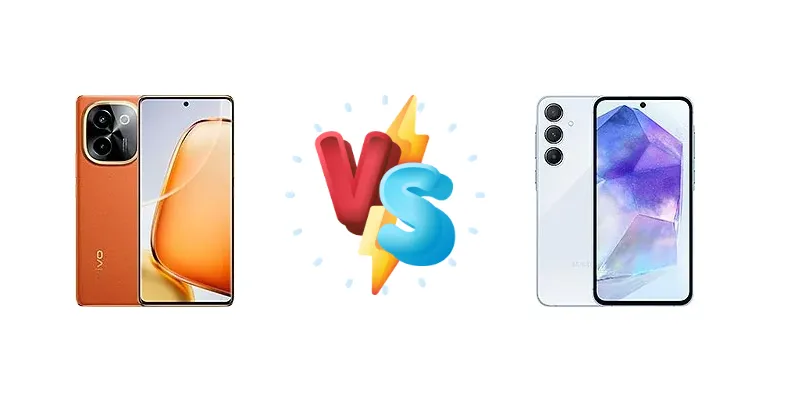
The mid-range smartphone market is fiercely competitive, and the vivo Y200 (China) and Samsung Galaxy A55 represent compelling options. The Y200, available primarily in the Chinese market, prioritizes rapid charging and a newer Snapdragon chipset, while the globally available A55 focuses on all-day battery life and a refined user experience. This comparison dissects their key differences to determine which device best suits your needs.
🏆 Quick Verdict
For the average user prioritizing longevity and a polished software experience, the Samsung Galaxy A55 is the better choice. Its significantly longer battery life (13:27h active use) outweighs the vivo Y200’s faster 80W charging, especially considering the Y200’s Snapdragon 6 Gen 1 isn't a substantial performance leap.
| Network |
|---|
| 2G bands | GSM 850 / 900 / 1800 / 1900 | GSM 850 / 900 / 1800 / 1900 |
| 3G bands | HSDPA 850 / 900 / 2100 | HSDPA 850 / 900 / 1700(AWS) / 1900 / 2100 |
| 4G bands | 1, 3, 5, 8, 28, 34, 38, 39, 40, 41 | 1, 2, 3, 4, 5, 7, 8, 12, 17, 20, 25, 26, 28, 32, 38, 40, 41, 66 |
| 5G bands | 1, 5, 8, 28, 41, 77, 78 SA/NSA | 1, 3, 5, 7, 8, 20, 28, 38, 40, 41, 66, 77, 78 SA/NSA/Sub6 |
| Speed | HSPA, LTE, 5G | HSPA, LTE, 5G |
| Technology | GSM / CDMA / HSPA / LTE / 5G | GSM / HSPA / LTE / 5G |
| Launch |
|---|
| Announced | 2024, May 20 | 2024, March 11 |
| Status | Available. Released 2024, May 24 | Available. Released 2024, March 15 |
| Body |
|---|
| Build | - | Glass front (Gorilla Glass Victus+), glass back (Gorilla Glass), aluminum frame |
| Dimensions | 164.4 x 74.8 x 7.6/7.8/8.0 mm | 161.1 x 77.4 x 8.2 mm (6.34 x 3.05 x 0.32 in) |
| SIM | Nano-SIM + Nano-SIM | · Nano-SIM· Nano-SIM + eSIM· Nano-SIM + Nano-SIM· Nano-SIM + Nano-SIM + eSIM (max 2 at a time) |
| Weight | 187/188/190 g (6.60 oz) | 213 g (7.51 oz) |
| Display |
|---|
| Protection | - | Corning Gorilla Glass Victus+ |
| Resolution | 1080 x 2400 pixels, 20:9 ratio (~388 ppi density) | 1080 x 2340 pixels, 19.5:9 ratio (~390 ppi density) |
| Size | 6.78 inches, 111.0 cm2 (~90.3% screen-to-body ratio) | 6.6 inches, 106.9 cm2 (~85.8% screen-to-body ratio) |
| Type | AMOLED, 1B colors, 120Hz, 1300 nits (peak) | Super AMOLED, 120Hz, HDR10+, 1000 nits (HBM) |
| Platform |
|---|
| CPU | Octa-core (4x2.2 GHz Cortex-A78 & 4x1.8 GHz Cortex-A55) | Octa-core (4x2.75 GHz Cortex-A78 & 4x2.0 GHz Cortex-A55) |
| Chipset | Qualcomm SM6450 Snapdragon 6 Gen 1 (4 nm) | Exynos 1480 (4 nm) |
| GPU | Adreno 710 | Xclipse 530 |
| OS | Android 14, OriginOS 4 | Android 14, up to 4 major Android upgrades, One UI 6.1 |
| Memory |
|---|
| Card slot | No | microSDXC (uses shared SIM slot) |
| Internal | 128GB 8GB RAM, 256GB 8GB RAM, 256GB 12GB RAM, 512GB 12GB RAM | 128GB 6GB RAM, 128GB 8GB RAM, 256GB 6GB RAM, 256GB 8GB RAM, 256GB 12GB RAM |
| Main Camera |
|---|
| Dual | 50 MP, f/1.8, (wide), 1/1.95", 0.8µm, PDAF
Auxiliary lens | - |
| Features | LED flash, panorama, HDR | LED flash, panorama, HDR |
| Triple | - | 50 MP, f/1.8, (wide), 1/1.56", 1.0µm, PDAF, OIS
12 MP, f/2.2, 123˚ (ultrawide), 1/3.06", 1.12µm
5 MP (macro) |
| Video | 4K@30fps, 1080p, gyro-EIS | 4K@30fps, 1080p@30/60fps, gyro-EIS |
| Selfie camera |
|---|
| Single | 8 MP, f/2.1, (wide), 1/4.0", 1.12µm | 32 MP, f/2.2, 26mm (wide), 1/2.74", 0.8µm |
| Video | 1080p@30fps | 4K@30fps, 1080p@30/60fps |
| Sound |
|---|
| 35mm jack | No | No |
| Loudspeaker | Yes | Yes, with stereo speakers |
| Comms |
|---|
| Bluetooth | 5.1, A2DP, LE, aptX HD, aptX Adaptive, aptX Lossless | 5.3, A2DP, LE |
| NFC | No | Yes (market/region dependent) |
| Positioning | GPS, GALILEO, GLONASS, QZSS, BDS (B1I+B1c) | GPS, GALILEO, GLONASS, BDS, QZSS |
| Radio | No | No |
| USB | USB Type-C 2.0, OTG | USB Type-C 2.0, OTG |
| WLAN | Wi-Fi 802.11 a/b/g/n/ac, dual-band | Wi-Fi 802.11 a/b/g/n/ac/6, dual-band, Wi-Fi Direct |
| Features |
|---|
| Sensors | Fingerprint (under display, optical), accelerometer, gyro, proximity, compass | Fingerprint (under display, optical), accelerometer, gyro, compass |
| Battery |
|---|
| Charging | 80W wired, 50% in 24 min
Reverse wired | 25W wired |
| Type | 6000 mAh | Li-Ion 5000 mAh |
| Misc |
|---|
| Colors | Black, Silver, Orange | Iceblue, Lilac, Navy, Lemon |
| Models | V2343A | SM-A556V, SM-A556B, SM-A556B/DS, SM-A556E, SM-A556E/DS, SM-A5560 |
| Price | About 200 EUR | $ 324.99 / £ 251.50 / € 319.99 / ₹ 23,998 |
| SAR EU | - | 0.68 W/kg (head) 1.04 W/kg (body) |
vivo Y200 (China)
- 80W fast charging significantly reduces charging time.
- Snapdragon 6 Gen 1 offers a balance of performance and efficiency.
- Potentially lower price point (depending on region).
- China-specific model with potential software limitations.
- Battery life likely shorter than the Galaxy A55.
- Camera specifications are currently unknown.
Samsung Galaxy A55
- Excellent battery life (13:27h active use).
- Bright and vibrant display (1010 nits).
- Globally available with Samsung’s software support.
- Slower 25W charging.
- Exynos 1480 may exhibit more thermal throttling under sustained load.
- Potentially higher price point.
Display Comparison
The Samsung Galaxy A55 boasts a brighter display, reaching a measured peak of 1010 nits, providing superior visibility in direct sunlight compared to the unmeasured vivo Y200. While both utilize 4nm chipsets, the A55’s brighter panel and likely higher quality panel construction contribute to a more immersive viewing experience. Details regarding the Y200’s panel type (LCD vs AMOLED) and refresh rate are currently unavailable, making a complete assessment difficult, but the A55’s brightness advantage is clear.
Camera Comparison
Without detailed camera specifications for the vivo Y200, a direct comparison is challenging. However, Samsung typically excels in image processing, and the A55 likely benefits from more refined algorithms. The presence of Optical Image Stabilization (OIS) on the A55 (assumed based on Samsung’s typical implementation) is a significant advantage for capturing sharp photos and stable videos, especially in low-light conditions. The Y200’s camera performance will heavily rely on its sensor size and image processing capabilities, which remain unknown.
Performance
Both devices employ 4nm chipsets, but the Samsung Galaxy A55’s Exynos 1480 features a slightly higher CPU clock speed (4x2.75 GHz Cortex-A78 vs 4x2.2 GHz Cortex-A78 on the Snapdragon 6 Gen 1). This translates to a modest performance advantage for the A55 in CPU-intensive tasks. However, the Snapdragon 6 Gen 1 in the Y200 benefits from Qualcomm’s optimized software and potentially better GPU performance for gaming, though real-world testing is needed to confirm. Both utilize Cortex-A55 cores for efficiency, but the A55’s higher peak CPU clock will be noticeable in demanding applications.
Battery Life
The Samsung Galaxy A55 demonstrably leads in battery endurance, achieving 13 hours and 27 minutes of active use. While the vivo Y200 compensates with 80W wired charging (50% in 24 minutes), the A55’s longer runtime reduces the need for frequent top-ups. The A55’s 25W charging is slower, but the substantial battery capacity provides a buffer, making it more suitable for users who prioritize minimizing charging frequency. The Y200’s faster charging is beneficial for those who can consistently access a power source.
Buying Guide
Buy the vivo Y200 (China) if you absolutely need the fastest possible charging speeds and are comfortable with a China-specific ROM and potential software differences. This phone is ideal for users who frequently top up their battery throughout the day. Buy the Samsung Galaxy A55 if you prioritize all-day battery life, a consistently smooth user experience, and a globally supported device with Samsung’s robust software updates and features.
Frequently Asked Questions
❓ Does the Exynos 1480 in the Galaxy A55 tend to overheat during prolonged gaming sessions?
While the Exynos 1480 is a capable chip, it's known to generate more heat than some Snapdragon counterparts under sustained load. Samsung typically implements thermal management solutions, but users engaging in extended gaming may experience some throttling to prevent overheating. The Snapdragon 6 Gen 1 in the Y200 may offer slightly better thermal efficiency, but the A55’s larger battery provides a buffer against performance dips.
❓ Is the 80W charging on the vivo Y200 truly a game-changer, or is it more of a convenience feature?
80W charging is a significant advantage, allowing you to replenish the battery from 0-50% in just 24 minutes. This is particularly useful for users who frequently forget to charge their phones overnight or need a quick power boost before heading out. However, the Galaxy A55’s longer battery life reduces the reliance on fast charging, making it less critical for many users.
❓ What are the potential drawbacks of purchasing a China-specific model like the vivo Y200?
The vivo Y200, being primarily a China-market device, may have software differences, including a different ROM, pre-installed apps, and potentially limited or delayed software updates compared to globally released models. Language support might also be a concern, and warranty service outside of China could be difficult to obtain.