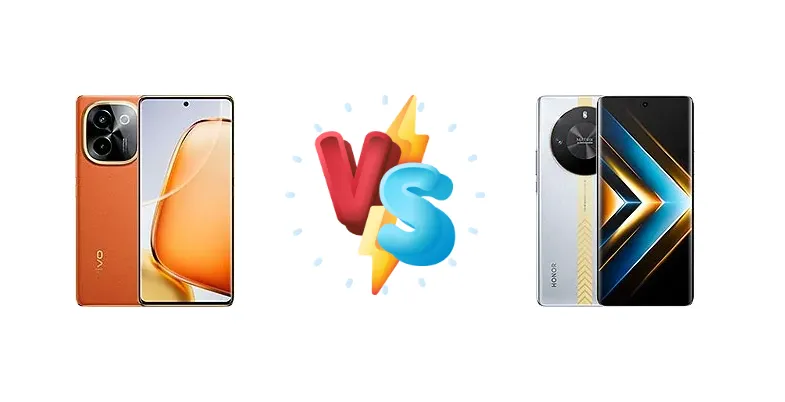
The vivo Y200 (China) and Honor X50 GT represent compelling options in the increasingly competitive mid-range smartphone market. While both devices utilize Qualcomm Snapdragon chipsets, they target slightly different priorities: the Y200 emphasizes rapid charging and efficiency, while the X50 GT prioritizes raw processing power with its older, but still potent, Snapdragon 8+ Gen 1. This comparison will dissect the key differences to help you determine which device best suits your needs.
🏆 Quick Verdict
For the average user prioritizing sustained performance and future-proofing, the Honor X50 GT emerges as the stronger choice. The Snapdragon 8+ Gen 1 offers a significant leap in CPU and GPU capabilities over the Snapdragon 6 Gen 1 in the Y200, despite the slower 35W charging. However, users who value extremely fast charging and efficient daily use will find the vivo Y200 a compelling alternative.
| Network |
|---|
| 2G bands | GSM 850 / 900 / 1800 / 1900 | GSM 850 / 900 / 1800 / 1900 |
| 3G bands | HSDPA 850 / 900 / 2100 | HSDPA 850 / 900 / 1700(AWS) / 1900 / 2100 |
| 4G bands | 1, 3, 5, 8, 28, 34, 38, 39, 40, 41 | LTE |
| 5G bands | 1, 5, 8, 28, 41, 77, 78 SA/NSA | SA/NSA |
| Speed | HSPA, LTE, 5G | HSPA, LTE, 5G |
| Technology | GSM / CDMA / HSPA / LTE / 5G | GSM / CDMA / HSPA / CDMA2000 / LTE / 5G |
| Launch |
|---|
| Announced | 2024, May 20 | 2024, January 04 |
| Status | Available. Released 2024, May 24 | Available. Released 2024, January 09 |
| Body |
|---|
| Dimensions | 164.4 x 74.8 x 7.6/7.8/8.0 mm | 163.6 x 75.5 x 8 mm (6.44 x 2.97 x 0.31 in) |
| SIM | Nano-SIM + Nano-SIM | Nano-SIM + Nano-SIM |
| Weight | 187/188/190 g (6.60 oz) | 192 g (6.77 oz) |
| Display |
|---|
| Resolution | 1080 x 2400 pixels, 20:9 ratio (~388 ppi density) | 1220 x 2652 pixels, 19.5:9 ratio (~431 ppi density) |
| Size | 6.78 inches, 111.0 cm2 (~90.3% screen-to-body ratio) | 6.78 inches, 112.6 cm2 (~91.2% screen-to-body ratio) |
| Type | AMOLED, 1B colors, 120Hz, 1300 nits (peak) | AMOLED, 1B colors, 120Hz |
| Platform |
|---|
| CPU | Octa-core (4x2.2 GHz Cortex-A78 & 4x1.8 GHz Cortex-A55) | Octa-core (1x3.0 GHz Cortex-X2 & 3x2.5 GHz Cortex-A710 & 4x1.80 GHz Cortex-A510) |
| Chipset | Qualcomm SM6450 Snapdragon 6 Gen 1 (4 nm) | Qualcomm SM8475 Snapdragon 8+ Gen 1 (4 nm) |
| GPU | Adreno 710 | Adreno 730 |
| OS | Android 14, OriginOS 4 | Android 13, MagicOS 7.2 |
| Memory |
|---|
| Card slot | No | No |
| Internal | 128GB 8GB RAM, 256GB 8GB RAM, 256GB 12GB RAM, 512GB 12GB RAM | 256GB 12GB RAM, 256GB 16GB RAM, 512GB 16GB RAM, 1TB 16GB RAM |
| Main Camera |
|---|
| Dual | 50 MP, f/1.8, (wide), 1/1.95", 0.8µm, PDAF
Auxiliary lens | 108 MP, f/1.8, (wide), 1/1.67", PDAF
Auxiliary lens |
| Features | LED flash, panorama, HDR | LED flash, panorama, HDR |
| Video | 4K@30fps, 1080p, gyro-EIS | 4K@30fps, 1080p@30fps |
| Selfie camera |
|---|
| Single | 8 MP, f/2.1, (wide), 1/4.0", 1.12µm | 8 MP, f/2.0, (wide) |
| Video | 1080p@30fps | 1080p@30fps |
| Sound |
|---|
| 35mm jack | No | No |
| Loudspeaker | Yes | Yes |
| Comms |
|---|
| Bluetooth | 5.1, A2DP, LE, aptX HD, aptX Adaptive, aptX Lossless | 5.2, A2DP, LE, aptX HD |
| NFC | No | Yes |
| Positioning | GPS, GALILEO, GLONASS, QZSS, BDS (B1I+B1c) | GPS, GLONASS, GALILEO, BDS |
| Radio | No | No |
| USB | USB Type-C 2.0, OTG | USB Type-C 2.0, OTG |
| WLAN | Wi-Fi 802.11 a/b/g/n/ac, dual-band | Wi-Fi 802.11 a/b/g/n/ac/6, dual-band, Wi-Fi Direct |
| Features |
|---|
| Sensors | Fingerprint (under display, optical), accelerometer, gyro, proximity, compass | Fingerprint (under display, optical), accelerometer, gyro, ultrasound proximity, compass |
| Battery |
|---|
| Charging | 80W wired, 50% in 24 min
Reverse wired | 35W wired
7.5W reverse wired |
| Type | 6000 mAh | Li-Po 5800 mAh |
| Misc |
|---|
| Colors | Black, Silver, Orange | Black, Silver |
| Models | V2343A | ALP-AN00 |
| Price | About 200 EUR | About 260 EUR |
vivo Y200 (China)
- Significantly faster 80W charging
- Potentially better battery efficiency with Snapdragon 6 Gen 1
- Reverse wired charging capability
- Less powerful Snapdragon 6 Gen 1 processor
- Likely lower GPU performance for gaming
- Potentially less future-proof
Honor X50 GT
- Much more powerful Snapdragon 8+ Gen 1 processor
- Superior GPU performance for demanding games
- Better sustained performance under load
- Slower 35W charging
- Potentially higher power consumption
- May run warmer under heavy load
Display Comparison
Neither device's display specifications are provided, so a direct comparison is limited. However, given the price points, we can expect both to utilize AMOLED panels. The Honor X50 GT, being positioned as a slightly more premium device, may feature a higher peak brightness and potentially a higher refresh rate. The absence of LTPO technology in either device suggests a less adaptive refresh rate, potentially impacting battery life during static content viewing.
Camera Comparison
Without specific camera sensor details, a detailed comparison is challenging. However, the Honor X50 GT, positioned as a gaming-focused device, may prioritize image processing for dynamic range and low-light performance. The Snapdragon 8+ Gen 1’s ISP (Image Signal Processor) is more advanced than the one found in the Snapdragon 6 Gen 1, potentially leading to better image quality. We can assume both phones will feature a multi-camera setup, but the quality will heavily depend on the main sensor resolution and aperture. The absence of information regarding OIS (Optical Image Stabilization) makes it difficult to assess video recording capabilities.
Performance
The core difference lies in the chipsets. The Honor X50 GT’s Snapdragon 8+ Gen 1 (4nm) is a flagship-level processor featuring a 1x3.0 GHz Cortex-X2 prime core, 3x2.5 GHz Cortex-A710 performance cores, and 4x1.80 GHz Cortex-A510 efficiency cores. This configuration delivers substantially higher CPU and GPU performance compared to the vivo Y200’s Snapdragon 6 Gen 1 (4nm) with its 4x2.2 GHz Cortex-A78 and 4x1.8 GHz Cortex-A55 cores. The 8+ Gen 1’s Adreno 730 GPU will handle graphically intensive games with significantly higher frame rates and detail levels. While both are built on a 4nm process, the architectural differences translate to a clear performance advantage for the Honor X50 GT. The X50 GT will likely exhibit better sustained performance under load due to the superior thermal design typically found in devices housing flagship chipsets.
Battery Life
The vivo Y200’s 80W wired charging is a standout feature, promising a 50% charge in just 24 minutes. This is significantly faster than the Honor X50 GT’s 35W charging. However, battery capacity isn’t specified for either device. The faster charging of the Y200 is particularly beneficial for users who frequently need to top up their battery quickly. While the X50 GT’s 7.5W reverse wired charging is present, it’s slower than the Y200’s reverse wired charging capability, suggesting the Y200 may be more useful for charging accessories.
Buying Guide
Buy the vivo Y200 (China) if you need a phone that charges incredibly quickly (0-50% in 24 minutes) and prioritize battery efficiency for all-day use. Buy the Honor X50 GT if you prefer a significantly more powerful processor for demanding games, multitasking, and applications, and are willing to trade off some charging speed for that performance boost.
Frequently Asked Questions
❓ Will the Snapdragon 8+ Gen 1 in the Honor X50 GT overheat during prolonged gaming sessions?
While the Snapdragon 8+ Gen 1 is a powerful chip, it's known to generate heat under sustained load. However, Honor typically implements effective thermal management solutions in their GT series, including vapor chamber cooling. Expect some throttling after extended gaming, but the X50 GT should maintain higher frame rates for longer than the Y200.
❓ Is the 80W charging on the vivo Y200 compatible with Power Delivery (PD) chargers?
vivo's 80W charging utilizes its proprietary SuperVOOC technology. While it may work with some PD chargers, it's best to use the charger included in the box to ensure optimal charging speeds and safety. Using a non-compatible charger may result in slower charging or potential damage to the device.
❓ How does the Snapdragon 6 Gen 1 handle graphically demanding games like Genshin Impact or PUBG?
The Snapdragon 6 Gen 1 can run Genshin Impact and PUBG, but you'll likely need to lower the graphics settings to medium or low to achieve a smooth frame rate. Don't expect the same level of performance as the Snapdragon 8+ Gen 1, which can handle these games at higher settings with more consistent frame rates.
❓ Does the Honor X50 GT support high refresh rate gaming?
While the refresh rate isn't specified, the Snapdragon 8+ Gen 1 is capable of driving high refresh rate displays. It's likely the Honor X50 GT supports at least a 120Hz refresh rate, providing a smoother gaming experience. Check the official specifications to confirm the exact refresh rate.