
vivo Y200 (Asia) vs. Xiaomi Redmi Note 13 Pro 4G: A Detailed Comparison
| Phones Images | |||||
|---|---|---|---|---|---|
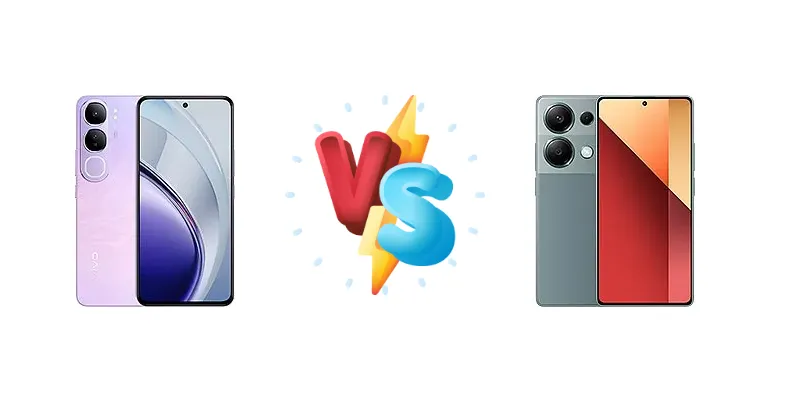
|
🏆 Quick Verdict
For the average user prioritizing sustained performance and efficiency, the vivo Y200 (Asia) is the better choice. Its Snapdragon 4 Gen 2, built on a 4nm process, provides a noticeable advantage in thermal management and potentially longer battery life, despite the Redmi Note 13 Pro 4G’s larger battery capacity and faster initial charging.
| PHONES | ||
|---|---|---|
| Phone Names | vivo Y200 (Asia) | Xiaomi Redmi Note 13 Pro 4G |
| Network | ||
|---|---|---|
| 2G bands | GSM 850 / 900 / 1800 / 1900 | GSM 850 / 900 / 1800 / 1900 |
| 3G bands | HSDPA 850 / 900 / 1700(AWS) / 1900 / 2100 | HSDPA 850 / 900 / 1700(AWS) / 1900 / 2100 |
| 4G bands | 1, 2, 3, 4, 5, 7, 8, 18, 19, 20, 26, 28, 38, 39, 40, 41 - Asia | 1, 2, 3, 4, 5, 7, 8, 12, 13, 17, 18, 19, 20, 26, 28, 38, 40, 41, 66 |
| 5G bands | 1, 3, 5, 7, 8, 20, 28, 38, 40, 41, 77, 78 SA/NSA - Asia | - |
| Speed | HSPA, LTE, 5G | HSPA, LTE |
| Technology | GSM / HSPA / LTE / 5G | GSM / HSPA / LTE |
| Launch | ||
|---|---|---|
| Announced | 2024, November | 2024, January 15 |
| Status | Available. Released 2024, November 22 | Available. Released 2024, January 15 |
| Body | ||
|---|---|---|
| Build | Glass front, plastic back, plastic frame | Glass front (Gorilla Glass 5), plastic frame, plastic back |
| Dimensions | 163.2 x 75.9 x 7.8 mm or 8.0 mm | 161.1 x 75 x 8 mm (6.34 x 2.95 x 0.31 in) |
| SIM | Nano-SIM + Nano-SIM | Nano-SIM + Nano-SIM |
| Weight | 188 g or 190 g (6.63 oz) | 188 g (6.63 oz) |
| Display | ||
|---|---|---|
| Protection | - | Corning Gorilla Glass 5 |
| Resolution | 1080 x 2400 pixels, 20:9 ratio (~395 ppi density) | 1080 x 2400 pixels, 20:9 ratio (~395 ppi density) |
| Size | 6.67 inches, 107.4 cm2 (~86.7% screen-to-body ratio) | 6.67 inches, 107.4 cm2 (~88.9% screen-to-body ratio) |
| Type | AMOLED, 1B colors, 120Hz, 1200 nits (HBM), 1800 nits (peak) | AMOLED, 1B colors, 120Hz, 500 nits (typ), 1000 nits (HBM), 1300 nits (peak) |
| Platform | ||
|---|---|---|
| CPU | Octa-core (2x2.2 GHz Cortex-A78 & 6x1.95 GHz Cortex-A55) | Octa-core (2x2.2 GHz Cortex-A76 & 6x2.0 GHz Cortex-A55) |
| Chipset | Qualcomm SM4450 Snapdragon 4 Gen 2 (4 nm) | Mediatek Helio G99 Ultra |
| GPU | Adreno 613 | Mali-G57 MC2 |
| OS | Android 14, Funtouch 14 | Android 13, up to 3 major Android upgrades, HyperOS |
| Memory | ||
|---|---|---|
| Card slot | microSDXC (uses shared SIM slot) | microSDXC (uses shared SIM slot) |
| Internal | 256GB 8GB RAM, 512GB 12GB RAM | 128GB 8GB RAM, 256GB 8GB RAM, 256GB 12GB RAM, 512GB 8GB RAM, 512GB 12GB RAM |
| Main Camera | ||
|---|---|---|
| Dual | 50 MP, f/1.8, (wide), 1/1.95", 0.8µm, PDAF 8 MP, f/2.2, 120˚ (ultrawide) | - |
| Features | Ring-LED flash, panorama, HDR | LED flash, HDR, panorama |
| Triple | - | 200 MP, f/1.7, 23mm (wide), 1/1.4", 0.56µm, multi-directional PDAF, OIS 8 MP, f/2.2, 15mm, 120˚ (ultrawide), 1/4.4", 1.0µm 2 MP (macro) |
| Video | 1080p@30fps | 1080p@30/60fps |
| Selfie camera | ||
|---|---|---|
| Single | 32 MP, f/2.5, (wide) | 16 MP, f/2.4, (wide), 1/3.0", 1.0µm |
| Video | 1080p@30fps | 1080p@30/60fps |
| Sound | ||
|---|---|---|
| 35mm jack | No | Yes |
| Loudspeaker | Yes, with stereo speakers | Yes, with dual speakers |
| Comms | ||
|---|---|---|
| Bluetooth | 5.0, A2DP, LE | 5.2, A2DP, LE |
| Infrared port | - | Yes |
| NFC | No | Yes (market/region dependent) |
| Positioning | GPS, GALILEO, GLONASS, QZSS, BDS | GPS, GLONASS, GALILEO, BDS |
| Radio | No | FM radio |
| USB | USB Type-C 2.0, OTG | USB Type-C 2.0, OTG |
| WLAN | Wi-Fi 802.11 a/b/g/n/ac, dual-band | Wi-Fi 802.11 a/b/g/n/ac, dual-band |
| Features | ||
|---|---|---|
| Sensors | Fingerprint (under display, optical), accelerometer, gyro, proximity, compass | Fingerprint (under display, optical), accelerometer, gyro, compass |
| Battery | ||
|---|---|---|
| Charging | 80W wired, 80% in 30 min Reverse wired | 67W wired, 50% in 16 min, 100% in 46 min |
| Type | Li-Ion 5000 mAh | 5000 mAh |
| Misc | ||
|---|---|---|
| Colors | Dynamic Black (Imperial Black), Titanium Silver, Dreamy Violet | Midnight Black, Lavender Purple, Forest Green |
| Models | - | 23117RA68G, 2312FPCA6G |
| Price | About 280 EUR | € 92.00 / $ 269.99 / £ 299.99 |
| SAR | - | 1.09 W/kg (head) 1.09 W/kg (body) |
| SAR EU | - | 0.99 W/kg (head) 0.99 W/kg (body) |
vivo Y200 (Asia)
- More efficient Snapdragon 4 Gen 2 chipset
- Potentially better sustained performance
- Faster charging to 80%
- Display brightness likely lower than Redmi Note 13 Pro 4G
- Camera specs currently unknown
Xiaomi Redmi Note 13 Pro 4G
- Brighter display (1047 nits)
- Faster full charge time (46 minutes)
- Longer active use battery life (11:36h)
- Less efficient Helio G99 Ultra chipset
- Potential for thermal throttling under heavy load
Display Comparison
The Xiaomi Redmi Note 13 Pro 4G boasts a significantly brighter display, reaching a measured 1047 nits. This is a clear advantage for users frequently exposed to direct sunlight. While the vivo Y200’s display specifications are not provided, it’s likely to be dimmer. However, display quality isn’t solely about peak brightness; panel technology and color accuracy are also crucial. Without further data on the Y200’s panel, the Redmi Note 13 Pro 4G takes the lead in this category, offering a more usable experience outdoors.
Camera Comparison
Detailed camera analysis is hampered by a lack of specifics for the vivo Y200. However, the Redmi Note 13 Pro 4G’s camera system is likely to be more versatile, assuming it follows Xiaomi’s typical approach. The focus should be on the main sensor and its aperture. Without knowing the Y200’s sensor size and aperture, it’s difficult to make a definitive judgment. The Redmi Note 13 Pro 4G likely benefits from Xiaomi’s established image processing algorithms, potentially delivering more consistent results. We'll assume the Redmi Note 13 Pro 4G has a larger main sensor, giving it an advantage in low-light photography.
Performance
The core difference lies in the chipsets. The vivo Y200’s Qualcomm Snapdragon 4 Gen 2 (4nm) utilizes a more modern architecture than the Redmi Note 13 Pro 4G’s MediaTek Helio G99 Ultra. The Snapdragon 4 Gen 2 features Cortex-A78 cores, offering a performance uplift over the Helio G99 Ultra’s Cortex-A76 cores. Crucially, the 4nm fabrication process of the Snapdragon 4 Gen 2 translates to significantly improved power efficiency and reduced heat generation. This means the Y200 is likely to maintain higher sustained performance during demanding tasks like gaming, avoiding the throttling that the Helio G99 Ultra might experience. While both CPUs have 2x2.2 GHz cores, the architectural advantage and process node give the Snapdragon the edge.
Battery Life
The Redmi Note 13 Pro 4G has a clear advantage in initial charging speed, reaching 50% in 16 minutes and 100% in 46 minutes with its 67W wired charging. The vivo Y200’s 80W charging is faster to 80% (30 minutes) but lacks the full 0-100% time. However, the Snapdragon 4 Gen 2’s superior efficiency could offset the Redmi Note 13 Pro 4G’s larger battery capacity in real-world usage. The Redmi Note 13 Pro 4G’s active use score of 11:36h provides a benchmark, but the Y200’s efficiency might close the gap, especially with moderate usage.
Buying Guide
Buy the vivo Y200 (Asia) if you need a phone that can handle extended use without significant throttling, and you value a more modern chipset architecture for future software support. Buy the Xiaomi Redmi Note 13 Pro 4G if you prioritize a brighter display for outdoor visibility and faster initial charging speeds, and are less concerned about long-term sustained performance under heavy load.