
vivo Y200 (Asia) vs. V29e: A Deep Dive into Performance and Charging
| Phones Images | |||||
|---|---|---|---|---|---|
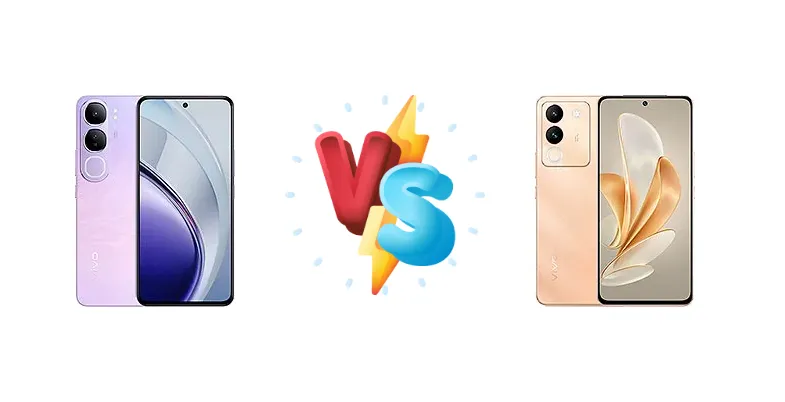
|
🏆 Quick Verdict
For the average user prioritizing performance and future-proofing, the vivo Y200 (Asia) emerges as the stronger contender. Its Snapdragon 4 Gen 2, built on a more efficient 4nm process, offers a noticeable advantage in sustained performance and power efficiency, complemented by significantly faster 80W charging. The V29e remains a viable option for those heavily reliant on 5G and seeking a slightly more mature software experience.
| PHONES | ||
|---|---|---|
| Phone Names | vivo Y200 (Asia) | vivo V29e |
| Network | ||
|---|---|---|
| 2G bands | GSM 850 / 900 / 1800 / 1900 | GSM 850 / 900 / 1800 / 1900 |
| 3G bands | HSDPA 850 / 900 / 1700(AWS) / 1900 / 2100 | HSDPA 850 / 900 / 1700(AWS) / 1900 / 2100 |
| 4G bands | 1, 2, 3, 4, 5, 7, 8, 18, 19, 20, 26, 28, 38, 39, 40, 41 - Asia | 1, 2, 3, 4, 5, 7, 8, 18, 19, 20, 26, 28, 38, 39, 40, 41 |
| 5G bands | 1, 3, 5, 7, 8, 20, 28, 38, 40, 41, 77, 78 SA/NSA - Asia | 1, 3, 5, 7, 8, 28, 38, 40, 41, 77, 78 SA/NSA |
| Speed | HSPA, LTE, 5G | HSPA, LTE, 5G |
| Technology | GSM / HSPA / LTE / 5G | GSM / HSPA / LTE / 5G |
| Launch | ||
|---|---|---|
| Announced | 2024, November | 2023, October 23 |
| Status | Available. Released 2024, November 22 | Available. Released 2023, October 23 |
| Body | ||
|---|---|---|
| Build | Glass front, plastic back, plastic frame | Glass front, plastic frame, glass back |
| Dimensions | 163.2 x 75.9 x 7.8 mm or 8.0 mm | 162.4 x 74.9 x 7.7 mm (6.39 x 2.95 x 0.30 in) |
| SIM | Nano-SIM + Nano-SIM | Nano-SIM + Nano-SIM |
| Weight | 188 g or 190 g (6.63 oz) | 190 g (6.70 oz) |
| Display | ||
|---|---|---|
| Resolution | 1080 x 2400 pixels, 20:9 ratio (~395 ppi density) | 1080 x 2400 pixels, 20:9 ratio (~395 ppi density) |
| Size | 6.67 inches, 107.4 cm2 (~86.7% screen-to-body ratio) | 6.67 inches, 107.4 cm2 (~88.3% screen-to-body ratio) |
| Type | AMOLED, 1B colors, 120Hz, 1200 nits (HBM), 1800 nits (peak) | AMOLED, 120Hz, 1150 nits (peak) |
| Platform | ||
|---|---|---|
| CPU | Octa-core (2x2.2 GHz Cortex-A78 & 6x1.95 GHz Cortex-A55) | Octa-core (2x2.2 GHz Kryo 660 Gold & 6x1.8 GHz Kryo 660 Silver) |
| Chipset | Qualcomm SM4450 Snapdragon 4 Gen 2 (4 nm) | Qualcomm SM6375 Snapdragon 695 5G (6 nm) |
| GPU | Adreno 613 | Adreno 619 |
| OS | Android 14, Funtouch 14 | Android 13, Funtouch 13 |
| Memory | ||
|---|---|---|
| Card slot | microSDXC (uses shared SIM slot) | No |
| Internal | 256GB 8GB RAM, 512GB 12GB RAM | 256GB 8GB RAM, 256GB 12GB RAM |
| Main Camera | ||
|---|---|---|
| Dual | 50 MP, f/1.8, (wide), 1/1.95", 0.8µm, PDAF 8 MP, f/2.2, 120˚ (ultrawide) | 64 MP, f/1.8, (wide), PDAF, OIS 8 MP, f/2.2, (ultrawide) |
| Features | Ring-LED flash, panorama, HDR | Ring-LED flash, panorama, HDR |
| Video | 1080p@30fps | 1080p@30fps |
| Selfie camera | ||
|---|---|---|
| Single | 32 MP, f/2.5, (wide) | 50 MP, f/2.0, 22mm (wide), AF |
| Video | 1080p@30fps | 1080p@30fps |
| Sound | ||
|---|---|---|
| 35mm jack | No | No |
| Loudspeaker | Yes, with stereo speakers | Yes |
| Comms | ||
|---|---|---|
| Bluetooth | 5.0, A2DP, LE | 5.1, A2DP, LE |
| NFC | No | No |
| Positioning | GPS, GALILEO, GLONASS, QZSS, BDS | GPS, GLONASS, GALILEO, BDS, QZSS |
| Radio | No | No |
| USB | USB Type-C 2.0, OTG | USB Type-C 2.0, OTG |
| WLAN | Wi-Fi 802.11 a/b/g/n/ac, dual-band | Wi-Fi 802.11 a/b/g/n/ac, dual-band |
| Features | ||
|---|---|---|
| Sensors | Fingerprint (under display, optical), accelerometer, gyro, proximity, compass | Fingerprint (under display, optical), accelerometer, gyro, proximity, compass |
| Battery | ||
|---|---|---|
| Charging | 80W wired, 80% in 30 min Reverse wired | 44W wired |
| Type | Li-Ion 5000 mAh | Li-Ion 4800 mAh |
| Misc | ||
|---|---|---|
| Colors | Dynamic Black (Imperial Black), Titanium Silver, Dreamy Violet | Forest Black, Rose Gold, Ice Creek Blue |
| Models | - | V2317 |
| Price | About 280 EUR | About 320 EUR |
vivo Y200 (Asia)
- Faster 80W charging for minimal downtime
- More efficient Snapdragon 4 Gen 2 (4nm) chipset
- Potentially better image processing capabilities
- 5G connectivity not explicitly stated (may be limited)
- Software optimization may be less mature than V29e
vivo V29e
- Integrated 5G modem for faster network speeds
- Snapdragon 695 has a longer track record of software support
- Potentially wider carrier compatibility
- Slower 44W charging
- Less efficient Snapdragon 695 (6nm) chipset
- May exhibit more thermal throttling under heavy load
Display Comparison
While both phones likely feature similar LCD or AMOLED panels (data unavailable), the core difference lies within. The focus here is on the processing power driving the display. The Y200's newer chipset can potentially handle more complex display tasks, like higher refresh rates or more advanced image processing, more efficiently. Without specific display specs, it's difficult to definitively declare a winner, but the Y200's chipset provides a foundation for a potentially superior visual experience.
Camera Comparison
Without detailed camera specifications, a direct comparison is challenging. However, the chipset plays a crucial role in image signal processing (ISP). The newer ISP within the Snapdragon 4 Gen 2 in the Y200 should offer improved noise reduction, dynamic range, and overall image quality, particularly in low-light conditions. The V29e's Snapdragon 695 is capable, but the Y200's newer architecture provides a computational advantage. We anticipate both phones will include standard features like portrait mode and night mode, but the Y200 is likely to deliver more refined results.
Performance
The Snapdragon 4 Gen 2 in the Y200 (4nm) represents a significant architectural leap over the Snapdragon 695 5G (6nm) in the V29e. The 4nm process inherently offers better power efficiency, translating to less heat generation under load and potentially reduced throttling during extended gaming sessions. While both CPUs feature a 2x2.2 GHz core configuration, the Cortex-A78 cores in the Y200 are generally more performant than the Kryo 660 Gold cores in the V29e. This means the Y200 will likely exhibit faster app launch times, smoother multitasking, and better overall responsiveness. The V29e's 5G modem is a key advantage for network connectivity, but the Y200's chipset provides a more modern and efficient processing foundation.
Battery Life
The Y200's 80W wired charging is a game-changer, capable of reaching 80% charge in just 30 minutes. This drastically reduces downtime compared to the V29e's 44W charging. While battery capacity isn't specified, the Snapdragon 4 Gen 2's superior power efficiency in the Y200 could offset a potentially smaller battery size, resulting in comparable or even better real-world battery life. The V29e's slower charging speed will require significantly more time to fully replenish the battery.
Buying Guide
Buy the vivo Y200 (Asia) if you need a phone that can handle demanding apps and games with better thermal management, and if minimizing charging times is a priority. Buy the vivo V29e if you prioritize 5G connectivity above all else, and prefer a chipset with a longer track record of software optimization, even if it means sacrificing some raw processing power and charging speed.