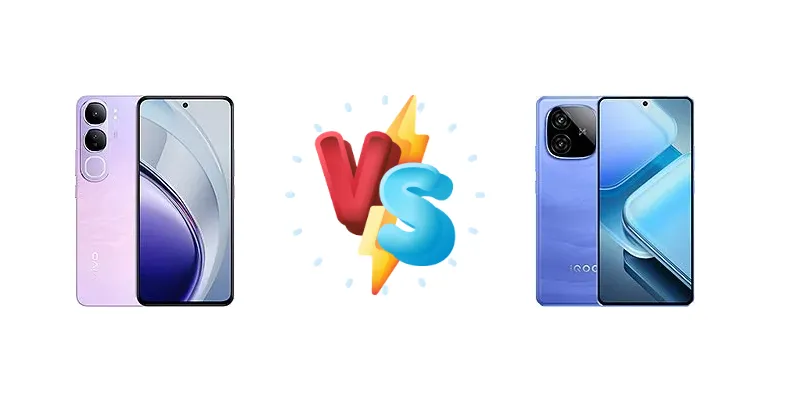
vivo's strategy is bifurcated: the Y-series focuses on affordability and style, while iQOO targets performance enthusiasts. The Y200 and Z9 Turbo Endurance represent this split, offering distinct experiences despite similar price points. This comparison dissects their core differences, focusing on the impact of their drastically different chipsets and how that translates to real-world usage.
🏆 Quick Verdict
For the average user prioritizing everyday tasks and moderate gaming, the vivo Y200 offers a solid experience. However, the iQOO Z9 Turbo Endurance is the clear winner for gamers and power users, thanks to the significantly more capable Snapdragon 8s Gen 3. The performance leap justifies the similar price.
| Network |
|---|
| 2G bands | GSM 850 / 900 / 1800 / 1900 | GSM 850 / 900 / 1800 / 1900 |
| 3G bands | HSDPA 850 / 900 / 1700(AWS) / 1900 / 2100 | HSDPA 850 / 900 / 2100 |
| 4G bands | 1, 2, 3, 4, 5, 7, 8, 18, 19, 20, 26, 28, 38, 39, 40, 41 - Asia | 1, 3, 5, 8, 28, 34, 38, 39, 40, 41 |
| 5G bands | 1, 3, 5, 7, 8, 20, 28, 38, 40, 41, 77, 78 SA/NSA - Asia | 1, 5, 8, 28, 41, 77, 78 SA/NSA |
| Speed | HSPA, LTE, 5G | HSPA, LTE, 5G |
| Technology | GSM / HSPA / LTE / 5G | GSM / CDMA / HSPA / LTE / 5G |
| Launch |
|---|
| Announced | 2024, November | 2025, January 03 |
| Status | Available. Released 2024, November 22 | Available. Released 2025, January 03 |
| Body |
|---|
| Build | Glass front, plastic back, plastic frame | Glass front, plastic back, plastic frame |
| Dimensions | 163.2 x 75.9 x 7.8 mm or 8.0 mm | 163.7 x 75.9 x 8 mm (6.44 x 2.99 x 0.31 in) |
| SIM | Nano-SIM + Nano-SIM | Nano-SIM + Nano-SIM |
| Weight | 188 g or 190 g (6.63 oz) | 196 g (6.91 oz) |
| Display |
|---|
| Resolution | 1080 x 2400 pixels, 20:9 ratio (~395 ppi density) | 1260 x 2800 pixels, 20:9 ratio (~453 ppi density) |
| Size | 6.67 inches, 107.4 cm2 (~86.7% screen-to-body ratio) | 6.78 inches, 111.0 cm2 (~89.3% screen-to-body ratio) |
| Type | AMOLED, 1B colors, 120Hz, 1200 nits (HBM), 1800 nits (peak) | AMOLED, 1B colors, 144Hz, HDR |
| Platform |
|---|
| CPU | Octa-core (2x2.2 GHz Cortex-A78 & 6x1.95 GHz Cortex-A55) | Octa-core (1x3.0 GHz Cortex-X4 & 4x2.8 GHz Cortex-A720 & 3x2.0 GHz Cortex-A520) |
| Chipset | Qualcomm SM4450 Snapdragon 4 Gen 2 (4 nm) | Qualcomm SM8635 Snapdragon 8s Gen 3 (4 nm) |
| GPU | Adreno 613 | Adreno 735 |
| OS | Android 14, Funtouch 14 | Android 14, OriginOS 4 |
| Memory |
|---|
| Card slot | microSDXC (uses shared SIM slot) | No |
| Internal | 256GB 8GB RAM, 512GB 12GB RAM | 256GB 12GB RAM, 256GB 16GB RAM, 512GB 12GB RAM, 512GB 16GB RAM |
| Main Camera |
|---|
| Dual | 50 MP, f/1.8, (wide), 1/1.95", 0.8µm, PDAF
8 MP, f/2.2, 120˚ (ultrawide) | 50 MP, f/1.8, (wide), 1/1.95", 0.8µm, PDAF, OIS
8 MP, f/2.2, (ultrawide) |
| Features | Ring-LED flash, panorama, HDR | LED flash, panorama, HDR |
| Video | 1080p@30fps | 4K@30/60fps, 1080p, gyro-EIS, OIS |
| Selfie camera |
|---|
| Single | 32 MP, f/2.5, (wide) | 16 MP, f/2.5, (wide), 1/3.0", 1.0µm |
| Video | 1080p@30fps | 1080p@30fps |
| Sound |
|---|
| 35mm jack | No | No |
| Loudspeaker | Yes, with stereo speakers | Yes, with stereo speakers |
| Comms |
|---|
| Bluetooth | 5.0, A2DP, LE | 5.4, A2DP, LE, aptX HD, aptX Adaptive, aptX Lossless |
| Infrared port | - | Yes |
| NFC | No | Yes |
| Positioning | GPS, GALILEO, GLONASS, QZSS, BDS | GPS (L1+L5), GLONASS (G1), BDS (B1I+B1c+B2a), GALILEO (E1+E5a), QZSS (L1+L5) |
| Radio | No | No |
| USB | USB Type-C 2.0, OTG | USB Type-C 2.0, OTG |
| WLAN | Wi-Fi 802.11 a/b/g/n/ac, dual-band | Wi-Fi 802.11 a/b/g/n/ac/6, dual-band |
| Features |
|---|
| Sensors | Fingerprint (under display, optical), accelerometer, gyro, proximity, compass | Fingerprint (under display, optical), accelerometer, gyro, proximity, compass |
| Battery |
|---|
| Charging | 80W wired, 80% in 30 min
Reverse wired | 80W wired
7.5W reverse wired |
| Type | Li-Ion 5000 mAh | Si/C Li-Ion 6400 mAh |
| Misc |
|---|
| Colors | Dynamic Black (Imperial Black), Titanium Silver, Dreamy Violet | Black, White, Blue |
| Models | - | V2352GA |
| Price | About 280 EUR | About 250 EUR |
vivo Y200 (Asia)
- More affordable price point
- Stylish design (likely)
- Fast 80W charging
- Significantly weaker processor
- Limited gaming performance
- Potentially lower-quality display
vivo iQOO Z9 Turbo Endurance
- Flagship-level Snapdragon 8s Gen 3
- Superior gaming performance
- Likely higher-quality display
- Efficient power management
- Similar price to the Y200
- May not have a standout camera system
- Design may be more utilitarian
Display Comparison
Both devices lack detailed display specifications in the provided data, but given their market positioning, we can infer differences. The Y200 likely utilizes an LCD or a lower-tier AMOLED panel, prioritizing cost savings. The iQOO Z9 Turbo Endurance, being a gaming-focused device, likely features a higher-quality AMOLED panel with a faster refresh rate (potentially 120Hz or 144Hz) and higher peak brightness for better visibility in sunlight. Bezels are expected to be slimmer on the iQOO model, contributing to a more immersive experience.
Camera Comparison
Without detailed camera specs, a direct comparison is limited. However, given the Y200’s positioning, its camera system likely focuses on versatility with a primary sensor and supporting lenses. The iQOO Z9 Turbo Endurance, while not necessarily boasting a dramatically higher megapixel count, likely benefits from the Snapdragon 8s Gen 3’s superior image signal processor (ISP), resulting in better image quality, dynamic range, and low-light performance. Expect more refined image processing and potentially better video recording capabilities on the iQOO device.
Performance
The core differentiator is the chipset. The vivo Y200’s Snapdragon 4 Gen 2 (4nm) is a capable entry-level SoC, featuring an octa-core configuration with 2x Cortex-A78 cores for moderate performance boosts. However, it’s dwarfed by the iQOO Z9 Turbo Endurance’s Snapdragon 8s Gen 3 (4nm). The 8s Gen 3 boasts a single high-performance Cortex-X4 core clocked at 3.0 GHz, alongside 4x Cortex-A720 cores and 3x Cortex-A520 cores. This architecture delivers significantly higher CPU and GPU performance, crucial for demanding games and multitasking. The 8s Gen 3’s Adreno GPU will provide a far superior gaming experience. While both are 4nm, the architectural improvements and higher clock speeds of the 8s Gen 3 translate to a substantial performance advantage.
Battery Life
Both phones feature 80W wired charging, promising rapid replenishment. The Y200 claims 80% charge in 30 minutes, while the Z9 Turbo Endurance’s charging speed is also 80W. While battery capacity isn’t specified, the iQOO Z9 Turbo Endurance’s more efficient Snapdragon 8s Gen 3 processor will likely result in comparable or even better real-world battery life despite potentially having a similar or slightly smaller battery capacity. The 80W charging on both devices is a significant advantage over slower charging solutions.
Buying Guide
Buy the vivo Y200 (Asia) if you need a stylish, reliable smartphone for daily communication, social media, and casual gaming. It’s ideal for users who value a balanced experience without demanding peak performance. Buy the vivo iQOO Z9 Turbo Endurance if you prioritize gaming, demanding applications, and future-proofing. This phone is for those who want a smooth, responsive experience even under heavy load and appreciate the benefits of a flagship-level processor.
Frequently Asked Questions
❓ Will the iQOO Z9 Turbo Endurance get noticeably hot during extended gaming sessions?
The Snapdragon 8s Gen 3 is a thermally efficient chip, and iQOO typically implements robust cooling solutions in their gaming-focused devices. While some heat is inevitable during prolonged gaming, the Z9 Turbo Endurance should manage temperatures effectively to prevent significant throttling and maintain consistent performance.
❓ Is the Snapdragon 4 Gen 2 in the vivo Y200 sufficient for playing popular games like PUBG Mobile or Call of Duty Mobile?
The Snapdragon 4 Gen 2 can run PUBG Mobile and Call of Duty Mobile, but you'll likely need to lower graphics settings to achieve a smooth frame rate. Expect occasional stuttering and a less immersive gaming experience compared to the iQOO Z9 Turbo Endurance.
❓ How does the 80W charging compare in real-world usage on both devices?
Both phones should charge from 0% to 80% in around 30 minutes with the 80W charger. However, the iQOO Z9 Turbo Endurance might reach 100% slightly faster due to the more efficient power management of the Snapdragon 8s Gen 3.
❓ Does the iQOO Z9 Turbo Endurance support any gaming-specific features like trigger buttons or game space?
While not explicitly stated in the provided data, iQOO phones are known for incorporating gaming-centric features. It's highly probable that the Z9 Turbo Endurance includes a dedicated 'Game Space' software suite for optimizing performance and blocking notifications, and potentially even capacitive shoulder triggers for enhanced control.