
vivo Y200 (Asia) vs. Samsung Galaxy A55: A Detailed Comparison
| Phones Images | |||||
|---|---|---|---|---|---|
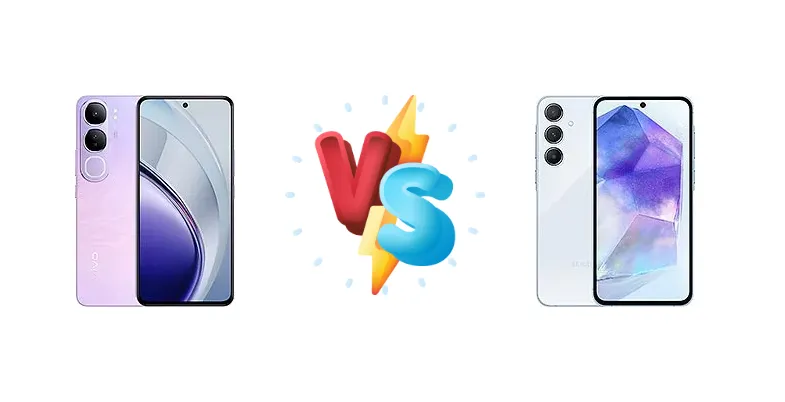
|
🏆 Quick Verdict
For the average user prioritizing all-day battery life and a polished software experience, the Samsung Galaxy A55 is the better choice. Its 13:27h active use score significantly outperforms what we'd expect from the Y200, despite the latter's faster charging. However, the Y200 appeals to those who value quick top-ups and a potentially more responsive CPU.
| PHONES | ||
|---|---|---|
| Phone Names | vivo Y200 (Asia) | Samsung Galaxy A55 |
| Network | ||
|---|---|---|
| 2G bands | GSM 850 / 900 / 1800 / 1900 | GSM 850 / 900 / 1800 / 1900 |
| 3G bands | HSDPA 850 / 900 / 1700(AWS) / 1900 / 2100 | HSDPA 850 / 900 / 1700(AWS) / 1900 / 2100 |
| 4G bands | 1, 2, 3, 4, 5, 7, 8, 18, 19, 20, 26, 28, 38, 39, 40, 41 - Asia | 1, 2, 3, 4, 5, 7, 8, 12, 17, 20, 25, 26, 28, 32, 38, 40, 41, 66 |
| 5G bands | 1, 3, 5, 7, 8, 20, 28, 38, 40, 41, 77, 78 SA/NSA - Asia | 1, 3, 5, 7, 8, 20, 28, 38, 40, 41, 66, 77, 78 SA/NSA/Sub6 |
| Speed | HSPA, LTE, 5G | HSPA, LTE, 5G |
| Technology | GSM / HSPA / LTE / 5G | GSM / HSPA / LTE / 5G |
| Launch | ||
|---|---|---|
| Announced | 2024, November | 2024, March 11 |
| Status | Available. Released 2024, November 22 | Available. Released 2024, March 15 |
| Body | ||
|---|---|---|
| Build | Glass front, plastic back, plastic frame | Glass front (Gorilla Glass Victus+), glass back (Gorilla Glass), aluminum frame |
| Dimensions | 163.2 x 75.9 x 7.8 mm or 8.0 mm | 161.1 x 77.4 x 8.2 mm (6.34 x 3.05 x 0.32 in) |
| SIM | Nano-SIM + Nano-SIM | · Nano-SIM· Nano-SIM + eSIM· Nano-SIM + Nano-SIM· Nano-SIM + Nano-SIM + eSIM (max 2 at a time) |
| Weight | 188 g or 190 g (6.63 oz) | 213 g (7.51 oz) |
| Display | ||
|---|---|---|
| Protection | - | Corning Gorilla Glass Victus+ |
| Resolution | 1080 x 2400 pixels, 20:9 ratio (~395 ppi density) | 1080 x 2340 pixels, 19.5:9 ratio (~390 ppi density) |
| Size | 6.67 inches, 107.4 cm2 (~86.7% screen-to-body ratio) | 6.6 inches, 106.9 cm2 (~85.8% screen-to-body ratio) |
| Type | AMOLED, 1B colors, 120Hz, 1200 nits (HBM), 1800 nits (peak) | Super AMOLED, 120Hz, HDR10+, 1000 nits (HBM) |
| Platform | ||
|---|---|---|
| CPU | Octa-core (2x2.2 GHz Cortex-A78 & 6x1.95 GHz Cortex-A55) | Octa-core (4x2.75 GHz Cortex-A78 & 4x2.0 GHz Cortex-A55) |
| Chipset | Qualcomm SM4450 Snapdragon 4 Gen 2 (4 nm) | Exynos 1480 (4 nm) |
| GPU | Adreno 613 | Xclipse 530 |
| OS | Android 14, Funtouch 14 | Android 14, up to 4 major Android upgrades, One UI 6.1 |
| Memory | ||
|---|---|---|
| Card slot | microSDXC (uses shared SIM slot) | microSDXC (uses shared SIM slot) |
| Internal | 256GB 8GB RAM, 512GB 12GB RAM | 128GB 6GB RAM, 128GB 8GB RAM, 256GB 6GB RAM, 256GB 8GB RAM, 256GB 12GB RAM |
| Main Camera | ||
|---|---|---|
| Dual | 50 MP, f/1.8, (wide), 1/1.95", 0.8µm, PDAF 8 MP, f/2.2, 120˚ (ultrawide) | - |
| Features | Ring-LED flash, panorama, HDR | LED flash, panorama, HDR |
| Triple | - | 50 MP, f/1.8, (wide), 1/1.56", 1.0µm, PDAF, OIS 12 MP, f/2.2, 123˚ (ultrawide), 1/3.06", 1.12µm 5 MP (macro) |
| Video | 1080p@30fps | 4K@30fps, 1080p@30/60fps, gyro-EIS |
| Selfie camera | ||
|---|---|---|
| Single | 32 MP, f/2.5, (wide) | 32 MP, f/2.2, 26mm (wide), 1/2.74", 0.8µm |
| Video | 1080p@30fps | 4K@30fps, 1080p@30/60fps |
| Sound | ||
|---|---|---|
| 35mm jack | No | No |
| Loudspeaker | Yes, with stereo speakers | Yes, with stereo speakers |
| Comms | ||
|---|---|---|
| Bluetooth | 5.0, A2DP, LE | 5.3, A2DP, LE |
| NFC | No | Yes (market/region dependent) |
| Positioning | GPS, GALILEO, GLONASS, QZSS, BDS | GPS, GALILEO, GLONASS, BDS, QZSS |
| Radio | No | No |
| USB | USB Type-C 2.0, OTG | USB Type-C 2.0, OTG |
| WLAN | Wi-Fi 802.11 a/b/g/n/ac, dual-band | Wi-Fi 802.11 a/b/g/n/ac/6, dual-band, Wi-Fi Direct |
| Features | ||
|---|---|---|
| Sensors | Fingerprint (under display, optical), accelerometer, gyro, proximity, compass | Fingerprint (under display, optical), accelerometer, gyro, compass |
| Battery | ||
|---|---|---|
| Charging | 80W wired, 80% in 30 min Reverse wired | 25W wired |
| Type | Li-Ion 5000 mAh | Li-Ion 5000 mAh |
| Misc | ||
|---|---|---|
| Colors | Dynamic Black (Imperial Black), Titanium Silver, Dreamy Violet | Iceblue, Lilac, Navy, Lemon |
| Models | - | SM-A556V, SM-A556B, SM-A556B/DS, SM-A556E, SM-A556E/DS, SM-A5560 |
| Price | About 280 EUR | $ 324.99 / £ 251.50 / € 319.99 / ₹ 23,998 |
| SAR EU | - | 0.68 W/kg (head) 1.04 W/kg (body) |
vivo Y200 (Asia)
- 80W Super-Fast Charging: Significantly reduces charging time.
- Snapdragon 4 Gen 2: Newer chipset architecture for potential efficiency gains.
- Reverse Wired Charging: Can charge other devices.
- Battery Life Unknown: Likely shorter battery life compared to the A55.
- Limited Display Information: Display quality is uncertain without further specs.
Samsung Galaxy A55
- Exceptional Battery Life: 13:27h active use score provides all-day power.
- Bright and Accurate Display: 1010 nits peak brightness for excellent visibility.
- Samsung One UI: Polished and feature-rich software experience.
- Slower Charging: 25W charging is significantly slower than the Y200.
- Exynos Chipset: Historically, Exynos chips have sometimes faced thermal throttling issues.
Display Comparison
The Samsung Galaxy A55 boasts a significantly brighter display, reaching a measured 1010 nits peak brightness, making it far more usable outdoors in direct sunlight. While the vivo Y200’s display specifications are not provided, Samsung’s panel technology typically offers superior color accuracy and viewing angles. The A55’s brightness advantage is crucial for users who frequently consume media outdoors or in brightly lit environments. We expect the A55 to also have a higher PWM dimming rate, potentially reducing eye strain for sensitive users.
Camera Comparison
Without detailed camera specifications for the vivo Y200, a direct comparison is challenging. However, Samsung typically excels in image processing, delivering consistent and vibrant photos. The A55 likely benefits from Samsung’s advanced computational photography algorithms. The presence of Optical Image Stabilization (OIS) on the A55 (assumed based on Samsung’s typical implementation) is a significant advantage for capturing sharp photos and stable videos, especially in low-light conditions. We can assume the Y200 will have a focus on megapixels, but image quality is more than just resolution.
Performance
Both phones utilize 4nm chipsets, but the Samsung Galaxy A55’s Exynos 1480 features a more powerful CPU configuration: 4x2.75 GHz Cortex-A78 cores versus the vivo Y200’s 2x2.2 GHz Cortex-A78 cores. This translates to faster processing speeds for demanding tasks and potentially better gaming performance. While the Y200’s Snapdragon 4 Gen 2 is efficient, the A55’s Exynos 1480 offers a noticeable performance edge. The A55’s GPU is also likely more capable, though specific benchmarks are needed for confirmation. The Y200’s newer architecture *could* offer better sustained performance due to improved thermal efficiency, but this remains speculative without testing.
Battery Life
The Samsung Galaxy A55’s 13:27h active use score is a standout feature, demonstrating exceptional battery endurance. While the vivo Y200 offers incredibly fast 80W wired charging (80% in 30 minutes), the A55’s longevity reduces the need for frequent top-ups. The A55’s 25W charging is considerably slower, but the superior battery life mitigates this disadvantage. Users who prioritize minimizing charging downtime will favor the Y200, while those who want all-day power will appreciate the A55.
Buying Guide
Buy the vivo Y200 (Asia) if you need blazing-fast 80W charging and prioritize a newer Snapdragon processor for potentially smoother app switching and responsiveness. Buy the Samsung Galaxy A55 if you prefer a longer-lasting battery, a brighter and more color-accurate display, and Samsung’s established One UI software ecosystem.