
vivo Y200 (Asia) vs Oppo Reno11 F: A Deep Dive into Mid-Range Performance
| Phones Images | |||||
|---|---|---|---|---|---|
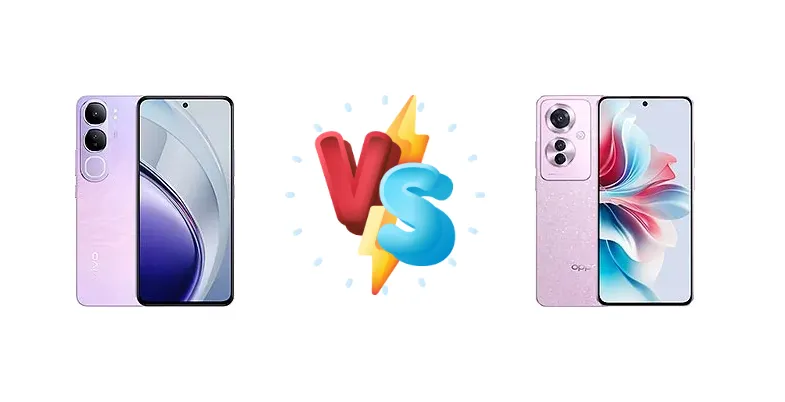
|
🏆 Quick Verdict
For the average user prioritizing sustained performance and faster charging, the vivo Y200 (Asia) emerges as the stronger contender. Its Snapdragon 4 Gen 2, built on a 4nm process, offers a slight edge in efficiency and potentially better thermal management, while the 80W charging significantly reduces downtime compared to the Reno11 F's 67W.
| PHONES | ||
|---|---|---|
| Phone Names | vivo Y200 (Asia) | Oppo Reno11 F |
| Network | ||
|---|---|---|
| 2G bands | GSM 850 / 900 / 1800 / 1900 | GSM 850 / 900 / 1800 / 1900 |
| 3G bands | HSDPA 850 / 900 / 1700(AWS) / 1900 / 2100 | HSDPA 800 / 850 / 900 / 1700(AWS) / 1900 / 2100 |
| 4G bands | 1, 2, 3, 4, 5, 7, 8, 18, 19, 20, 26, 28, 38, 39, 40, 41 - Asia | 1, 2, 3, 4, 5, 7, 8, 12, 13, 17, 18, 19, 20, 26, 28, 38, 39, 40, 41, 66 |
| 5G bands | 1, 3, 5, 7, 8, 20, 28, 38, 40, 41, 77, 78 SA/NSA - Asia | 1, 2, 3, 5, 7, 8, 20, 26, 28, 66, 38, 40, 41, 77, 78 SA/NSA |
| Speed | HSPA, LTE, 5G | HSPA, LTE, 5G |
| Technology | GSM / HSPA / LTE / 5G | GSM / HSPA / LTE / 5G |
| Launch | ||
|---|---|---|
| Announced | 2024, November | 2024, February 08 |
| Status | Available. Released 2024, November 22 | Available. Released 2024, February 08 |
| Body | ||
|---|---|---|
| Build | Glass front, plastic back, plastic frame | - |
| Dimensions | 163.2 x 75.9 x 7.8 mm or 8.0 mm | 161.1 x 74.7 x 7.5 mm (6.34 x 2.94 x 0.30 in) |
| SIM | Nano-SIM + Nano-SIM | Nano-SIM + Nano-SIM |
| Weight | 188 g or 190 g (6.63 oz) | 177 g (6.24 oz) |
| Display | ||
|---|---|---|
| Protection | - | Panda glass |
| Resolution | 1080 x 2400 pixels, 20:9 ratio (~395 ppi density) | 1080 x 2412 pixels, 20:9 ratio (~394 ppi density) |
| Size | 6.67 inches, 107.4 cm2 (~86.7% screen-to-body ratio) | 6.7 inches, 108.0 cm2 (~89.8% screen-to-body ratio) |
| Type | AMOLED, 1B colors, 120Hz, 1200 nits (HBM), 1800 nits (peak) | AMOLED, 1B colors, 120Hz, HDR10+, 500 nits (typ), 900 nits (HBM), 1100 nits (peak) |
| Platform | ||
|---|---|---|
| CPU | Octa-core (2x2.2 GHz Cortex-A78 & 6x1.95 GHz Cortex-A55) | Octa-core (2x2.6 GHz Cortex-A78 & 6x2.0 GHz Cortex-A55) |
| Chipset | Qualcomm SM4450 Snapdragon 4 Gen 2 (4 nm) | Mediatek Dimensity 7050 (6 nm) |
| GPU | Adreno 613 | Mali-G68 MC4 |
| OS | Android 14, Funtouch 14 | Android 14, upgradable to Android 15, ColorOS 15 |
| Memory | ||
|---|---|---|
| Card slot | microSDXC (uses shared SIM slot) | microSDXC |
| Internal | 256GB 8GB RAM, 512GB 12GB RAM | 256GB 8GB RAM |
| Main Camera | ||
|---|---|---|
| Dual | 50 MP, f/1.8, (wide), 1/1.95", 0.8µm, PDAF 8 MP, f/2.2, 120˚ (ultrawide) | - |
| Features | Ring-LED flash, panorama, HDR | LED flash, HDR, panorama |
| Triple | - | 64 MP, f/1.7, 25mm (wide), 1/2.0", 0.7µm, PDAF 8 MP, f/2.2, 16mm, 112˚ (ultrawide), 1/4.0", 1.12µm 2 MP (macro) |
| Video | 1080p@30fps | 4K@30fps, 1080p@30/60/120/480fps, gyro-EIS |
| Selfie camera | ||
|---|---|---|
| Features | - | Panorama |
| Single | 32 MP, f/2.5, (wide) | 32 MP, f/2.4, 22mm (wide), 1/2.74", 0.8µm |
| Video | 1080p@30fps | 4K@30fps, 1080p@30fps, gyro-EIS |
| Sound | ||
|---|---|---|
| 35mm jack | No | No |
| Loudspeaker | Yes, with stereo speakers | Yes |
| Comms | ||
|---|---|---|
| Bluetooth | 5.0, A2DP, LE | 5.2, A2DP, LE, aptX HD, LHDC |
| NFC | No | Yes |
| Positioning | GPS, GALILEO, GLONASS, QZSS, BDS | GPS, GLONASS, GALILEO, BDS, QZSS |
| Radio | No | No |
| USB | USB Type-C 2.0, OTG | USB Type-C 2.0, OTG |
| WLAN | Wi-Fi 802.11 a/b/g/n/ac, dual-band | Wi-Fi 802.11 a/b/g/n/ac/6, dual-band |
| Features | ||
|---|---|---|
| Sensors | Fingerprint (under display, optical), accelerometer, gyro, proximity, compass | Fingerprint (under display, optical), accelerometer, gyro, proximity, compass |
| Battery | ||
|---|---|---|
| Charging | 80W wired, 80% in 30 min Reverse wired | 67W wired, PD2.0, QC3, 100% in 48 min Reverse wired |
| Type | Li-Ion 5000 mAh | 5000 mAh |
| Misc | ||
|---|---|---|
| Colors | Dynamic Black (Imperial Black), Titanium Silver, Dreamy Violet | Palm Green, Ocean Blue, Coral Purple |
| Models | - | CPH2603 |
| Price | About 280 EUR | About 570 EUR |
vivo Y200 (Asia)
- Faster 80W charging significantly reduces downtime.
- More efficient 4nm Snapdragon 4 Gen 2 chipset.
- Potentially better thermal management for sustained performance.
- Slightly lower CPU clock speeds compared to the Reno11 F.
- Camera specifications are unknown, potentially lagging behind Oppo.
Oppo Reno11 F
- Higher CPU clock speeds for quicker response in bursty tasks.
- Oppo’s established software ecosystem and user interface.
- Potentially superior display quality based on Reno series history.
- Slower 67W charging takes longer to fully replenish the battery.
- Less efficient 6nm Dimensity 7050 chipset may throttle under load.
- Potential for higher heat generation.
Display Comparison
Neither device's display specifications are provided, so a direct comparison is limited. However, given the price bracket, both likely utilize AMOLED panels. The Reno series historically prioritizes display quality, suggesting a potentially brighter and more color-accurate panel. The absence of LTPO technology on either device implies standard refresh rate management, impacting battery life during dynamic content viewing. Bezels are likely comparable, with both aiming for a modern, immersive experience.
Camera Comparison
Without detailed camera specifications, a definitive comparison is challenging. However, both brands typically focus on megapixel count over sensor size in this segment. The image processing style will likely differ – vivo often leans towards vibrant, saturated colors, while Oppo tends towards a more natural look. The absence of information regarding Optical Image Stabilization (OIS) is a key omission; its presence on either device would significantly improve low-light photography and video stabilization. We can assume both will include standard wide, ultrawide, and potentially macro lenses, but the quality of these secondary sensors is often limited.
Performance
The core difference lies in the chipsets: the vivo Y200 (Asia) features the Qualcomm Snapdragon 4 Gen 2 (4nm), while the Oppo Reno11 F utilizes the MediaTek Dimensity 7050 (6nm). While the Dimensity 7050 boasts higher peak CPU clock speeds (2.6 GHz vs 2.2 GHz), the Snapdragon 4 Gen 2’s 4nm fabrication process provides a significant advantage in power efficiency. This translates to less heat generation under sustained load, potentially mitigating thermal throttling during extended gaming sessions. The CPU architecture is similar – both employ Cortex-A78 and A55 cores – but the Snapdragon’s process node gives it an edge. The Reno11 F's CPU may offer slightly quicker response in single-core tasks, but the Y200's efficiency will be more noticeable in multi-threaded workloads and longevity.
Battery Life
The charging speeds are a clear differentiator. The vivo Y200 (Asia) supports 80W wired charging, claiming an 80% charge in 30 minutes. The Oppo Reno11 F offers 67W charging, taking 48 minutes for a full charge. This 18-minute difference is substantial for users who frequently need to top up their battery. While battery capacity isn't specified, the Snapdragon 4 Gen 2’s efficiency could offset a potentially smaller battery in the Y200, resulting in comparable real-world battery life despite the faster charging.
Buying Guide
Buy the vivo Y200 (Asia) if you need a phone that can handle everyday tasks and moderate gaming with consistent performance, and if minimizing charging time is a priority. Buy the Oppo Reno11 F if you prefer a slightly more powerful CPU core clock speed for bursty tasks and appreciate Oppo’s established software ecosystem, accepting a longer charging duration.